StateUniversity.com – U.S. University Directory [ Home :: University List :: New Jersey ]
p. 609-258-3000
w. www.princeton.edu
Note, this school has an ambiguous address and may not be represented accurately in the map above.
Princeton University
General Information, Alumni, History, Campus, Students, Faculty, Address, and Tuition
- NEW - College and University Blog with many tips like acing the ACTs, SATs, college admissions, and preparing for college.
- University Forum and Discussion - Brand New Message Board For All Your Questions
- Information on Thousands of Careers - One-stop resource for very comprehensive, and up-to-date career information. Contains more than several thousand job profiles each with a job description, education and training requirements, salary information, working conditions, employment outlook and much more!
- Student Encyclopedia - Encyclopedia for reference and research from the Cambridge Collection.
Princeton University Introduction
One of the leading universities in the world, Princeton is impressive on all levels and deservedly appears at or near the top of all of the ranking reports you might read. Like other Ivy League schools, competition to get in is stiff: in a recent class, ninety-eight percent of the enrolling students had been in the top fifth of their high school class and two-thirds of them had scores higher than 700 on both Math and Verbal SATs. Like other Ivy League schools, the faculty members represent the best in their fields, from professors whose novels win the National Book Award to those whose achievements in molecular biology win a Nobel prize.
I graduated from a public school in a small town where all the teachers were neighbors and not only knew the students, but knew the parents, too. I didn’t have a lot of choice about courses, but I was used to getting high grades pretty easily and getting along with my teachers really well. When I first got to Princeton, I was nervous—the campus seemed huge, I was taking an introductory course in philosophy in a lecture hall with more kids than had been in my whole high school, and the professor was down on a stage and seemed as far away from me as a famous rock star in a concert. On top of that, I didn’t do very well on my first paper. My roommate told me to go to see my preceptor for the course. My preceptor went through the whole paper with me, and helped me to broaden my thinking about how to tackle different concepts. She really cared about helping me learn how to learn. Not only did I write better papers after that, but I wasn’t nervous anymore. Princeton wasn’t so different from home after all.
What sets Princeton apart, however, is its dedication to undergraduate education. The undergraduate population of approximately 4,400 students comprises over seventy percent of the total student population. More than ninety years ago, Woodrow Wilson, as president of Princeton, implemented the preceptorial system; even the largest lecture courses meet in small class groups once or twice a week. As early as your first year you could find yourself sitting at a seminar table with only ten other students arguing the finer points of Hamlet with one of the world’s leading Shakespearean scholars.
Not surprisingly, this commitment to undergraduates results in both flexibility in devising academic programs and greater access to faculty members for independent study. Between the two bachelor’s degree programs (A.B. and B.S.E.), the university offers more than sixty department and interdepartmental programs. Students may also apply for independent concentration outside of the already existing programs. In fact, independent study is an important part of every undergraduate’s academic life. For A.B. candidates, all departments require a combination of upper-level courses and independent study during both junior and senior years, and all A.B. candidates (as well as most B.S.E. candidates) must write a senior thesis. The thesis averages 100 pages and is the culmination of a year’s study (outside of regular coursework) on a topic of your choice under the direction of a faculty advisor.
In a world where some colleges require no core courses and others require course plans structured toward practical applications, Princeton remains a fierce proponent of a balanced liberal arts education. All A.B. candidates must meet a one-term writing requirement and show proficiency in a foreign language. In addition, they must take one course each in the four distribution areas of epistemology and cognition, ethical thought and moral values, historical analysis, and quantitative reasoning, and they must take two courses each in literature and the arts, science and technology (with laboratory), and social analysis. Nor are engineering students off the hook. They too have to satisfy a writing requirement and take a number of (although not as many) courses in the various areas of study.
That Princeton’s distribution areas are not traditional represents a conscious decision by the university to move with the twenty-first century. There are other signs, in both enrollment and governance, that the Princeton of today is not the elitist tradition-bound school of past portraits. The undergraduate student body comes from all fifty states and seventy foreign countries. American minorities (including African American, Latino, Asian American, and Native American students) make up twenty-seven percent, and an additional five percent are foreign citizens. Almost forty-five percent of all undergraduates receive some kind of financial aid. Students also play an active role in policy-making at the school, sitting on committees right along with faculty and administration. Each spring a graduating senior is elected to serve a term on the university’s Board of Trustees.
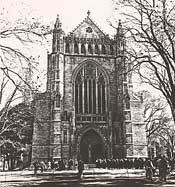
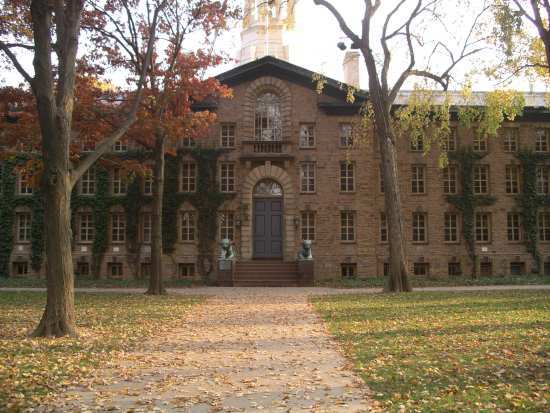
Of course, you can still find plenty of tradition at Princeton, from Opening Exercises in the Gothic University Chapel to the locomotive cheer at football games to Class Day festivities on Cannon Green behind Nassau Hall, the home of the president’s office and for several months (in 1783) the capital of the United States. Princeton seems to connect its preparation for the future with its affection for the past in so many ways that, no matter how diverse the community, anyone can find a place to feel at home there.
Princeton University successfully combines the best of several possible worlds. It has a world-renowned faculty, yet its primary focus is on its undergraduates. It has a range of activities that rivals even the largest universities in the country, yet the undergraduate population of 4,400 gives it an intimacy similar to that of a small liberal arts school. The diverse student body is drawn from all corners of the United States and the world, yet the students all share one thing—the intellectual potential to achieve at the highest level.
This is not to say that Princeton is for everyone; however, the students who have been disappointed tend to be those who expected something that Princeton never attempted to offer. If you are a star running back and want to play your college football games in front of rows of scouts and national television audiences, Princeton is not for you. On the other hand, the Princeton Tigers regularly get to the NCAA Basketball Championships and have defeated such powerhouses as UCLA. If you want to get a B.F.A. in film or creative writing, Princeton is not for you. On the other hand, you could design your own interdisciplinary major under the auspices of the Film Studies Committee or write a novel for your senior thesis in the English department and go on to a career in entertainment or the arts.
What you can expect from Princeton is one of the finest educations in the country. In this you won’t be disappointed. You will also get something more: experiences that will stay with you a lifetime. You may have the chance to hear a famous Chaucer scholar recite The Miller’s Talein Middle English to a packed lecture hall, making everyone laugh in the right places just by the judicious raising of an eyebrow. You may have the chance to work with a new preceptor in microbiology who will win the Nobel Prize in 2019. You may have the chance to dance in a Triangle Show kickline next to a skinny young man who will go on to become the next Jimmy Stewart.
The Princeton experience can be as unique as each student chooses to make it. Most graduates look back on their four years as a wonderful time of unlimited opportunities. This combination of the unique and the universal creates a bond among Princetonians that lasts far beyond graduation day.
Princeton University Academics
Some students joke that it is harder to flunk out of Princeton than it is to get in. There is some truth in that. You could spend your four years cruising, making full use of pass/fail options and easier courses, doing the minimum amount of work, getting by with Cs. But what a waste that would be. Princeton has so much to offer that these can also be the most intellectually stimulating years of your life. If anything, the tough part for a new student is trying to absorb all of the information about department offerings, programs, and seminars.
The undergraduate course catalogue is more than 400 pages. Princeton has thirty-three departments, supplemented by twenty-nine interdisciplinary programs ranging from African American Studies to Musical Performance to Women’s Studies. New students can start right in on their special interests through Freshman Seminars, small groups of students chosen on the basis of a short essay who meet with a professor on a specific topic. Recently there have been as many as forty-six freshman seminars, including The Aims of Education, led by the president of the university.
Off Campus
Princeton is flexible with off-campus opportunities. The Field Study Program lets students substitute, for one semester, a full-time job or research assignment closely relat- ed to their academic interests. For example, if you major in biology, you could apply to do biological research in a private lab. The field study doesn’t have to be near Princeton: people have done work from San Francisco’s Bay Area to the Woods Hole Oceanographic Institute on Cape Cod. Although Princeton doesn’t run any of its own foreign study programs, the university will allow students to receive credit for a semester or a full year in an approved program. Students on financial aid even continue to receive support.
Special Schools
There are also some special schools on the undergraduate level. In addition to the School of Engineering and Applied Science, Princeton has a School of Architecture and the Woodrow Wilson School of Public and International Affairs. The official word is that the Woodrow Wilson School “prepares students for participation and leadership in public affairs on the local, national, and international levels.” Most Princetonians will tell you, though, that it is a breeding ground for budding lawyers. The Woodrow Wilson School limits its enrollment to eighty students a year and the competition is pretty intense. (Good practice for trying to get into law school.)
Advisors
If this already seems like too much to take in, there is help. Academic advising is available to all freshmen and sophomores through the residential colleges. The masters and directors of studies in the colleges are also available for counseling.
I didn’t pay any attention to my advisor my freshman year; I figured that all he had about me was a file. How could he know what I might want to do? Well, by sophomore year I realized that I had been pretty arrogant. He might not have known me, but he did know Princeton. The suggestions he had made would have been much more sensible for me. Instead, I just did my own thing and ended up taking some courses that were just not right for me. I wish I had paid more attention to him—and I sure wish now that I had that time back.
Graduation Requirements
Graduation requirements are based on the number of courses taken, not the number of credits. Students in the A.B. program must complete thirty courses. (Students in the B.S.E program must complete thirty-six courses.) Normally, students take four courses a semester during their first three years, and then three courses a semester during the senior year. Most students try to take care of the distribution requirements in the early years so that they can have as much flexibility as possible in structuring their majors. (Majors are usually declared in the spring of sophomore year.) Be aware: You may be able to use a high score on an Advanced Placement test or an SAT II: Subject test to satisfy the language requirement, but all students must take one of the university courses to satisfy the writing requirement—even if you did get a 5 on the English AP.
Classes
Courses usually meet three times a week, with two lectures and a class (precept). (Engineering and science courses may meet more frequently and have required lab periods.) You might notice, however, that as you start taking upper-level courses the size of the lecture gets smaller, or you have two precepts and only one lecture, or you meet as seminar groups. You will have more and more individual contact with professors, whose accessibility is one of Princeton’s hallmarks. All professors have weekly office hours, open time when any student can go in and just talk.
Papers and the Thesis
You will get to know some of the professors in your department especially well during your junior and senior years when you are doing the required independent work with an advisor: the J.P. (Junior Paper) and the senior thesis. The J.P. is in many ways practice for the thesis. It is usually a long paper written each semester on a topic of your choice. Work on the senior thesis, part of Princeton’s student lore, is intended to take the time you would spend on a course. (This is why seniors take only three courses per semester, not four.) Many students very diligently allocate their time that way, regularly holing up in a carrel in the basement of Firestone Library, accumulating several shelves of texts for references, filling out box after box of index cards, handing in chunks of a rough draft periodically to their advisors. Several unfortunate students have been known to endure some very unpleasant weeks with little or no sleep right before the spring due date for the thesis.
Facilities
Princeton’s facilities are top-notch, too. The main library, Firestone, provides easy access to more than five million books and 30,000 periodicals as well as manuscripts, maps, coins, prints, and microform. All but the rarest of materials are in open stacks. There are an additional sixteen satellite libraries associated with various departments. Princeton has two museums on campus, the Princeton University Art Museum and the Natural History Museum, as well as a variety of exhibition spaces. There are four major venues for the cultural and performing arts, from a 200-seat recital hall to Tony Award-winning McCarter Theatre. Princeton also provides an extensive computing environment. Students can go to hundreds of workstations in two dozen computing clusters around campus. Students who bring their own computers can subscribe to Dormnet, a data service available in every undergraduate dorm room on campus that connects to campus and Internet resources. In 1999–2000, ninety-three percent of those eligible for Dormnet participated.
Academic life at Princeton can be as rich as you choose to make it. The array of opportunities is far more than you will be able to explore in your four years, and there is the danger that, in trying to do it all, you will feel stressed and pulled in too many directions. But it is all there for the taking, and the rewards are well worth the risks.
The hardest thing for me to get used to at Princeton was the different sense of time. In high school, my days and weeks were pretty structured (usually by someone else!) and we had specific assignments almost every night. At Princeton, courses meet only a couple times a week, sometimes leaving big blocks of time during the day. Many professors just hand out a syllabus at the beginning of the course and you are on your own to keep up with the reading and to remember when papers are due. At the end of each semester is “reading period”—about two weeks with no classes scheduled just before exams. At first it seemed as though I had unlimited free time, and I confess I spent a lot of my first semester goofing off. Then, when I had three papers due at once and got into a jam, I realized that it wasn’t that it was freetime; it was mytime. I had to learn to be responsible for my own time now. No one else was going to do it for me.
Princeton University Admissions
For an Ivy League school, Princeton is relatively small: it enrolls approximately 1,130 freshmen of the 1,700 it accepts. Yet nearly 15,000 applications come into the Admissions Office. In other words, almost ninety percent of those who apply will receive that dreaded thin envelope.
It’s not easy to get into Princeton. Among those admitted, more than seventy-five percent had SAT I scores over 680, and one-third of those had scores over 780. On the other hand, Princeton has only three mandatory admission requirements—SAT, SAT Subject Tests in three subject areas, and the application form itself. While the Admissions Office recommends that applicants take four years each of English, math, and a language, as well as two years each of history and a lab science, it also insists that there are no fixed unit or course requirements that must be completed before admission. The school gives “full consideration to any applicant who has been unable to pursue studies to the extent recommended if the record otherwise shows clear promise.”
Of course, the key words are “clear promise”—and the admissions process itself can seem far from clear. There is no formula for getting in. Like other highly competitive schools, Princeton wants to see how candidates have excelled, not only in their coursework but also in their extracurricular activities. Because Princeton is a residential university, the committee takes an interest in candidates’ roles in their communities. Special talents are also considered, whether the talent is on the athletic field or on the stage. The Admissions Office encourages candidates involved in the performing and creative arts to submit audition tapes or portfolios. Legacies (children of alumni) are given a certain amount of special consideration. (In 1999, forty percent of the 451 alumni children who applied were admitted; seventy-nine percent of those admitted enrolled, accounting for 143 of the class of 2003.)
Decision Programs
Princeton has two decision programs: Early Decision and Regular Decision. (The university has discontinued its Early Action program. You may apply Early Decision only if you are not applying Early Decision or Early Action anywhere else.) Early Decision applications must be mailed by November 1. You will hear from the Admissions Office in December whether your application has been accepted, denied, or deferred for review in the Regular Decision process. All admissions are for September enrollment; however, Princeton allows you to defer enrollment to travel, work, perform military service, or participate in special year-abroad programs. You cannot request a deferral until you have actually been notified that you have been admitted.
My mother was a whiz at Latin in high school and got a really high score on the Latin Achievement Test. When she was accepted at Princeton, the Classics Department wrote her a letter saying that if she wanted to major in classics she could start as a sophomore. She said, “No way! I worked hard to get into Princeton and I’m not going to shortchange my time there by a year!”
Princeton University Financial Aid
Princeton admissions are need-blind, and the university pledges “to provide aid to all enrolled students judged by the Financial Aid Office to be in need of assistance.” In a recent year, Princeton allocated almost $23 million in direct support through endowed scholarships and general funds to more than 2,000 undergraduates. That’s almost forty-five percent of the student population. The Financial Aid Office looks at not only the parents’ contribution, but also the potential contribution from the student, from savings, student loans, summer jobs, and campus jobs. Princeton is also very flexible in helping families who are not typical candidates for financial aid. The Student Employment Office helps undergraduates find jobs on and off campus. Financial aid students are given priority, but there really are jobs for anyone who wants one and almost seventy percent of the undergraduate student body works part-time. There is also a Princeton Student Loan program for students who don’t qualify for financial assistance. And there is even a loan program, called the Princeton Parent Loan, for high-income families who do not need financial aid but who want to extend their payments over a much longer time than the four years.
In other words, if you are admitted to Princeton, Princeton will work with you and your family to figure out a way to pay for your four years there.
Princeton University Students
Whenever something exciting happens in the borough of Princeton (which is not very often), the newspapers always refer to it as a “genteel college town.” The 300-year-old town (population of about 30,000) is charming. Shops range from the local hardware store to Laura Ashley and The Gap. More restaurants and coffee shops have appeared over the last twenty years as the area right outside of Princeton has become home to several corporate headquarters. Students can get fries at Burger King, and parents can splurge at a fancy French restaurant right around the corner.
But Princeton is not a party town. The few “hang-outs” are strict about checking IDs and they close early. New York and Philadelphia are only an hour away, with regular bus and train service to New York City, and the university often subsidizes student trips for various cultural and athletic events in both cities. Nevertheless, there is hardly a mass exodus to either city on the weekends, or at any time. Princeton really is a residential college, with more than ninety-seven percent of undergraduates living on campus, and it is on campus that most students experience their social life.
Residential College, Dorms, and Clubs
For freshmen and sophomores, life generally revolves around their residential colleges. Each college houses between 440 and 490 students and is made up of a cluster of dorms, a dining hall, lounges and study rooms, a library, computing facilities, and game and television rooms. Some of the colleges even have theaters and exhibit spaces, and all have an extensive intramural athletic program. Students themselves plan most of the activities, so that each college takes on the character of the group of students in it. This residential college system is relatively new for Princeton (it was instituted in 1982), and freshmen particularly like it. It’s a lot easier to be a new person in a group of 440 than in a universe of 4,400.
Upperclass students live in dorms that are not part of the residential colleges, and seventy-five percent of juniors and seniors belong to one of the twelve eating clubs that line Prospect Avenue. Each club has between 120 and 180 members who meet and eat and socialize in large houses that the clubs themselves run. Run by student officers under the guidance of independent alumni boards, the clubs are more than simply a place to eat. While each club has study and computer areas, they really are a haven for a tight community of friends to relax together. On any given weekend, several—or all—of the clubs will be having parties and the Street (as Prospect Avenue is called) is alive with activity, windows lit up, music streaming out of open doors, groups of people wandering from one club to another to visit friends and to see who has the best band that night.
Alternatives to the clubs do exist. Upperclass students may choose instead a university-sponsored nonresidential dining facility on Prospect that has its own extensive social program and is open to juniors and seniors. They may also opt to remain in the residential colleges or to be independent—to make their own arrangements for meals. Several of the dorms have special facilities for independents who want to cook their own meals, including one house that has been converted to a dorm for those who want to shop and cook vegetarian meals as a co-op. The new 170,000-square-foot Frist Campus Center opened in the year 2000, providing food, meeting spaces, and activities of various kinds for undergraduates in all four classes, as well as graduate students, faculty, and staff.
Extracurricular Activities
Princeton provides a remarkable choice of extracurricular activities. In athletics alone, there are sixty teams and crews, men and women compete in thirty-seven varsity sports, and there are another thirty-one men’s, women’s, and coed club teams. Nearly forty-five percent of the undergraduate student body competes in intercollegiate sports. While Princeton may not be known as an athletic powerhouse, during the past several years the school’s varsity teams have won eight national championships. Sports Illustratedrecently ranked Princeton the number ten jock school in the country. The basketball, lacrosse, and squash and field hockey programs rank at the top of anyone’s list.
One of Princeton’s most famous extracurricular activities is Triangle Club. Each year students write and produce a musical that they perform in McCarter Theatre and take on tour. Prominent Triangle alumni include Josh Logan, Jimmy Stewart, and, of more recent vintage, Brooke Shields. Theatre Intime, one of three other student production facilities, offers a student-produced drama series every year. Students interested in music have numerous outlets for their talents: the Orchestra, the Opera Theatre, the Jazz Ensemble, the Band (well known for its irreverent attitude at football games), the Glee Club, the Chapel Choir, and the Gospel Ensemble. Nine a cappellasinging groups perform their own arrangements regularly around campus and in concert tours during vacation breaks.
Publications
Writers will find all kinds of publications on campus. Students publish two regular newspapers, the Daily Princetonianand the Nassau Weekly. The Nassau Literary Reviewis the nation’s oldest student-run literary magazine. There are at least ten other publications, from the yearbooks to Business Today, which has a national circulation. (Princeton also has its own radio station, WPRB, which is affiliated with the Associated Press.)
Organizations
The American Whig-Cliosophic Society (known as Whig-Clio) is the oldest college political, literary, and debating society in the United States. (When a school has been around for more than 250 years, it’s bound to have many of “the oldest” organizations!) This organization brings about twenty speakers to campus each year and sponsors a variety of programs related to public affairs. Those thinking of going into public affairs themselves can practice by participating in the Undergraduate Student Government (USG). In addition, twelve undergraduates sit on the Council of the Princeton University Community. The Student Volunteers Council and Community House provide service opportunities in which more than a thousand students participate each year.
These organizations may be the largest, but they are not the only ones on campus. The Office of the Dean of Student Life recognizes more than 200 official student organizations, and new ones are started all the time. These include more than twenty minority organizations on campus. On a far larger scale, the Third World Center, founded in 1971, emphasizes the cultural, intellectual, and social issues of students of color. Its mission is to be a readily accessible resource to all students interested in minority and Third World issues. The International Center, the Center for Jewish Life, and the Women’s Center all represent the university’s commitment to educational, cultural, and social programs that speak to a diverse student body. The Dean of the Chapel and Religious Life and various denominational chaplains on campus provide many opportunities for religious inquiry and expression—and Princeton surely has one of the most glorious college chapels in the world.
As with the academic programs, there is something for everyone in the abundance of extracurricular activities. Just pick one…or ten.
I was scared about the workload at Princeton, so I decided that I wouldn’t do anything else but study. I had a pretty dull freshman year, and my grades weren’t even that good! Then I missed singing too much and decided to audition for Triangle and one of the a cappellagroups. I got into both and started having fun. It also turned out that having other commitments helped me organize my study time better and—surprise!—my grades went up. That might not work for everybody, of course, but I have found since graduation that the people I keep in touch with most are the ones I sang with.
Princeton University Alumni
My father was an alumnus of Princeton, and I was the first girl (woman!) in the family to be accepted. During the spring of my senior year in high school, he and I spent a lot of time going over the catalog and talking about all of the things we would do together. Then that summer my father died suddenly. Everything changed. Not only did I miss my father terribly, but it was also too late for me to apply for financial aid for that year. I knew my mother was worried about the costs. Instead of arriving on campus for Freshman Week bouncy and eager, I arrived sad and anxious. I hadn’t been there more than a few days when I got a call from one of my father’s classmates who was in the administration. I had never met this gentleman before, and I didn’t remember my father ever having mentioned him as a good friend. Somehow, though, he had heard about my father’s death and knew that I was starting at Princeton. He invited me to a home-cooked meal with his family. Within a few weeks he had helped me find the right people to talk to in the Financial Aid Office and had helped me find a part-time job. Later that year, he nominated me for a scholarship established by my dad’s class. I was awarded that scholarship for my remaining three years. In June he invited me to stop by the class’s tent at Reunions, where I met many of my father’s college pals who made me laugh—and cry—with stories about my dad when he was my age. These men didn’t know me at all, but they made me feel part of a family when the strongest link in my own family was gone.
I honestly believe no other school can claim the intense alumni loyalty that Princeton generates—loyalty both to fellow Princetonians and to Princeton itself. This speaks volumes about just how remarkable the Princeton experience is.
Over the past decade or so, there has been a slight shift in the postgraduate choices of Princeton seniors. The number choosing to go straight into the job market has steadily risen. In a survey of a recent graduating class, fifty-two percent said that they were going to get a job right away. Of the twenty-seven percent who answered that they were going to continue their education, half were going to graduate school and the other half to professional school. Of those choosing professional schools, most were going to medical school (twenty-four percent) or law school (twenty percent). Only a handful were going on for degrees in education, business, or public policy.
What do all these numbers mean? Because of its former elite reputation, Princeton is still often thought of as a place that churns out only doctors and lawyers. In fact, however, less than twelve percent of the Class of 1996 planned to go into those fields. Princetonians can be found in all walks of life, and the university has a number of resources to help graduates explore many kinds of prospects. Those interested in teaching or school administration can turn to the Program in Teacher Preparation, which maintains a placement service for all Princeton students and alumni. The Princeton-in-Asia program places interested students in short-term teaching assignments in China or Japan. Career Services offers a full range of programs and counseling, including workshops on résumé-writing and interviewing. Staff members can arrange interviews with representatives of professional schools and corporations. Career Services also coordinates with the Alumni Careers Network, which is made up of over 4,500 alumni around the world who have volunteered to give guidance and job-hunting assistance.
It’s no surprise that Princeton has an incredibly loyal alumni body. Of the nearly 70,000 living Princeton alumni, both undergraduate and graduate, at any given time ten percent are involved in some kind of volunteer work for Princeton, whether in regional associations, the job placement network, or community service. More than 13,000 alumni keep up with the university and each other through an electronic alumni network known as Tigernet. And every spring more than 5,000 alumni return to Princeton on the weekend before Commencement for Reunions, to walk again the paths between the dorms, to catch up with classmates, and to parade through the campus, smiling at the cheers of current students and proudly wearing their orange and black.
Prominent Grads
- Woodrow Wilson, 1879, Twenty-eighth President of the United States
- Adlai Stevenson, ’22, Former Governor of Illinois; former Ambassador to the United Nations; Presidential Candidate
- Josh Logan, ’31, Broadway Producer
- Jimmy Stewart, ’32, Actor
- Jose Ferrer, ’33, Actor
- Claiborne Pell, ’40, U.S. Senator (Rhode Island)
- James Baker, ’52, Former Presidential Advisor
- Frank Carlucci, ’52, Former Secretary of Defense
- Ralph Nader, ’55, Activist
- Frank Deford, ’61, Sportswriter
- Bill Bradley, ’65, Former NBAstar, U.S. Senator
- Steve Forbes, ’70, President and CEO, Forbes, Inc.
- Queen Noor (Lisa Halaby), ’73, Former Queen of Jordan
- David Duchovny, ’82, Actor
- Brooke Shields, ’87, Actress
- Dean Cain, ’88, Actor
Princeton University Faculty
Princeton has more than 700 full-time faculty members and all of them teach undergraduates, making the student-faculty ratio 7-1. The faculty is top-notch. At any one time there may be six Nobel Prize winners teaching, or eighteen MacArthur Fellows. (MacArthur Foundation grants are sometimes referred to as “genius grants.”) And, yes, it can be exciting to bump into novelists Toni Morrison or Joyce Carol Oates coming out of the English department office. But it can be equally exciting to be on an adventure of discovery with a new assistant professor in the biology department. Because of its prestige, Princeton attracts the best and the brightest of candidates out of graduate schools, people who are doing the most up-to-the-minute research in their chosen fields.
I kept telling my roommate how much I enjoyed the preceptor of my United States and World Affairs course. She was young and had terrific energy and seemed to know everything. My roommate told me to invite her to dinner at our eating club. I didn’t think she’d come, but I asked her anyway. She said sure! A bunch of us sat around a table with her, all talking at once and having a great time. For that hour or so she seemed just like one of us—only a lot smarter!
Information Summary
Ranks 3rd overall and 1st in New Jersey
| Overall Score
On StateUniversity.com (about) |
99.4 |
|---|---|
| Total Cost
On-Campus Attendance |
$47,975 |
| Admission
Success rate |
10% |
| ACT / SAT
75 %ile scores |
34 / 1580 |
| Student Ratio
Ratio of students to faculty |
9 : 1 |
| Retention
(Full-Time / Part-Time) |
98% / N/A |
| Enrollment
Total (all students) |
7,085 |
Carnegie Foundation Classification
Research Universities (very high research activity)
| Undergraduate | Arts & sciences plus professions, high graduate coexistence |
|---|---|
| Graduate | Comprehensive doctoral (no medical/veterinary) |
| Undergraduate Population | Full-time four-year, more selective, lower transfer-in |
| Enrollment | Majority undergraduate |
| Size & Setting | Medium four-year, highly residential |
General Characteristics
| Highest offering | Doctoral degree |
|---|---|
| Calendar System | Semester |
| Years of college work required | N/A |
| Variable Tuition |
Special Learning Opportunities
| Distance Learning | |
|---|---|
| ROTC — Army / Navy / Airforce | |
| Study Abroad | |
| Weekend College | |
| Teacher Certification |
Student Tuition Costs and Fees
What are the typical tuition costs and fees for attending Princeton University?
Ranks 61st for total cost of attendance
| In District | In State | Out of State | |
|---|---|---|---|
| FT Undergraduate Tuition | $33,000 | $33,000 | $33,000 |
| FT Undergraduate Required Fees | N/A | N/A | N/A |
| PT Undergraduate per Credit Hour | N/A | N/A | N/A |
| FT Graduate Tuition | $33,000 | $33,000 | $33,000 |
| FT Graduate Required Fees | $1,050 | $1,050 | $1,050 |
| PT Graduate per Credit Hour | N/A | N/A | N/A |
| Total Cost of Attendance — On-Campus | $47,975 | $47,975 | $47,975 |
| Total Cost of Attendance — Off-Campus w/out Family | $34,145 | $34,145 | $34,145 |
| Total Cost of Attendance — Off-Campus with Family | $34,145 | $34,145 | $34,145 |
Student Tuition Cost History and Trends
Three year history and trends on the cost of attending
| In District | In State | Out of State | |
|---|---|---|---|
| Published Tuition & Fees | $31,450 |
$31,450 |
$31,450 |
| Cost (regardless of residency) | |||
|---|---|---|---|
| Books & Supplies | $990 |
||
| On-Campus – Room & Board | $8,763 |
||
| On-Campus – Other Expenses | $2,623 |
||
| Off-Campus w/out Family – Room & Board | N/A |
||
| Off-Campus w/out Family – Other Expenses | N/A |
||
| Off-Campus with Family – Room & Board | N/A |
||
Admission Details
| Application Fee Required | N/A |
|---|---|
| Undergraduate Application Fee | $65 |
| Graduate Application Fee | $85 |
| First Professional Application Fee | N/A |
| Applicants | 18,942 (9,971 male / 8,971 female) |
| Admitted | 1,838 (971 male / 867 female) |
| Admission rate | 10% |
| First-time Enrollment | 1,244 (651 male / 593 female) |
| FT Enrollment | 1,244 (651 male / 593 female) |
| PT Enrollment | N/A (N/A male / N/A female) |
| Total Enrollment | 7,085 |
Admission Criteria
What criteria does Princeton University use for admissions?
| Open Admissions | |
|---|---|
| Secondary School GPA / Rank / Record | |
| College Prep. Completion | |
| Recommendations | |
| Formal competency demo | |
| Admission test scores | |
| TOEFL | |
| Other tests | N/A |
Admission Credits Accepted
What types of credits does Princeton University accept?
| Dual Credit | |
|---|---|
| Life Experience | |
| Advanced Placement (AP) |
Athletics - Association Memberships
| Sports / Athletic Conference Memberships | NCAA |
|---|---|
| NCAA Football Conference | Ivy Group |
| NCAA Basketball Conference | Ivy Group |
| NCAA Baseball Conference | Ivy Group |
| NCAA Track & Field Conference | Ivy Group |
ACT Test Admission
Ranks 12th for 75pctl scores
| Applicants submitting ACT results | 14% |
|---|---|
| Verbal scores (25/75 %ile) | 30 / 35 |
| Math scores (25/75 %ile) | 30 / 35 |
| Cumulative scores (25/75 %ile) | 30 / 34 |
SAT Test Admission
Ranks 5th for 75pctl scores
| Applicants submitting SAT results | 98% |
|---|---|
| Verbal scores (25/75 %ile) | 690 / 790 |
| Math scores (25/75 %ile) | 700 / 790 |
| Cumulative scores (25/75 %ile) | 1390 / 1580 |
Student Services
| Remedial Services | |
|---|---|
| Academic / Career Counseling | |
| PT Cost-defraying Employment | |
| Career Placement | |
| On-Campus Day Care | |
| Library Facility |
Student Living
| First-time Room / Board Required | |
|---|---|
| Dorm Capacity | 4,720 |
| Meals per Week | N/A |
| Room Fee | $5,980 |
| Board Fee | $5,000 |
Student Financial Aid Details
How many students use Financial Aid, and how much do they use?
Princeton University Ranks 3387th for the average student loan amount.
| Average | Users | % of Attendees | |
|---|---|---|---|
| Federal Grant Aid | $5,950 | 110 | |
| State & Local Grant Aid | $1,785 | 76 | |
| Institutional Grant Aid | $25,143 | 668 | |
| Student Loan Aid | $3,419 | 145 | |
| Any financial aid type | 668 |
Student Enrollment Demographics
How many students are enrolled at Princeton University?
| Men | Women | Total | |
|---|---|---|---|
Non Resident Alien | 841 | 485 | 1,326 |
Black Non-Hispanic | 201 | 272 | 473 |
Hispanic | 208 | 205 | 413 |
Asian / Pacific Islander | 362 | 440 | 802 |
American Indian / Alaskan Native | 19 | 24 | 43 |
White Non-Hispanic | 2,130 | 1,567 | 3,697 |
Race Unknown | 182 | 149 | 331 |
| Total | 3,943 | 3,142 | 7,085 |
Student Graduation Demographics
How many students graduated at Princeton University?
| Men | Women | Total | |
|---|---|---|---|
Non Resident Alien | 52 | 43 | 95 |
Black Non-Hispanic | 42 | 46 | 88 |
Hispanic | 27 | 42 | 69 |
Asian / Pacific Islander | 66 | 74 | 140 |
American Indian / Alaskan Native | 5 | 5 | 10 |
White Non-Hispanic | 398 | 359 | 757 |
Race Unknown | N/A | N/A | N/A |
| Total | 590 | 569 | 1,159 |
Most Popular Fields of Study
The top 5 fields of study completed at Princeton University.
| Men | Women | Total | |
|---|---|---|---|
| 90 | 88 | 178 | |
| 109 | 52 | 161 | |
| 68 | 64 | 132 | |
| 72 | 55 | 127 | |
| 72 | 24 | 96 |
Student Completion / Graduation Demographics
How many students are successful graduates?
Faculty Compensation / Salaries
Princeton University Ranks 8th for the average full-time faculty salary.
| Tenure system | |
|---|---|
| Average FT Salary | $127,018 ($137,086 male / $101,548 female) |
| Number of FT Faculty | 826 (592 male / 234 female) |
| Number of PT Faculty | 163 |
| FT Faculty Ratio | 5 : 1 |
| Total Benefits | $23,282,646 |


Comment and Corrections Make a comment …
Familiar with this University? We would love to hear about your experience. Feel free to add comments or additional information regarding Princeton University.