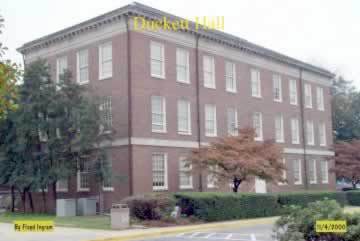
Benedict College is a historically black institution with a long history. It was founded in 1870, and originally began as a teachers’ college. The American Baptist Home Mission Society founded the school with $13,000 donated from a Rhode Island woman. It was created so recently-emancipated African natives could attend college. Rhode Island native Mrs. Bathsheba Benedict and the Baptist Home Mission’s goal was to educate African-Americans and produce citizens “powers for good in society”
The school’s first “campus” was a former slave master’s mansion, and students learned grammar, Bible and theology. Later, the school’s mission evolved into training teachers and preachers, and courses were added to accomplish that task. In 1894, the school’s first seven presidents where white, and in 1930 the Reverend John J. Starks, an alum, became the school’s first black president. Every president since Starks has been black.
Benedict College
Academics
Benedict College was founded in 1870 in Columbia, South Carolina. The school describes itself as a private, co-educational liberal arts institution, and enrolls about 3,100 students yearly. Benedict College features six schools: The School of Business and Economics, The School of Education, The School of Humanities, Arts and Social Sciences, The School of Science, Technology, Engineering and Mathematics, The School of Continuing Education and The School of Honors.
Benedict College offers students about 25 majors with courses in about 50 different programs, along with the continuing education program which offers students three undergraduate degree options. It is accredited by a number of organizations, including the Commission on Colleges of the Southern Association of Colleges and Schools to award bachelor’s degrees. Individual department accreditation includes: The School of Business and Economics for its business programs by The Association of Collegiate Business Schools and Programs, the Office of Teacher Education by the National Council for Accreditation of Teacher Education, The Benedict College Social Work Program by the Council on Social Work Education, and The Recreation and Leisure Services Program by the National Recreation and Parks Association (NRPA). Benedict College is only the second historically black college in the nation to receive national accreditation for its Environmental Health Program (EHAC). It’s Child Development Center is accredited by the National Association for the Education of Young Children (NAEYC).
Most Popular Fields of Study
The top 5 fields of study completed at Benedict College.
Benedict College has certain requirements for admissions. Applicants must have earned a high school diploma or a GED certificate, have at least a 2.0 GPA and have scored 750 on the SAT or 15 on the ACT. Or, an applicant may be ranked in the top 75 percent of its graduating class.
There are also a number of non-degree application requirements. People looking to take classes to improve their skills, transfer credits to another institution or for personal reasons can apply for school. They must prove they have the preparation and ability to do college-level coursework. High school students are also able to study at Benedict College, and must receive permission from the admissions office.
Benedict College has a transfer program with a local college. The Benedict College – Midlands Technical College Bridge Program is designed to ease the transfer process of students from Midlands Technical College. It provides program support and services during the transfer process.
Financial Aid
There are more than seven different types of school-based scholarships, along with more than 10 other scholarship and fellowship programs at Benedict College besides the traditional financial aid awards. The Benedict College Trustee Club level scholarship awards $17,000 annually, or $68,000 over eight semesters to students with GPAs between 3.8-4.0. The Trustee scholarship grants students $13,000 annually, or $52,000 over eight semesters, if they have a GPA between 3.5 and 3.79. There are also three different scholarship levels for South Carolina residents — the Palmetto Fellowship, the S.C. Life and the S.C. Hope scholarships.
The school also awards a number of other scholarships. Those include scholarships in athletics, concert choir, gospel choir, Army ROTC, wind ensemble, dance and marching band. The opportunities to obtain scholarships also extend through programs like the Mercedes Benz scholarship program and the Kellogg African American Public Health Fellowship.
Benedict College is a Division II school. It competes in the Southern Intercollegiate Athletic Conference. The school competes in the following sports: football, men and women’s basketball, baseball, softball, track and field, cross country, golf, handball, soccer, tennis,volleyball, cheerleading, and marching band. On-campus football games are held in the Charlie W. Johnson Stadium. The school’s men’s and women’s basketball teams, and men’s cross-country team, have won championships.
Local Community
Columbia is South Carolina’s largest city and the state capitol. It’s population in the 2010 census was 129,272. It routinely receives high rankings in numerous studies of metro areas in the United States. The city has received “best of” rankings status by Forbes, BusinessWeek, Bizjournals, Policom, among others.
Benedict College
Additional School Information
Diversity magazine named Benedict College one of the top 100 black colleges in the country. It’s enrollment growth since the mid-1990s has made it the second largest private undergraduate school in South Carolina.
Benedict College’s Honors Debate Team has won a championship, and the Benedict College Gospel Choir is nationally-ranked. The debate team’s honors include first place at the National Association of African-Americans Honors Program Conference in 2005, 2007 and 2009. For Physics students, it is one of the top ten colleges in the country, according to the Education and Employment Statistic Division of the American Institute of Physics. The school’s Service Learning Program is a national model program and serves over 114 non-profit organizations around in South Carolina. It recently won the 6th Annual Commission on Higher Education’s Service Learning Competition.
For minority entrepreneurs, The Business Development Center provies educational opportunities and a revolving loan program geared to starting new businesses. The school offers an international study program for students. Benedict College students have studied in Colombia, Mexico, Chile, Brazil, Venezuela, Italy, Ghana, China, South Africa, Spain, Haiti, the Dominican Republic, Monaco and Italy, among other countries.
This website and associated pages are not associated with, endorsed by, or sponsored by Benedict College. StateUniversity.com has no official or unofficial affiliation with Benedict College.
Columbia, SC 29204-1086
p. 803-256-4220
w. www.benedict.edu