StateUniversity.com – U.S. University Directory [ Home :: University List :: Virginia ]
Lexington, VA 24450-2116
p. 540-458-8400
w. www.wlu.edu/
Washington and Lee University
General Information, Alumni, History, Campus, Students, Faculty, Address, and Tuition - a StateUniversity.com profile
- College and University Blog with many tips like acing the ACTs, SATs, college admissions, and preparing for college.
- University Forum and Discussion - Brand New Message Board For All Your Questions
- Information on Thousands of Careers - One-stop resource for very comprehensive, and up-to-date career information. Contains more than several thousand job profiles each with a job description, education and training requirements, salary information, working conditions, employment outlook and much more!
- Student Encyclopedia - Encyclopedia for reference and research from the Cambridge Collection.
Washington and Lee University Introduction
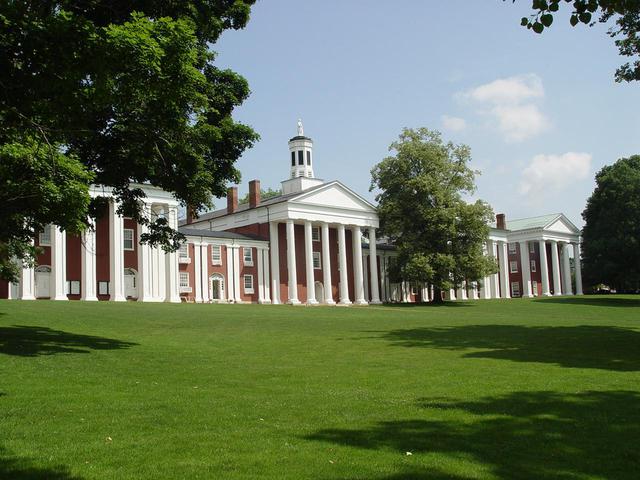
On a crisp fall afternoon in Virginia, students walk up the grassy slope to Washington and Lee’s colonnade, rows of white columns that define the face of the campus’s red brick buildings. The students walk in the shadows of the columns and climb the worn steps of Payne Hall. Just inside their classroom is a bronze plaque commemorating the space where General Robert E. Lee took his oath of office as president of the school in 1865. The open windows frame more students passing along the back campus. Some enter Leyburn Library, a wide complex of concrete and brick. Others open the doors to the Great Hall of the Science Center; vaulted, sky-lit ceilings expose balconies for each of the floors above, where more students move to and from completely modern classrooms and laboratories.
As these students cross Washington and Lee University’s picturesque campus, they see its balance of the old and the new – traditions and changes. Founded in 1749, the university boasts a long and rich history. The school won critical support in 1796 when George Washington donated $20,000 to its endowment. (Washington’s gift was the largest ever made to a private American school at the time, and the sum continues to pay a portion of every student’s tuition.) The school was known as Washington College at the end of the Civil War, when Robert E. Lee assumed its presidency. Lee led the college through far-reaching changes until his death in 1870. Washington and Lee students cherish Lee for his educational reforms: joining the college with a local law school, instituting classes in business and economics, creating the first college-level journalism program, and establishing the seeds of the student-governed Honor System. Those century-old innovations are now traditions that make Washington and Lee the fine liberal arts institution it is today. The university maintains these traditions and follows Lee’s example, always initiating change. The last decade has witnessed additions to the curriculum, complete revitalization of the fraternity system, and construction of new facilities for the fine arts, athletics, and the sciences. A new fitness center opened in Fall 2002, along with the newly renovated journalism school, and the new John W. Elrod University Commons opened in Fall 2003. The year 2006 saw the inaugural season of Wilson Hall, the new music and art facility.
Students at Washington and Lee call their school “W&L,” and their love for W&L is as loyal as their love for Lee. One former student admits:
I called home crying a few times during my freshman year because I was so grateful to my parents for giving me the opportunity to come to W&L.
National surveys routinely rank W&L students among the happiest in the country. When naming what makes them happy, every student generation names the same strong traditions: a small student body of 1,770 that is truly a community, intimate classes averaging around sixteen students, a faculty dedicated to students and to teaching, and an Honor System that creates a society of trust where no student will lie, cheat, or steal.
The small town of Lexington, Virginia forms the backdrop for all of this student bliss. Although only 7,000 residents live in Lexington year-round, students from Washington and Lee and its neighbor, the Virginia Military Institute, add substantially to the town’s true population. (The two schools add much to the town through their cultural and athletic programs as well.) One politics major notes:
The scenic, safe surroundings have allowed me to make W&L a home away from home, to enjoy the college experience without the worries and distractions of a big school or a big city.
W&L students become active citizens of Lexington as “big brothers” or “big sisters” to local youths, as coaches for Little League teams, as members of church congregations, and as participants in outreach groups such as Habitat for Humanity and the Nabors Service League.
Although all W&L students call Lexington “home,” they journey from all corners of the United States to get there. Only fourteen percent of undergraduates hail from Virginia. Other well-represented states include Florida, Georgia, Maryland, New Jersey, New York, Pennsylvania, and Texas. It surprises many to learn that the student body includes nearly as many from California as from Kentucky or Connecticut. W&L truly has a national student body to match its national reputation. An intensified effort to recruit international students has resulted in attracting young men and women of nearly fifty citizenships.
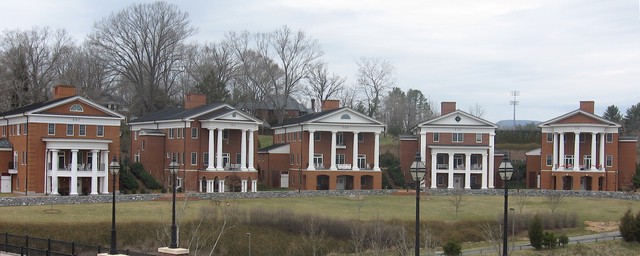
Washington and Lee’s four freshman dormitories form a cluster on the edge of campus. Baker, Davis, and Gilliam dorms face one another, creating a horseshoe; students gather in its “quad” every day. Just across the street, Graham-Lees – the oldest of the four dorms – overlooks the Baker-Davis-Gilliam quad. An arched breezeway passes through the building; on the left, a marble step between two columns is clearly worn more than the rest. Superstition holds that freshmen must walk up this step, between the columns, or risk failing their first test. Millions of feet have kept the tradition.
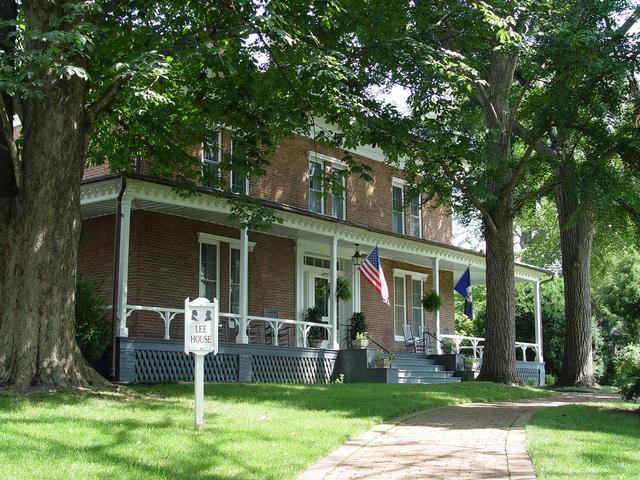
Just next door to Graham-Lees dormitory is the Lee House. Robert E. Lee built this home when he was the president of the school, and presidents of Washington and Lee have lived there ever since. Freshman voices can be heard in the Lee House as they echo from the dormitories. A past president joked that, although he preferred classical music, he could not help becoming familiar with the musical tastes of each freshman class.
That the president of the university lives so close to the freshman class demonstrates something wonderful about Washington and Lee: The person who runs the school shares the same block with those who are just learning the school’s nuances. There is a continuity from the top of the administration to the bottom of the student body, and this continuity permeates the entire university. There is a sense of familiarity and camaraderie. Washington and Lee students cherish this camaraderie and guard it closely long after they leave the quaint streets of Lexington.
This site is not sponsored by, affiliated with, nor endorsed by Washington and Lee University
Washington and Lee University Academics
Nothing shapes life at Washington and Lee more than its Honor System. The Honor System dates back to Lee’s simple demand that all of his students act honorably. Today, a committee of elected students (known as the Executive Committee) administers the Honor System, informing freshmen of its guidelines and enforcing its principles. The system is built upon trust; it holds that students who lie, cheat, or steal are not trustworthy and, therefore, not welcome in the Washington and Lee community. For that reason, there is only one sanction for any student found guilty of an honor violation: permanent removal from the student body.
Because the Honor System works so well, Washington and Lee students enjoy freedoms that would be impossible at other universities. All academic buildings on the W&L campus, including the library, remain open twenty-four hours a day. Since professors trust that cheating will not occur, students take unproctored tests and exams. Students even schedule their own exams during week-long exam periods. It is possible that every student in an English class could take the same exam in a different place at a different time; students are trusted not to discuss the content of their exams with their classmates. These freedoms extend beyond the classroom as well.
I constantly leave money in my backpack right in the middle of campus without giving a moment’s thought to its security.
Classes
If there is one thing that defines all colleges, it must be the classroom. Today, many college classrooms are cavernous, badly lit lecture halls. A professor or, more likely, a teaching assistant speaks through a microphone to hundreds of students seated in row after row of identical chairs. W&L defines the classroom differently. Its students enjoy small, intimate classes that are never taught by a graduate student or a teaching assistant. A large class at W&L might contain thirty-five students. Average classes number fourteen to seventeen. Many upperclassmen take seminar classes with fewer than ten other students. They all might sit around a single table with their professor, creating the kind of personal, in-depth interaction that is a W&L hallmark.
Professors
Small classes allow students to get to know their professors as people, and vice versa.
Teachers here seem to relish the opportunity to get to know the students, even if they realize that that particular student will only be taking that one class from them. Within your major, every professor knows you and begs you to take their classes. It’s rather flattering.
An alumnus remembers similar experiences:
I never lost my awe of my professors, but I really came to rely on many of them as friends. Of course, that made the stakes higher. I always felt that I had to do my best work because I didn’t want to disappoint them.
Professors keep long office hours so that they can meet with students outside of class. Most professors do not have strict attendance guidelines, but, because classes are so small, every student learns that an absence gets noticed. Although it may be unheard of at other universities, W&L students enjoy eating dinner occasionally at professors’ homes.
Curriculum
Despite Washington and Lee’s small size, the university offers a startlingly varied curriculum that a Washington Post article described as “the envy of many larger institutions.” Committed to the ideal of a liberal arts education, W&L requires all students to meet general education requirements in composition; literature; a foreign language; the fine arts, history, philosophy, and religion; science and mathematics; the social sciences; and physical education. Most students meet these requirements by the end of their sophomore year. They spend their junior and senior years fulfilling a major course of study and exploring elective classes.
Students divide their time between the university’s College of Arts and Sciences which includes the School of Journalism (or “J-School”), and the Ernest Williams II School of Commerce, Economics, and Politics (or “C-School”). W&L’s broad curriculum allows it to offer majors in subjects not commonly taught in outer top colleges, such as accounting, business, engineering, East Asian languages and literature, geology, and neuroscience. Students may earn Bachelor of Arts or Bachelor of Science degrees, in addition to Bachelor of Science degrees with Special Attainments in Chemistry and Bachelor of Science degrees with Special Attainments in Commerce. The Shepherd Program for the Interdisciplinary Study of Poverty as well as the Society and the Professions Studies in Applied Ethics are among W&L’s unique, crosscurricular courses of study, along with formal non-major programs in African American studies, environmental studies, global stewardship, and women’s studies. Undergraduates also benefit from the presence of W&L’s top-ranked school of law. Some law courses are open to undergrads, and most special events and guest lectures welcome them, as well.
Study Areas
W&L students spread all over the campus to study. Carrels in Leyburn Library may be reserved on the first day of classes. Confident in the Honor System, students leave texts and notebooks in their carrels for the entire school year. Other students study in the libraries located in the Science Center, Journalism School, or Commerce School. Because academic buildings stay open twenty-four hours a day, an occasional student may “pull an all-nighter” while working in a classroom. Students compose their papers on computers in computer labs located in most academic buildings. Every dormitory room is connected to the university computer network, and wireless zones around campus allow students to get on-line wherever they might be studying.
W&L classes typically demand considerable reading and writing. Students quickly learn that no skill proves more valuable than the ability to write clearly and concisely; professors expect nothing less. Classes and workloads may be tough, but the academic mood at Washington and Lee never becomes cutthroat.
W&L may have competitive admissions, but students here enjoy learning more through cooperation and collaboration with peers.
This mood may be due, in part, to the Honor System. Students trust one another. They do not compete against one another; they compete against themselves.
The Academic Year
W&L has a unique academic year consisting of a twelve-week fall term, a twelve-week winter term, and a six-week spring term. Most students take four classes in the fall, four classes in the winter, and two classes in the spring. The spring term allows for a kind of academic flexibility that is truly uncommon. In years past, students in English classes spent the term studying five of Faulkner’s novels in great detail. Those in botany classes traveled to the American West to examine its indigenous fauna. Members of economics classes journeyed to the financial centers of Europe to learn about the European Economic Community, while politics majors interned in Washington, D.C. Because the spring term closes the school year, students who study abroad or serve in internships for the term may continue to do so throughout the summer. Students who stay at W&L enjoy compressed classes, along with beautiful weather for reading outdoors or tubing down the Maury River.
This site is not sponsored by, affiliated with, nor endorsed by Washington and Lee University
Washington and Lee University Admissions
Word is out – magazines rank W&L one of the nation’s premiere liberal arts institutions year after year. Its academic reputation, small size, and pure beauty attract an increasing number of applicants with increasingly stronger credentials. Because space in Washington and Lee’s student body is limited, gaining admittance to the university has become increasingly difficult.
A glance at Washington and Lee’s admissions statistics confirms just how selective the school has become. Of the 4,215 students who applied for admission into a recent class, only 1,150 were admitted, yielding a freshman class of 450 (228 men, 222 women). These enrolling students achieved remarkable scores on their standardized tests. The middle fifty percent range of their SAT scores spanned 13301450; the same range of ACT scores was 2831. These freshmen earned an average rank in class above ninety-three percent of their high school classmates. Forty-five were valedictorians or salutatorians; thirty-seven were National Merit Scholars or Finalists.
These facts certainly portray W&L’s selectivity, but they do not illustrate the great care that its Admissions Office takes in reviewing all applications. Washington and Lee believes that the high school record is the surest sign of a student’s potential for success in college. Admissions officers read every student’s transcript, weighing grades against the difficulty of the curriculum. Successful applicants typically have strong grades in rigorous college-preparatory or Advanced Placement classes. Standardized tests are used as a uniform measurement in comparing students who often come from schools with drastically different curricula and grading scales. W&L also strives to evaluate each student’s character and personality through essays and recommendations. In hopes of finding future members of the school’s athletic teams, cultural groups, and student committees, W&L’s Admissions Office further judges applicants by their extracurricular pursuits.
Interviews
Proof of Washington and Lee’s genuine interest in getting to know applicants lies in the fact that it continues to offer personal interviews. Interviews and student-guided tours may be scheduled by calling the Admissions Office. For students who cannot travel to Lexington for a meeting with an admissions officer, interviews with alumni admissions program representatives are available in most major cities in the United States (http://admissions.wlu.edu/app).
Requirements
W&L’s admissions requirements are clear and straightforward. Applicants must submit the Common Application (www.commonapp.org), or they may use W&L’s own paper forms. Those using W&L’s paper application should complete Part I of the application for admission, this preliminary application asks for biographical information. After receiving Part I from applicants, W&L then sends Part II of the application. It includes transcript forms, two teacher recommendation forms, and guidelines for the submission of supplemental information (including an essay). Applicants should submit the SAT or the ACT with its writing section, plus two SAT Subject Exams in different subjects. The Regular Decision deadline for submission of applications is January 15. Students can expect replies from Washington and Lee in early April. All application forms are available on-line at http://admissions.wlu.edu.
Early Decision
For students who want to attend Washington and Lee above all other schools, there are two binding Early Decision options. Early Decision applicants must acknowledge that Washington and Lee is their first choice and that they will attend if admitted. Early Decision applications are due by November 15 for Early Decision I or January 2 for Early Decision II. W&L delivers notice by December 22 for E.D. I or February 1 for E.D. II. Admitted students happily claim a coveted place in the freshman class. W&L defers consideration of those who are not admitted until the regular admissions process.
Another admissions deadline remains for applicants who want to vie for the university’s many generous Honor Scholarships. These students complete an additional essay and submit their applications by December 15. W&L invites finalists to visit the campus during the late winter; the Admissions Office notifies scholarship recipients in early April.
This site is not sponsored by, affiliated with, nor endorsed by Washington and Lee University
Washington and Lee University Financial Aid
Washington and Lee uses student tuition dollars as efficiently and fairly as any university in the country. At many schools, students and their families pay inflated tuitions; one fullpaying student’s cost of attending school also includes a portion of the fees necessary to educate another student who receives financial aid. In other words, students subsidize other students’ tuitions. At W&L, most financial aid dollars are drawn from grants and endowment, so the cost of attendance at W&L is often lower than the cost of attending other highly selective colleges. For a small school offering a world-class education, W&L is clearly a tremendous value. W&L students and their families find that the university possesses an intimate academic setting that rivals any other – at an extremely competitive cost.
No one will claim that the annual tuition and room and board is small change, however. The cost of any college education exceeds the budgets and imaginations of many American families. Washington and Lee strives to make tuition costs affordable by offering generous financial aid packages to students whenever possible.
W&L’s admissions process is need-blind, so a student’s ability to pay tuition is never a part of the admissions decision. W&L’s Financial Aid Office, upon learning of a student’s admission, works to ensure that a student’s financial needs can be met.
In order to reach its goal of meeting a student’s financial needs, W&L’s Financial Aid Office requires that a student’s family fill out the College Scholarship Service Financial Aid Profile. The CSS Profile may be found online. The Financial Aid Office strongly recommends submission of the profile by mid-January. Doing so will ensure receipt of all student information by mid-February. Additionally, W&L’s Financial Aid Office requires a student’s family to provide tax returns from the two previous tax years. W&L’s priority deadline for submitting all required Financial Aid application materials is March 1st. Applicants and their parents are strongly encouraged to review the detailed instructions about making application for financial aid on W&L’s web site http://wlu.edu/financialaid.
Students applying through W&L’s Early Decision program may obtain a financial aid estimate by registering with the College Scholarship Service in October and submitting forms through CSS in mid-November.
Because any college financial aid process may prove frustrating and confusing, W&L’s Admissions Office recommends early, careful planning for any student’s family. The Financial Aid Office takes great care in addressing each family’s personal and individual needs.
Apart from its need-based aid programs, Washington and Lee also awards numerous merit-based scholarships every year. Ranging from partial tuition awards to scholarships that cover full tuition, room, and board, W&L’s Honor Scholarships reward students who possess great academic and personal promise. Therefore, finalists must meet and exceed the university’s admissions standards in addition to demonstrating potential campus leadership. Recipients carry their scholarships throughout their four-year tenure at Washington and Lee, provided they establish a minimum 3.0 grade-point average and maintain a personal record fitting an Honor Scholar. Students who wish to apply for these awards must submit their applications along with an additional Honor Scholarship essay by December 15.
Washington and Lee also sponsors Finalists in the National Merit Scholarship Competition. National Merit Finalists who are admitted to the university and designate Washington and Lee as their first choice of colleges with the National Merit Finalist Scholarship Corporation will receive up to $7,000 yearly.
This site is not sponsored by, affiliated with, nor endorsed by Washington and Lee University
Washington and Lee University Students
Phil Flickinger, a 1997 graduate of Washington and Lee, has published a collection of his cartoons that appeared in W&L’s student newspapers. Entitled Invasion of the Bug-Eyed Preppies, the book captures many of the quirks of social life at W&L. Flickinger’s most revealing cartoon juxtaposes two groups – “Generation X” and “Generation Lex.” “Generation X” is a frowning, shaggy group of tattooed and pierced slackers. “Generation Lex” is a group of Lexington, Virginia’s W&L students – straitlaced and smartly dressed. One W&L male in the cartoon asks, “Has anyone seen my Duckheads?”
Like most humor, this cartoon evokes a great deal of truth by use of stereotypes. Of course, every member of Generation X does not have a skateboard and a navel ring. Likewise, every student at W&L does not fit the cartoon’s notion of a preppy. For every rule or stereotype, there are exceptions. It may be true that most W&L students are more conservative than their peers at other schools. Nevertheless, W&L’s student body contains a strong mix of “ambitious, on-the-ball” individuals who pursue differing interests with differing attitudes. Somehow, they all seem bound by a single thread.
I still maintain that in no other school can one find such a classy group of well brought-up individuals. Everyone respects one another to an amazing degree.
Residences
All W&L freshmen live in one of four freshman dormitories and take their meals in a contemporary common dining room in the Elrod Commons, the Marketplace. Sophomores live on campus, too, in upperclass dorms and apartments, fraternity houses, and separate houses for groups such as the Outing Club, International Club, and Spanish Club. Juniors and seniors may live on campus, though many choose to live off campus. Apartments above downtown stores provide many options for students, as do legendary student homes with colorful names like Fishbait, Munster, Windfall, the Batcave, Jacob’s Ladder, and Amityville. All students enjoy the majestic beauty of the surrounding Shenandoah Valley and Blue Ridge Mountains, which provide every imaginable outdoor activity.
The Greeks
Seventy-five percent of W&L men and women are in one of thirteen fraternities or five sororities. Many fraternities and sororities engage in volunteer efforts, such as tutoring elementary students, cleaning up nature trails, organizing food blood drives, and working for the local emergency services. Their social events aren’t exclusive affairs, but welcome all students, Greek and non-Greek alike. Friendships between members of different organizations are common, as are friendships between Greek members and independent students. Fraternity and sorority houses are owned by the university and are clean and well-maintained.
Other Organizations
For a small school, Washington and Lee supports an impressive array of civic, cultural, and athletic organizations to meet every student’s interests. The Society for the Arts, for example, sponsors dramatic performances and readings of student poetry and fiction. The General Activities Board brings bands and comedians to campus. W&L’s many journalism majors contribute to two rival student newspapers, the traditional Ring-tum Phi and the more winsome Trident. The Contact Committee presents debates and lectures by nationally-known visitors. Through club and intramural sports, choral groups, an orchestra, college Democrats, college Republicans, religious organizations, and service groups, any W&L student finds fulfilling diversions and relationships outside of class.
h3,. Popular Events
Among W&L’s most popular events are two campus-wide bonanzas: the Fancy Dress Ball and Mock Convention. A black-tie ball attended by students, alumni, and faculty, Fancy Dress (or “FD”) is a yearly affair that celebrated its centennial in 2007. A student committee sponsors a concert on a Friday evening, followed by the ball on a Saturday night. Festivities fill the weekend, making for a marathon that only the most excited students can complete. Mock Convention (or “Mock Con”) occurs with equal flair every four years. Organized to predict the presidential candidate for the political party out of office, Mock Con approximates an actual political convention on a grand scale. Students form state delegations and spend countless hours in research. They succeed in predicting candidates at an uncanny rate. The 1992 Mock Democratic Convention accurately selected Bill Clinton as its nominee. The 1996 Mock Republican Convention garnered live coverage on C-SPAN. House Speaker Newt Gingrich addressed the crowd of Washington and Lee students, and Bob Dole spoke to the assembly via phone when he accepted the convention’s nomination. The 2000 mock convention predicted the nomination of George W. Bush, and the 2004 convention correctly chose John Kerry.
This site is not sponsored by, affiliated with, nor endorsed by Washington and Lee University
Washington and Lee University Athletics
Many Washington and Lee students also choose to participate in varsity sports. W&L’s Generals compete in Division III sports through the Old Dominion Athletic Conference, maintaining sterling academic and athletic records. Recently, 194 of W&L’s 400 varsity athletes achieved GPAs of 3.5 or better. The Generals have had ten conference championship teams, seventeen All-American athletes, nine conference players of the year, and seventynine first-team all-conference players. For ten of the last twelve years, W&L teams won the ODAC Commissioner’s Cup for the best all-around athletic program. Football and lacrosse remain the perennial favorites of spectators at W&L, attracting large and vocal crowds.
This site is not sponsored by, affiliated with, nor endorsed by Washington and Lee University
Washington and Lee University Alumni
The percentage of freshmen who return to Washington and Lee for their sophomore years stands as a sure, impressive sign of student contentment: typically ninety-five percent of freshmen return to W&L as sophomores. A more impressive sign is the number of W&L students who enter as freshmen and graduate four years later. Typically between eighty-five and ninety percent graduate on schedule. Clearly, Washington and Lee students stay at the university, and they stay happy. In an age when many college students need five years to earn a degree, the vast majority of W&L students find both adequate advisement and access to the classes they need in order to graduate in four years.
Traditionally, W&L produces a high percentage of history, biology, and economics majors. That so many students should favor history at W&L, given the university’s own long history, should be no surprise. The university’s numerous biology majors include many who regularly establish a stellar record in gaining admittance to medical schools. Economics majors typically carry their expert training from W&L’s Commerce School into the business world.
All Washington and Lee students receive excellent advice from the Career Services Office. The Career Services Office provides mock interview and résumé-review services. Students use the office’s complete resources to research potential employers. The Office welcomes over 100 companies to interview W&L students for jobs and summer internships every year. It further organizes off-campus interviews and enlists students in job fairs through the Selective Liberal Arts Consortium and Big Apple Recruiting Consortium. These job fairs enable W&L students to meet employers in major American cities. The Career Services Office has an internship exchange with twenty-five top liberal arts colleges, which produces over 6,000 internship listings each year.
The Career Services Office also tracks W&L students as they leave W&L for employment and graduate school. Its report for the class of 2005 shows sixty-seven percent of graduates in employment, along with twenty-three percent seeking postbaccalaureate degrees. A slim five percent either were seeking employment or were content taking time off after graduation. The report reveals that large numbers of working graduates found positions in business, banking and finance, government, journalism, or education. Of the 2003 graduates who decided to pursue advanced degrees, thirty-five percent entered general graduate schools, thirty-two percent entered law school, and twenty-three percent entered medical school. Other students began studies in dental, veterinary, engineering, and business schools.
Because students come from all parts of the country to attend Washington and Lee, they also disperse themselves across the map after graduation. Recent trends show increasing numbers of W&L graduates moving to New York City, Washington, Charlotte, and Atlanta for work. In every city, existing alumni association chapters support and welcome new graduates.
Washington and Lee alumni share a unique experience that creates “an immediate bond” between them. They treasure their undergraduate memories and remain fiercely loyal to their alma mater. One graduate describes a revelation about the nature of Washington and Lee alumni this way:
I have a W&L trident decal on the back of my car, and I was at the gas station one day when a stranger asked me what it was. I explained that it was the symbol for my school, Washington and Lee University. The stranger said, “Oh, I thought maybe it was a sign for some kind of cult.” I laughed, and then, the more I thought about it, the more I realized the stranger wasn’t necessarily wrong. W&L is a kind of cult – but in a good way. We all believe very strongly in the same ideals and we all have a strong sense of belonging to a very special place.
Prominent Grads
- Lloyd Dobyns, News Commentator
- Joseph Goldstein, Nobel Prize Winner
- Bill Johnston, President of the New York Stock Exchange
- David Low, Astronaut
- Roger Mudd, Journalist
- Cy Twombly, Artist
- Tom Wolfe, Author
This site is not sponsored by, affiliated with, nor endorsed by Washington and Lee University
Information Summary
Ranks 21st overall and 1st in Virginia
| Overall Score
On StateUniversity.com (about) |
98.3 |
|---|---|
| Total Cost
On-Campus Attendance |
$47,096 |
| Admission
Success rate |
27% |
| ACT / SAT
75 %ile scores |
31 / 1460 |
| Student Ratio
Ratio of students to faculty |
8 : 1 |
| Retention
(Full-Time / Part-Time) |
94% / N/A |
| Enrollment
Total (all students) |
2,149 |
Demographics – Main Campus and Surrounding Areas
Reported area around or near Lexington, VA 24450-2116
| Surrounding community | Distant town (between 10 to 35 mi. away from an urban cluster) |
|---|---|
| Total Population | 15,511 (7,606 urban / 7,905 rural) |
| Households | 5,740 (2.29 people per house) |
| Families | 3,587 (2.8 people per family) |
| Pop. — African American | 902 |
| Pop. — Asian | 231 |
| Pop. — Pacific Islander | 8 |
| Pop. — American Indian / Alaskan Native | 66 |
| Pop. — White (incl. Hispanic) | 14,353 |
| Pop. — Other | 71 |
Carnegie Foundation Classification
Baccalaureate Colleges — Arts & Sciences
| Undergraduate | Arts & sciences plus professions, no graduate coexistence |
|---|---|
| Graduate | Postbaccalaureate professional (other dominant fields) |
| Undergraduate Population | Full-time four-year, more selective, lower transfer-in |
| Enrollment | High undergraduate |
| Size & Setting | Small four-year, highly residential |
General Characteristics
| Highest offering | Master's degree |
|---|---|
| Calendar System | Semester |
| Years of college work required | N/A |
| Variable Tuition |
Special Learning Opportunities
| Distance Learning | |
|---|---|
| ROTC — Army / Navy / Air Force | |
| Study Abroad | |
| Weekend College | |
| Teacher Certification |
Student Tuition Costs and Fees
What are the typical tuition costs and fees for attending Washington and Lee University?
Ranks 91st for total cost of attendance
| In District | In State | Out of State | |
|---|---|---|---|
| FT Undergraduate Tuition | $34,650 | $34,650 | $34,650 |
| FT Undergraduate Required Fees | $795 | $795 | $795 |
| PT Undergraduate per Credit Hour | $1,155 | $1,155 | $1,155 |
| FT Graduate Tuition | $36,080 | $36,080 | $36,080 |
| FT Graduate Required Fees | $885 | $885 | $885 |
| PT Graduate per Credit Hour | $1,164 | $1,164 | $1,164 |
| Total Cost of Attendance — On-Campus | $47,096 | $47,096 | $47,096 |
| Total Cost of Attendance — Off-Campus w/out Family | $36,845 | $36,845 | $36,845 |
| Total Cost of Attendance — Off-Campus with Family | $36,845 | $36,845 | $36,845 |
Student Tuition Costs for Professional Fields
What are the typical tuition costs and fees for getting a professional degree?
| In State | Out of State | |
|---|---|---|
| Law Degree — Tuition | $32,800 | $32,800 |
| Law Degree — Required Fees | $885 | $885 |
Student Tuition Cost History and Trends
Three year history and trends on the cost of attending
| In District | In State | Out of State | |
|---|---|---|---|
| Published Tuition & Fees | $28,635 |
$28,635 |
$28,635 |
| Cost (regardless of residency) | |||
|---|---|---|---|
| Books & Supplies | $1,500 |
||
| On-Campus – Room & Board | $7,225 |
||
| On-Campus – Other Expenses | $1,630 |
||
| Off-Campus w/out Family – Room & Board | N/A |
||
| Off-Campus w/out Family – Other Expenses | N/A |
||
| Off-Campus with Family – Room & Board | N/A |
||
Admission Details
| Application Fee Required | N/A |
|---|---|
| Undergraduate Application Fee | $50 |
| Graduate Application Fee | $50 |
| First Professional Application Fee | $50 |
| Applicants | 3,719 (1,837 male / 1,882 female) |
| Admitted | 1,018 (498 male / 520 female) |
| Admission rate | 27% |
| First-time Enrollment | 462 (230 male / 232 female) |
| FT Enrollment | 462 (230 male / 232 female) |
| PT Enrollment | N/A (N/A male / N/A female) |
| Total Enrollment | 2,149 |
Admission Criteria
What criteria does Washington and Lee University use for admissions?
| Open Admissions | |
|---|---|
| Secondary School GPA / Rank / Record | |
| College Prep. Completion | |
| Recommendations | |
| Formal competency demo | |
| Admission test scores | |
| TOEFL | |
| Other tests | N/A |
Admission Credits Accepted
What types of credits does Washington and Lee University accept?
| Dual Credit | |
|---|---|
| Life Experience | |
| Advanced Placement (AP) |
Athletics - Association Memberships
| Sports / Athletic Conference Memberships | NCAA |
|---|---|
| NCAA Football Conference | Old Dominion Athletic Conference |
| NCAA Basketball Conference | Old Dominion Athletic Conference |
| NCAA Baseball Conference | Old Dominion Athletic Conference |
| NCAA Track & Field Conference | Old Dominion Athletic Conference |
ACT Test Admission
Ranks 65th for 75pctl scores
| Applicants submitting ACT results | 30% |
|---|---|
| Verbal scores (25/75 %ile) | / |
| Math scores (25/75 %ile) | / |
| Cumulative scores (25/75 %ile) | 28 / 31 |
SAT Test Admission
Ranks 42nd for 75pctl scores
| Applicants submitting SAT results | 68% |
|---|---|
| Verbal scores (25/75 %ile) | 660 / 740 |
| Math scores (25/75 %ile) | 650 / 720 |
| Cumulative scores (25/75 %ile) | 1310 / 1460 |
Student Services
| Remedial Services | |
|---|---|
| Academic / Career Counseling | |
| PT Cost-defraying Employment | |
| Career Placement | |
| On-Campus Day Care | |
| Library Facility |
Student Living
| First-time Room / Board Required | |
|---|---|
| Dorm Capacity | 1,254 |
| Meals per Week | 20 |
| Room Fee | $3,856 |
| Board Fee | $4,695 |
Student Financial Aid Details
How many students use Financial Aid, and how much do they use?
Washington and Lee University Ranks 1456th for the average student loan amount.
| Average | Users | % of Attendees | |
|---|---|---|---|
| Federal Grant Aid | $5,200 | 23 | |
| State & Local Grant Aid | $2,320 | 71 | |
| Institutional Grant Aid | $23,500 | 175 | |
| Student Loan Aid | $5,302 | 121 | |
| Any financial aid type | 312 |
Student Enrollment Demographics
How many students are enrolled at Washington and Lee University?
| Men | Women | Total | |
|---|---|---|---|
Non Resident Alien | 40 | 42 | 82 |
Black Non-Hispanic | 39 | 54 | 93 |
Hispanic | 14 | 17 | 31 |
Asian / Pacific Islander | 28 | 63 | 91 |
American Indian / Alaskan Native | 3 | 8 | 11 |
White Non-Hispanic | 987 | 831 | 1,818 |
Race Unknown | 10 | 13 | 23 |
| Total | 1,121 | 1,028 | 2,149 |
Student Graduation Demographics
How many students graduated at Washington and Lee University?
| Men | Women | Total | |
|---|---|---|---|
Non Resident Alien | 14 | 7 | 21 |
Black Non-Hispanic | 4 | 12 | 16 |
Hispanic | 3 | 2 | 5 |
Asian / Pacific Islander | 6 | 1 | 7 |
American Indian / Alaskan Native | N/A | N/A | N/A |
White Non-Hispanic | 219 | 172 | 391 |
Race Unknown | 1 | 5 | 6 |
| Total | 247 | 199 | 446 |
Most Popular Fields of Study
The top 5 fields of study completed at Washington and Lee University.
| Men | Women | Total | |
|---|---|---|---|
| 74 | 51 | 125 | |
| 40 | 34 | 74 | |
| 26 | 14 | 40 | |
| 31 | 8 | 39 | |
| 19 | 12 | 31 |
Student Completion / Graduation Demographics
How many students are successful graduates?
Faculty Compensation / Salaries
Washington and Lee University Ranks 328th for the average full-time faculty salary.
| Tenure system | |
|---|---|
| Average FT Salary | $76,357 ($82,539 male / $63,456 female) |
| Number of FT Faculty | 284 (192 male / 92 female) |
| Number of PT Faculty | 4 |
| FT Faculty Ratio | 71 : 1 |
| Total Benefits | $4,324,030 |


Comment and Corrections Make a comment …
Familiar with this University? We would love to hear about your experience. Feel free to add comments or additional information regarding Washington and Lee University.
2 months ago
Phillip Welch diamondstreet ((at)) embarqmail dot com
The glowing report you provide about your student body may have merit, but it doesn't coincide with my experience. I live on Furrs Mill Road, just outside of Lexington, which is now overrun with W&L students. From what I see, these so called students have nothing to do but "party", that is, drink copious amounts of cheap beer, scream, shout, throw garbage everywhere, play moronic music as loud as they can without any respect for the many people who live here who actually work for a living and need to be able to sleep at night, speed up and down the road, and generally behave like spoiled idiots who have never had to be responsible for anything in their pampered lives, four and five nights a week. We're all quite sick of them, and so far, W&L has assumed no responsibility for their conduct. Quite the opposite in fact. Adding insult to injury, they drive the underage students out here in a bus so they can drink and scream and puke off campus, and then they drive them back where I suppose they can look like the students you describe on your website.