StateUniversity.com – U.S. University Directory [ Home :: University List :: Connecticut ]
New London, CT 06320
p. 860-447-1911
w. www.connecticutcollege.edu
Connecticut College
General Information, Alumni, History, Campus, Students, Faculty, Address, and Tuition
- College and University Blog with many tips like acing the ACTs, SATs, college admissions, and preparing for college.
- University Forum and Discussion - Brand New Message Board For All Your Questions
- Information on Thousands of Careers - One-stop resource for very comprehensive, and up-to-date career information. Contains more than several thousand job profiles each with a job description, education and training requirements, salary information, working conditions, employment outlook and much more!
- Student Encyclopedia - Encyclopedia for reference and research from the Cambridge Collection.
Connecticut College Introduction
If indeed there are ten thousand worlds for the choosing as Cormac McCarthy wrote in All the Pretty Horses, Connecticut College gives you access to each of them. The opportunities are endless. CC students are their own breed—intelligent and inventive souls with a strong commitment to social justice. Fewer than 2,000 students from all parts of the world (a surprisingly large majority from “outside of Boston”) come together to partake in a four-year journey—academic, social, and personal transformations. Connecticut College is a highly competitive coeducational liberal arts college where the classes are like exotic lands of thought that you enter at your own will, the people—your tour guides. With a tradition of shared governance, social activism, and an Honor Code, it promotes an academically strong, socially conscious home base from which to embark on the inevitable adventures to follow beyond the undergraduate years.
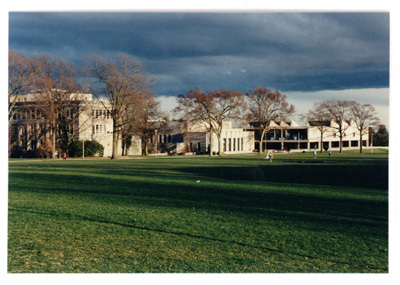
Resting on what is referred to as “the hill” in historic New London, Connecticut, the picturesque campus is located halfway between New York City and Boston and overlooks the Long Island Sound. “What college is supposed to look like,” my father remarked the first time we stepped foot on the green. Our eyes widened to the casual gait of students moving from one class to another, tossing Frisbees across the green, and two dozen more students sitting under a blossom tree by the sun dial, engaged in what was their 2:30 P.M. Writing the Short Story course. Yes, I felt, this isit.
Connecticut College is committed to empowering students to take charge of their own education; the faculty works to provide students with the necessary tools to implement their ideas. My experience with professors goes unmatched. With a student-to-faculty ratio of 10-to-1, I never felt short of attention from professors! It is common for professors and faculty to host students to do everything from watching “Rosewood” and eating nachos, to sitting around a backyard picnic table discussing existentialism, or whether or not our D3 basketball team would make it to this year’s NCAA basketball tournament.
The Connecticut College education in a nutshell? That is the point: There is no nutshell. Each individual brings a different spark to the campus community. Because of this, there are infinite ways any one student can work to take advantage of opportunities such as international study, research with faculty, paid internships, self-designed studies, and community action. While the CC Experience may encompass a set of core values and ideals, opportunities, and experiences each serving as colors on a palette, no one student colors his or her canvas the same. This is the greatest part about CC—you can truly develop yourself as a scholar and as an individual.
The Connecticut College experience is a metamorphosis. Each semester unfolds an organic undergraduate experience for students. As freshmen, CC students may come in wide-eyed and idealistic, questions in hand. As graduates, they leave only to embark on another journey. Now, however, they have the tools to create answers of their own. Nothing could begin to compete with the altruistic qualities of the curriculum at Connecticut College, the spirit of philanthropy among its students and faculty.
Like a pebble tossed in a pond, CC’s ripple effect can be felt literally all over the world. From the Adult Education ESL classes in downtown New London to the maze of streets in Hanoi, Vietnam, where dozens of CC students have completed a Study Away Teach Away semester accompanied by CC professors. Professors conduct research in countries all over the world and an impressive number of students have been able to copublish along with them. Without a doubt, the extraordinary study and work experiences the college offers through its unique centers and programs are what make CC stand out from the rest.
When I first stepped on campus, I had no idea what a carpet ride I would embark on dur- ing the next four years. As an undergraduate, I was able to travel to twelve different countries including Vietnam, France, and Nigeria. If the spine of my college experience at Connecticut College is a liberal arts curriculum, then the flesh is international experience. Still, what makes CC stand out from the rest is just that—each CC experience unfolds for itself, thereby making each CC student a valued part of the greater Connecticut College Camel community.
During the entire college process—from looking at colleges as a junior in high school to facing graduation day as a Connecticut College senior. I asked myself many questions. How do I choose a major? What kinds of people will I spend four years with? Where will I study abroad? How will I be able to take my college education and transform it into an actual job? Honestly, it was through contemplating the core questions of such programs like Freshmen Focus and CISLA, that I continued to realize just how important it is for a student to take authority over his or her education, and to steer and clear his or her own path when necessary. And to know that to assume the role as an educated person means acting responsibly with that education—to question the essence of what and why we learn. Connecticut College fostered so many of my life goals in a few short years. And yet I know none of these experiences would have been possible without the perfect combination of my curiosity and will, and Connecticut College’s plentiful collection of opportunity and encouragement. For this reason, I know I made the right decision in coming to Connecticut College.
Connecticut College Academics
My vision of college was a nebulous one before my freshman year. I never imagined that “learning” could take place while sitting among my classmates in the living room of one of my professor’s houses and discussing issues of the “Other” or the problem of choice in a pluralistic society. I never imagined that so much of my education would be attributed to long talks in dorm hallways late at night while procrastinating challenging assignments. And I surely never imagined that my college experience would endow study abroad or work experiences in a dozen different countries.
Distribution Requirements
Take the liberalin liberal arts college seriously. Students choose from fifty-five majors, with the option of self-designing a major as well. Yet that’s not to say that the academic program falls anywhere short of demanding and powerful. Connecticut College’s academic program within the major is extensive with its requirements. In addition, there are seven General Education requirements (seven courses from seven different academic areas), a language requirement, and a writing across the curriculum requirement.
Students must take a foreign language course at the intermediate level or study a new language for two semesters. Placement at the intermediate level is achieved by passing a college-administered oral and written proficiency exam during orientation. I found that many students took advantage of the plethora of language study programs and services offered by the college (see Study Abroad section).
Some people consider spending a semester or a summer in New York City as an international experience. In many ways I found this to be true while interning at Ms. Magazine in downtown Manhattan for a summer. Professor Blanche Boyd in the English Department and the Office of Career Services helped me earn an internship at the prominent feminist magazine. Suddenly I was in the working world (or at least I was trying it out), and I had research deadlines and editorial meetings where Gloria Steinem would frequently make an appearance. I learned as much from her as I did from the incredibly brilliant staff of women working at Ms. They answered questions I hadn’t even proposed yet about the world.
Connecticut College students have the unique opportunity of applying to a number of centers and programs that are designed to integrate a student’s major with a service project, domestic or international internship, intensive science research, or other technologically advanced research project. This hands-on experience is designed to complement curriculum with practical experience often reserved for graduate students at larger academic institutions. Basically, of all the competitive colleges and universities I looked at as a senior in high school, not one offered such distinct, creative opportunities as the ones described below.
The Toor Cummings Center for International Studies and the Liberal Arts (CISLA)
A Connecticut College gem is its Toor Cummings Center for International Studies and the Liberal Arts, a program to which students apply in the fall of their sophomore year to work toward completing an integrative research project relative to their major. The center funds an international internship the summer before the senior year. In addition, students are required to complete two International Studies courses, with a focus on the following questions: What are the origins and dynamics of contemporary society? What is the relevance of the past in understanding the present and the possibilities of the future? What are the material, spiritual, and ethical challenges of modernity?
The Toor Cummings Center for International Studies and the Liberal Arts is indeed one of the most highly regarded international studies programs in the country. Officially, it aims for its students to leave prepared for a lifelong reflection on study and learning as a journey to wisdom that one shares with others. Unofficially, it is the coolest program at Connecticut College. The plethora of independent research projects can include conducting environmental field research in Bali, researching media studies while interning at CNN in Berlin for a summer, and examining the effects of Amnesty International’s human rights work in Santiago, Chile. These experiences, combined with the solid academic foundation of a liberal arts college, in addition to the large realm of study and work experiences in all parts of the world, surely make for profound, diverse classroom discussions.
The most challenging and rewarding experience I had as a Connecticut College student, by far, was my CISLA internship. As a member of the Center for International Studies and the Liberal Arts, I was able to complete my international internship at the United Nations Development Fund for Women (UNIFEM) in Lagos, Nigeria, where I interviewed women and wrote articles on the various projects that UNIFEM implements in Nigeria and Ghana.
In short, I had a dream internship. Monday through Friday, my host family’s driver would take me to the United Nations headquarters in Lagos. The actual drive was a whirlwind of smoky cars, motorbikes, women holding baskets on their heads, babies crying, kids skipping, adults standing in line at the various European and American embassies, lethargic policemen in military uniforms, and then occasional homeless people on the street asking for money or food. By the time I got to work, my mind was already full. I signed in every day and was handed an “Official Consultant” badge (I never got used to the idea). Nonetheless, I worked at UNIFEM.
Amazed at how the UNIFEM-Lagos team (a staff of eight people) was able to balance friendliness and professionalism in their day-to-day work schedules, I felt immediately comfortable in the work environment. I shared an office with one of the Program Officers, and fortunately I was supplied with a laptop. On my first day at work the Regional Program Director (my boss) said to me, “So why don’t you look through the UNIFEM literature that we have and then make a list of stories you want to write about, people you’d like to interview, and then make a time table for it all—oh and be specific, work on what you’re interested in, because frankly, I don’t want to waste your time.” And so the summer began.
My original CISLA project proposal was to study the dynamics of UNIFEM and the ways in which it promotes growth and empowerment in women in the three areas of governance, economics, and human rights. Really, I was able to see the backstage aspect of development programs and of the United Nations in general. The internship experience was a huge leap in that it gave a practical meaning to my academic major of International Relations. Also, in publishing articles in the UNIFEM monthly publication, The UNIFEM Currents and the United Nations Partnership of Nigeria quarterly magazine, I feel that my writing not only strengthened but that I was able to attain a certain level of legitimacy in my work.
The Ammerman Center for Arts and Technology
Students can weave their academic, personal, and artistic expression together through the college’s Center for Arts and Technology. The Ammerman Center links studio art, music, dance, theater, writing, film, and museum studies with the world of mathematics and computer science. Students study the symbiotic relationship between technology and the arts while exploring such areas as computer graphics, animation, music composition, recording technology, and virtual reality. In addition, students of this center have the opportunity to undertake projects such as designing a program to conduct a virtual music ensemble, exploring 3-D visualization to enhance scientific learning, and designing interactive web sites. Like the other distinguished interdisciplinary centers at Connecticut College, The Ammerman Center offers funded internships. For example, working at a high-technology firm during the summer can complement a student’s key knowledge gained in the way of coursework and involvement in the center.
The Goodwin-Niering Center for Conservation Biology and Environmental Studies
The location of Connecticut College—on Long Island Sound and the Thames River— attracts a faculty that includes some of the world’s leading experts on wetland ecology, water quality, tidal marsh vegetation, and bird migration. Goodwin-Niering Center internships have included studying production and environmental sustainability on an organic banana farm in Costa Rica; studying a component of Vitamin E found in palm oil in Malaysia; and working for the Oregon Environmental Council. Many students choose to use their extensive research experience and copublish their results with faculty members. In the past, students have won environmental awards for their presentations at national conferences.
The Holleran Center for Community Action and Public Policy (CCAPP)
Connecticut College provides a supportive environment in which students take advantage of many volunteer or community service opportunities. Indeed, CC is a school that pushes students to walk their talk, so to speak, when it comes to issues of social justice. With students committing as many as 30,000 hours a year to organizations in the surrounding area, the Holleran Center for Community Action and Public Policy builds on CC’s long- standing tradition of working to address issues of poverty, inequality, and racial/ethnic conflict. This remarkable center also sponsors the Program in Community Action, otherwise known as PICA, which has formed many community partnerships and public policy initiatives with local and national causes and their organizations. Through the Holleran Center, students have completed internships at the Harvard University Medical School, U.S. Department of Housing and Urban Development in Washington, D.C., Save the Children in Bolivia, and the Georgia O’Keeffe Museum in Santa Fe, New Mexico.
Study Abroad
The second semester of my sophomore year I studied abroad in Hanoi, Vietnam, on the SATA program. SATA, the College’s Study Away Teach Away Program, enables CC students to travel to another country and study with CC professors. It is a unique program that works to broaden experiences of both students and professors, with the goal of having them bring back what they learned to the greater CC community. It was through taking classes in government, economics, and even Vietnamese, that my major of international relations was first actualized for me. For the first time I felt I could see the answers to questions we asked in class and the certain effects that a government could have on a nation. From riding my bicycle through the maze of streets on a daily basis to talking to new Vietnamese friends, I felt I was able to gain a greater understanding of Vietnam.
- The Office of National and International Programs
- Whatever happened to regular study abroad? The Office of National and International Programs at Connecticut College helps to place students in a number of different study abroad programs around the world according to their personal and academic interests, independent of the college’s unique centers and programs. These more traditional study abroad programs include L’Institute d’Etudes Européenes in Paris, France; London School of Economics; University of Cape Town in South Africa; or a semester abroad in Sydney, Australia. Other study abroad opportunities take the regularterm to a new dimension however.
The first semester of my junior year I studied abroad in Paris, France through L’Institute d’Etudes Européenes. I learned about this study abroad program through the Connecticut College Office of National and International Programs, which works to place students in a number of different study abroad programs around the world according to their personal and academic interests. While taking courses in the French language and living with a French family, I learned to value the French way of doing things, and I also earned a new perspective on government policy and immigration issues in France. Through an IES program, I had the opportunity of participating in a Model European Union program in Freiburg, Germany. I was able to propose questions to other EU member state leaders and answer on behalf of France’s position. By far, this opportunity served as an eye-opener of the way states interact with each other in the international arena.
- Study Away Teach Away (SATA)
- An unmatched study abroad opportunity offered to Connecticut College students, this program enables students to travel to another country and study withConnecticut College professors. Both students and professors work together to explore the host society, thereby broadening their experiences on a multitude of levels. The greater goal of having them bring back what they learned to the greater college community is icing on the cake. Among students on campus, widely recognized SATA countries include Vietnam, Egypt, Morocco, India, Greece, Italy, and Czech Republic.
- Travel and Research Immersion Program (TRIPS)
- TRIPS, Connecticut College’s Travel and Research Immersion Program, is an unparalleled academic opportunity. This fairly new program allows students and their professors in designated courses to travel outside of the classroom in order to enhance what they are learning in the classroom. Take these words literally: outsideoftheclassroom. TRIPS can take you to Ellis Island for the weekend with an American Literature class, or to Jerusalem for two weeks with an Introductory to Religious Studies class. This is by far one of the most outstanding programs CC offers.
I was fortunate to be able to travel to Spain during Thanksgiving break of my senior year with Professor Kushigian of the Hispanic Studies Department and several classmates as part of our advanced Spanish Literature course, “Orientalism.” While in Madrid, I interviewed an eighty-three-year-old woman who spoke of her experience in the Franco era. She offered a great and serious insight into Spain, as she solidified my own passion for writing and journalism.
Connecticut College Admissions
Admission to Connecticut College is competitive. Know this: the Admissions staff at Connecticut College seeks bright individuals, and they are cognizant that there is more than one way to reveal this. While CC has experienced an increasing number of applications in the last few years, the “criteria” remain such that any dedicated, thoughtful applicant has the opportunity to compete. Connecticut College is looking for students with passion and with a commitment to pursuing academic excellence through a rigorous academic program and selective travel and work experiences.
Common Application
Connecticut College uses the Common Application. A college application is made with the following basic building blocks: Your biographical information and extracurricular activities, a high school transcript, standardized test scores, an essay, recommendations, and perhaps an interview. In addition, each applicant must submit the Supplement to the Common Application. The supplement is due by December 15 with the Common Application and other admission materials due by January 1 with notification by April 1. Submission of the SAT Reasoning Test is optional, but all candidates for admission must choose one of the following testing options: results of three SAT Subject Tests or the results of the American College Testing Assessment (ACT). Beginning with the class of 2010, which marks the introduction of the new SAT with the writing component, either the ACT or two SAT Subject Tests will be required. Submission of SAT scores will still be optional. Interviews are not required but are highly recommended as part of the application process. Interviewers see the conversation as a time to exchange information and personalize what can often seem like an impersonal process to students.
Early Decision
Many of my good friends at CC applied Early Decision. The college offers two Early Decision options, both of which are binding. Early Decision Round I has an application deadline of November 15 with a notification date of mid-December. Early Decision Round II has a supplement deadline of December 15 and all other application materials are due January 1. The notification date for Early Decision Round II is mid-February.
Connecticut College Financial Aid
Connecticut College invests in its students. The Financial Aid Services Office works diligently to make the CC experience affordable to anyone based on need. The entire college works from a foundation of true scholarship; this is evident in the student body. In recent years more than forty-five percent of all Connecticut College students have received financial aid.
Connecticut College Students
Students make or break a college social environment. Nowhere else is this as true as Connecticut College. With students representing forty-five states and thirty-five foreign countries, and approximately ninety-eight percent of undergraduates living on campus, the social scene can be lively and varied. A Friday evening may include attending a dance performance in Cummings Arts Center, followed by a Comedy Club routine in the student center. Parties are to follow, of course, although Saturday night’s roar is usually heard the loudest.
With more than fifty-five student organizations on campus, students never fall short of ways to be involved. If you do, then feel free to start the fifty-sixth student organization! Join Student Government, or the Ballroom Dance Club. Start your own jazz band or contribute to TheCollegeVoice(the college newspaper), or better yet, one of several student-run magazines. Engage in dynamic discussions in La Unidad, the Latino/a-American student organization, or UMOJA (African/African-American student organization). Make your voice heard; participate in Feminist Majority, or pitch in on the college’s own radio station, WCNI-FM.
In addition, the dance, theater, music, and studio art departments pride themselves on outstanding student performances, yet Connecticut College works to include other ways of artistic expression under the umbrella of “the arts.” For example, in recent years film studies, museum studies, architectural studies, and the nation’s first undergraduate certificate program in art and technology are increasingly popular among Connecticut College students. And there are a number of ways to let your creativity flow. Connecticut College hosts a number of guest artists throughout the year as well. Situated between Boston and New York City, Connecticut College rests in a prime spot to attract artists and performers of every kind.
Dorm Life
With ninety-eight percent of Connecticut College students living on campus, and all four classes living together in each student residence, housing is a breeze. The college has no Greek system (no fraternities or sororities) but there are theme houses as well as traditional residence halls. Some of these include Knowlton (cultural/language house), Blackstone (substance-free house), Plant (quiet house), Unity House (multicultural house), Earth House (environmental house), and Abbey House (co-op house). Each of the twenty-one dorms has a Housefellow; basically he or she serves as a person to count on for personal or academic matters or concerns undergrads may have. The College’s Honor Code values come into play in residential life as well.
My senior year I lived in Knowlton Dormitory, an old-fashioned high-ceiling building, now a cultural/language house. Students who wish to immerse themselves in a second language apply to live in the dorm. For example, as a French Studies minor I chose to apply to the French section of the dorm. Although casual, I enjoyed speaking French with the people in my hall and I was submerged in a living environment where hallmates had an appreciation for French culture. The hardwood floors were great, too.
Connecticut College Athletics
Connecticut College is a member of the New England Small College Athletic Conference (NESCAC) and is a Division III member of the National Collegiate Athletic Association (NCAA). The Camels compete in twenty-eight intercollegiate varsity sports (fifteen— women, twelve—men, one coed) including soccer, basketball, hockey, lacrosse, and water polo. Men’s basketball, women’s soccer, women’s rowing, and women’s lacrosse have each qualified for NCAA Championship competition in the past. With a broad range of intramural, club, and athletic sports to choose from, ninety percent of the student body participates in intercollegiate, club, intramural, recreational, or physical educational athletics. In addition to the usual tennis, hockey, golf, and volleyball, other club sports such as Ultimate Frisbee, karate, and cricket are also offered. Nothing beats cheering for the Camels during weekend games for both men’s and women’s soccer and lacrosse, while sitting on the campus green and enjoying a view of the Long Island Sound too.
Connecticut College Alumni
Some of the best mail you’ll ever receive after college comes in the form of Connecticut College Magazine. It’s downright fascinating to see what your fellow grads are up to these days. Without a doubt, they are doing something amazing and demanding. On any given page, I can read about a fellow CISLA (Toor Cummings Center for International Studies and the Liberal Arts) scholar heading a development project in West Africa, or learn news of a CC couple starting a school in western Massachusetts.
The advantage of going to a small school is clear in this regard—the alumni network is booming with successful social and professional relationships. And the pool is so eclectic due to the varied interests of the diverse student body. It is not uncommon to find many double majors, too.
A key benefit of going to a small liberal arts college such as Connecticut College surfaces here. Because your education at CC is so personal and individualized, you are able to gain the skills and make the professional contacts as an undergraduate that will put you ahead of the rest in what is becoming a more and more competitive job search. When applying to any given field—professional and academic—sure enough, you will find a CC alumnus involved in some way. With more than 20,000 alumni and nearly 600 of them living abroad, if you wanted to, say, apply for an international fellowship in Timbuktu, it’s guaranteed that current undergraduates or Connecticut College alumni have been there—and they are willing to help you, too.
CELS
Also willing to help you in your job search is the staff of the college’s Career Enhancing Life Skills (CELS) program. They provide everything from résumé writing one-on-one conferences, workshops on job search-related skills, as well as a number of resources and alumni contact information for specific fields of interest. In addition, CELS offers a unique e-Portfolio system that allows students to keep an on-line record of their career and academic planning processes and accomplishment during their undergraduate years at Connecticut College. This creative and sophisticated manner of documenting academic information as well as cocurricular experiences serves as a vital tool in the job search.
Connecticut College students are doing meaningful work in their fields, and are often publishing or presenting the results before they go on to graduate school or their first real job. Funded internships, international study, the use of technology, and collaborative research with other students and faculty all help to build résumés for Connecticut College students before they graduate. An impressive number of graduates choose to pursue competitive post-graduate programs such as the Thomas J. Watson Fellowship, the Fulbright, the Peace Corps, or Teach for America, thereby continuing their adventure in education.
Other graduates pursue fields such as medicine/science, law, journalism, fine arts, education, and business. With a strong liberal arts background developed in classrooms, in extracurricular activities, in conversations with professors and debates over dinners, in venues across campus and around the globe, students acquire the ability to see the particular as part of a larger phenomenon, to understand people from different backgrounds and cultures, to acquire skills in negotiation and problem-solving and to critically evaluate new ideas. These are skills that make CC alumni valuable in whatever profession they choose. The value of a liberal arts degree from Connecticut College lasts a lifetime.
Prominent Grads
- James Berrien ’74, President, Forbes Magazine Group
- Allen Carroll ’73, Chief Cartographer, National Geographic
- Michael Collier ’76, Poet Laureate of Maryland and Director of the Bread Loaf Writers’ Conference
- Anita DeFrantz ’74, Olympic Medallist and Member of the International Olympic Committee
- David Foster ’77, Ecologist, Author, and Director of the Harvard Forest
- Agnes Gund ’60, President Emerita, The Museum of Modern Art
- Bruce Hoffman ’76, Terrorism Expert, Rand Corporation
- Peter Som ’93, Fashion Designer
- Susan Kronick ’73, Vice Chairman, Federated Department Stores
- Dr. S. Harvey Moseley Jr. ’72, Senior Astrophysicist, NASA Goddard Space Flight Center
- Estelle Parsons ’49, Academy Award-winning Actress and Artistic Director of The Actors Studio
- Dr. Ellen Vitetta ’64, Cancer Researcher and Director of the Cancer Immunobiology Center at the University of Texas
- Patricia Wald ’48, Former Chief Judge on the U.S. Court of Appeals (D.C.)
- Amy Gross, Editor-in-Chief, O, The Oprah Magazine
Information Summary
Ranks 65th overall and 4th in Connecticut
| Overall Score
On StateUniversity.com (about) |
96.0 |
|---|---|
| Total Cost
On-Campus Attendance |
$2,300 |
| Admission
Success rate |
38% |
| ACT / SAT
75 %ile scores |
29 / 1420 |
| Student Ratio
Ratio of students to faculty |
9 : 1 |
| Retention
(Full-Time / Part-Time) |
91% / N/A |
| Enrollment
Total (all students) |
1,886 |
Demographics – Main Campus and Surrounding Areas
Reported area around or near New London, CT 06320
| Surrounding community | Small city (inside urban area, pop. under 100,000) |
|---|---|
| Total Population | 25,671 (25,671 urban / N/A rural) |
| Households | 10,181 (2.26 people per house) |
| Families | 5,386 (3.0 people per family) |
| Pop. — African American | 5,597 |
| Pop. — Asian | 747 |
| Pop. — Pacific Islander | 84 |
| Pop. — American Indian / Alaskan Native | 589 |
| Pop. — White (incl. Hispanic) | 17,342 |
| Pop. — Other | 2,947 |
Carnegie Foundation Classification
Baccalaureate Colleges — Arts & Sciences
| Undergraduate | Arts & sciences focus, no graduate coexistence |
|---|---|
| Graduate | N/A |
| Undergraduate Population | Full-time four-year, more selective, lower transfer-in |
| Enrollment | Very high undergraduate |
| Size & Setting | Small four-year, highly residential |
General Characteristics
| Highest offering | Master's degree |
|---|---|
| Calendar System | Semester |
| Years of college work required | N/A |
| Variable Tuition |
Special Learning Opportunities
| Distance Learning | |
|---|---|
| ROTC — Army / Navy / Air Force | |
| Study Abroad | |
| Weekend College | |
| Teacher Certification |
Student Tuition Costs and Fees
What are the typical tuition costs and fees for attending Connecticut College?
Ranks 4164th for total cost of attendance
| In District | In State | Out of State | |
|---|---|---|---|
| FT Undergraduate Tuition | N/A | N/A | N/A |
| FT Undergraduate Required Fees | N/A | N/A | N/A |
| FT Undergraduate Comprehensive Fee | $46,675 | $46,675 | $46,675 |
| PT Undergraduate per Credit Hour | $1,084 | $1,084 | $1,084 |
| FT Graduate Tuition | $9,300 | $9,300 | $9,300 |
| FT Graduate Required Fees | N/A | N/A | N/A |
| PT Graduate per Credit Hour | $388 | $388 | $388 |
| Total Cost of Attendance — On-Campus | $2,300 | $2,300 | $2,300 |
| Total Cost of Attendance — Off-Campus w/out Family | $900 | $900 | $900 |
| Total Cost of Attendance — Off-Campus with Family | $900 | $900 | $900 |
Student Tuition Cost History and Trends
Three year history and trends on the cost of attending
| In District | In State | Out of State | |
|---|---|---|---|
| Published Tuition & Fees | N/A |
N/A |
N/A |
| Comprehensive Fee | $41,975 |
$41,975 |
$41,975 |
| Cost (regardless of residency) | |||
|---|---|---|---|
| Books & Supplies | $900 |
||
| On-Campus – Room & Board | N/A |
||
| On-Campus – Other Expenses | $1,400 |
||
| Off-Campus w/out Family – Room & Board | N/A |
||
| Off-Campus w/out Family – Other Expenses | N/A |
||
| Off-Campus with Family – Room & Board | N/A |
||
Admission Details
| Application Fee Required | N/A |
|---|---|
| Undergraduate Application Fee | $60 |
| Graduate Application Fee | $60 |
| First Professional Application Fee | N/A |
| Applicants | 4,278 (1,565 male / 2,713 female) |
| Admitted | 1,624 (649 male / 975 female) |
| Admission rate | 38% |
| First-time Enrollment | 491 (197 male / 294 female) |
| FT Enrollment | 491 (197 male / 294 female) |
| PT Enrollment | N/A (N/A male / N/A female) |
| Total Enrollment | 1,886 |
Admission Criteria
What criteria does Connecticut College use for admissions?
| Open Admissions | |
|---|---|
| Secondary School GPA / Rank / Record | |
| College Prep. Completion | |
| Recommendations | |
| Formal competency demo | |
| Admission test scores | |
| TOEFL | |
| Other tests | N/A |
Admission Credits Accepted
What types of credits does Connecticut College accept?
| Dual Credit | |
|---|---|
| Life Experience | |
| Advanced Placement (AP) |
Athletics - Association Memberships
| Sports / Athletic Conference Memberships | NCAA |
|---|---|
| NCAA Basketball Conference | New England Small College Ath Conf |
| NCAA Track & Field Conference | New England Small College Ath Conf |
ACT Test Admission
Ranks 133rd for 75pctl scores
| Applicants submitting ACT results | 32% |
|---|---|
| Verbal scores (25/75 %ile) | / |
| Math scores (25/75 %ile) | / |
| Cumulative scores (25/75 %ile) | 25 / 29 |
SAT Test Admission
Ranks 61st for 75pctl scores
| Applicants submitting SAT results | 37% |
|---|---|
| Verbal scores (25/75 %ile) | 620 / 720 |
| Math scores (25/75 %ile) | 610 / 700 |
| Cumulative scores (25/75 %ile) | 1230 / 1420 |
Student Services
| Remedial Services | |
|---|---|
| Academic / Career Counseling | |
| PT Cost-defraying Employment | |
| Career Placement | |
| On-Campus Day Care | |
| Library Facility |
Student Living
| First-time Room / Board Required | |
|---|---|
| Dorm Capacity | 1,740 |
| Meals per Week | 20 |
| Room Fee | N/A |
| Board Fee | N/A |
Student Financial Aid Details
How many students use Financial Aid, and how much do they use?
Connecticut College Ranks 2692nd for the average student loan amount.
| Average | Users | % of Attendees | |
|---|---|---|---|
| Federal Grant Aid | $5,261 | 42 | |
| State & Local Grant Aid | $4,115 | 31 | |
| Institutional Grant Aid | $22,523 | 175 | |
| Student Loan Aid | $3,996 | 161 | |
| Any financial aid type | 216 |
Student Enrollment Demographics
How many students are enrolled at Connecticut College?
| Men | Women | Total | |
|---|---|---|---|
Non Resident Alien | 44 | 63 | 107 |
Black Non-Hispanic | 30 | 39 | 69 |
Hispanic | 39 | 61 | 100 |
Asian / Pacific Islander | 20 | 45 | 65 |
American Indian / Alaskan Native | 2 | 1 | 3 |
White Non-Hispanic | 563 | 841 | 1,404 |
Race Unknown | 50 | 88 | 138 |
| Total | 748 | 1,138 | 1,886 |
Student Graduation Demographics
How many students graduated at Connecticut College?
| Men | Women | Total | |
|---|---|---|---|
Non Resident Alien | 21 | 18 | 39 |
Black Non-Hispanic | 3 | 11 | 14 |
Hispanic | 2 | 10 | 12 |
Asian / Pacific Islander | 6 | 5 | 11 |
American Indian / Alaskan Native | 1 | 1 | 2 |
White Non-Hispanic | 153 | 238 | 391 |
Race Unknown | 3 | 4 | 7 |
| Total | 189 | 287 | 476 |
Most Popular Fields of Study
The top 5 fields of study completed at Connecticut College.
| Men | Women | Total | |
|---|---|---|---|
| 18 | 30 | 48 | |
| 22 | 18 | 40 | |
| 5 | 32 | 37 | |
| 9 | 26 | 35 | |
| 21 | 8 | 29 |
Student Completion / Graduation Demographics
How many students are successful graduates?
Faculty Compensation / Salaries
Connecticut College Ranks 496th for the average full-time faculty salary.
| Tenure system | |
|---|---|
| Average FT Salary | $71,093 ($75,930 male / $65,019 female) |
| Number of FT Faculty | 194 (108 male / 86 female) |
| Number of PT Faculty | 58 |
| FT Faculty Ratio | 3 : 1 |
| Total Benefits | $3,747,541 |


Comment and Corrections Make a comment …
Familiar with this University? We would love to hear about your experience. Feel free to add comments or additional information regarding Connecticut College.
about 1 year ago
Paul luckyguypaul ((at)) aim dot com
I graduated with a double-major in 2003. The faculty and staff are fully devoted to serving the academic and developmental needs of the students. A student who wants to take full advantage of what's available in terms of courses, career services, special programs and certificates, study abroad, and specialty dorms would have a wonderful experience. The limitations are related to the location (it's between Boston and New York, so it's possible to go to those places, but there isn't much to do in the New London area per se). Also, if your SAT scores were above 1400, you may find your peers to not be intellectually provocative. This is off-set by the fact that the students tend to have agreeable personalities, liberal values, and to be, generally speaking, "good citizens," so it would be easy to make friends and to have a favorable social experience. The intellectual level of the courses, is excellent, and many of the professors come from excellent academic backgrounds and actively publish. When I was there, the Psychology, Chemistry, Dance, and Economics departments stood out as very strong, although I am sure that there are other departments that are excellent. The college emphasizes multiculturalism, human rights, and is highly progressive; again, because of it's location, it has difficulty attracting as many minority students as it would like to, although strong efforts are constantly being made. One of the best things about the college is that it does not have a fraternity/sorority system, which makes the social environment much more congenial and good-natured. The campus is simply gorgeous. Did I mention that students get individual rooms after the first year?