StateUniversity.com – U.S. University Directory [ Home :: University List :: Massachusetts ]
Waltham, MA 02454-9110
p. 781-736-2000
w. www.brandeis.edu/
Brandeis University
General Information, Alumni, History, Campus, Students, Faculty, Address, and Tuition
- Latest News: Brandeis U. professor's book on shocking cartoons censored
- College and University Blog with many tips like acing the ACTs, SATs, college admissions, and preparing for college.
- University Forum and Discussion - Brand New Message Board For All Your Questions
- Information on Thousands of Careers - One-stop resource for very comprehensive, and up-to-date career information. Contains more than several thousand job profiles each with a job description, education and training requirements, salary information, working conditions, employment outlook and much more!
- Student Encyclopedia - Encyclopedia for reference and research from the Cambridge Collection.
Brandeis University Introduction
Founded in 1948, Brandeis is one of the youngest top-tier universities in the nation that is rated most competitive. In this respect and others, Brandeis has achieved in decades what other universities have taken centuries to accomplish. The university is named for the late Louis Brandeis, the first Jewish associate justice of the United States Supreme Court, and reflects the ideals of academic excellence and social justice he personified. These principles continue to shape every aspect of the university’s character.
One of the many reasons Brandeis has rapidly risen through the ranks is because its founders, including Albert Einstein, modeled it after the best of three centuries worth of American colleges and universities. It balances the feel of a small liberal arts college with the resources and faculty of a major research university. As a result, Brandeis students not only have remarkable faculty, but they actually have the opportunity to create personal and close working relationships with them, something few other colleges can offer to the same degree.
This balance between a small liberal arts college and large research university is reflected again in both Brandeis’s student population and its location. The Brandeis paths are filled with familiar smiles, but the undergraduate population is big enough to meet new people daily. While the community is fairly small, every state and over one hundred countries are represented at Brandeis. Since more than eighty percent of students live on campus, there is extraordinary exposure to a wide variety of different cultures, backgrounds, and perspectives. The campus is surrounded by the safe streets and great restaurants of Waltham, Massachusetts, but with easy access to Boston, including free shuttles and a train stop adjacent to campus, giving students the best of the big city as well.
No description of Brandeis would be complete without paying homage to the rich activist history and to the student body’s dedication to social justice. Brandeis was a frequent destination of Martin Luther King Jr and others during the civil rights movement because of its activism. Brandeis students led the National Student Strike to protest American Foreign Policy during the Vietnam War. The history of Brandeis is filled with passionate students advocating change. The traditions of social activism and social services continues today.
Brandeis students work hard and play hard. While Brandeis has been able to rise through the ranks with the highest of academic standards, extracurricular activities, athletics, and parties have a presence on campus that can entangle even the strongest of wills. One factor that distinguishes extracurricular life at Brandeis from many other schools is that while nearly every conceivable interest is available on campus, students can be actively involved in multiple activities, not just one: A student can be an editor of The Justice, the independent student newspaper, play soccer with the Brandeis Football Club, and be a class senator, all at the same time. If you matriculate to Brandeis, regardless of your major you will attend at least one Pachanga—a clublike party put on by the International club that frequently attracts well over a third of the student body—see the stat- ue of Louis Brandeis transmogrified into a variety of different characters such as a giant chick- en or WWF wrestler during your stay, and sled down a snowy hill on a cafeteria tray in the dead of winter.
The founders of Brandeis succeeded in creating a university modeled after the best parts of other universities. Strong academics, a commitment to social activism, a robust student life, and a great community all contribute to the wonderful experiences and bountiful opportunities Brandeis offers. While other universities have multiple-century head starts, Brandeis continues to rise because of the quality of the experience.
While most American universities were named for a location or major benefactor, Brandeis was given its name seven years after Justice Louis Brandeis died. He is the namesake solely for who he was and the ideals for which he stood. In design, Brandeis was modeled after the best parts of the best American colleges and universities. The founders managed to combine the best qualities of location, size, offerings, and campus life to maximize the university’s potential. As a result, in its short life span it has been able to create an experience that places it among the best colleges. The university fully embraces the mission of a liberal arts college with renowned research. The success of its graduates is perhaps the best indicator. A Brandeis degree can take its graduates anywhere they want to go. While not a household name in America, it is a name that is known and respected in both academic and professional circles. It is a name that allows its graduates to compete for the most sought-after jobs and most selective graduate schools. However, the value of a college experience is not in the diploma that hangs on the wall; it is based on the quality of the experience.
Brandeis University Academics
Academic life is one of the aspects of Brandeis that make it really shine in comparison to other top-rated colleges and universities. Brandeis attracts the most prestigious professors because of the attractiveness of its resources as a research institution. In a major study of higher education, “The Rise of American Research Universities” by Graham and Diamond, Brandeis was named the number one rising research university in the nation. When normalized for size, the Brandeis faculty rank number two out of the 3,000 colleges in the United States in the percentage of faculty who are members of the top three scholarly societies in America, namely the Academy of Science, the American Academy of Arts and Sciences, and the American Association for the Advancement of Science. However, prestigious faculty are not the only factors in making Brandeis stand out: The intimate learning environment that students share with their accomplished professors is exceptional. Other universities may have prestigious faculty, and other liberal arts colleges may have small classes, but having top professors in a small classroom is a rare luxury.
The one-on-one experiences with professors are really what makes the Brandeis experience special. I was able to attend a conference on Civic Engagement with one of my professors and at the conference present a paper I wrote to his peers. While a grad student is frequently common, my thesis advisor was also the chair of the department. The relationships with professors and peers contributed to the best learning experiences of my life.
This dynamic between professor and student translates into the classroom and beyond. World-renowned professors doing research at a university with small classes means exceptional research opportunities. Brandeis offers first-year students the unusual opportunity to be able to participate in a research lab assisting professors. Through students’ stays at Brandeis they are presented with a number of opportunities to participate in research with their professors. Some examples that extend beyond the lab include working with national and international organizations and traveling to other countries to assist in the field. The product of this cooperation between professor and student is an opportunity-filled academic experience. Brandeis is the youngest institution to earn recognition by Phi Beta Kappa, in part, because of this successful dynamic.
The Curriculum
The College of Arts and Sciences (CAS) is the core of the University. CAS is comprised of twenty-four departments and twenty-four interdepartmental programs, which offer thirty-nine majors and forty-four minors. The departments and interdepartmental programs are divided among four schools forming broad groupings among the disciplines: the School of Creative Arts, Humanities, Science, and Social Science. Interdepartmental programs provide structured opportunities to explore areas of study that are interdisciplinary in scope. The broad range of departments and interdepartmental programs offer students and faculty the opportunity and formal structures needed to explore fields in-depth and across disciplines. The structure and offerings of CAS encourage and inspire students and faculty to pursue a true liberal arts education through university requirements and continuing research endeavors. The CAS’s offerings are bolstered by the university’s established graduate schools whose classes are open to undergraduates.
This broad range of offerings provide classes in almost every conceivable discipline. For students who aren’t sure what they want to major in, Brandeis provides variety that smaller liberal arts colleges can rarely offer. For students who know (or think they know) exactly what they want to major in on their first day of class, the depth of the course selection will more than fulfill their interests.
Requirements
Flexibility and an interdisciplinary approach characterize the entire curriculum at Brandeis. Studying ideas from a variety of academic perspectives gives you the ability to form your own critical viewpoint and synthesize knowledge in new ways. To earn a Bachelor of Arts or Bachelor of Science degree at Brandeis, students must complete thirty-two semester courses, which include the required courses of your major and the general university requirements:
- One university seminar
- Three writing-intensive courses (one of which may be a writing-intensive university seminar)
- One quantitative reasoning course
- A three-semester foreign language sequence (or the equivalent)
- One course in nonwestern and comparative studies
- Two semesters of physical education
- At least one course from each of the four schools at the university—Humanities, Social Science, Science, and Creative Arts. (Courses taken to fulfill requirements listed above may also count for this requirement.)
The University Seminar in Humanistic Inquiries (USEM) is a hallmark of the Brandeis curriculum, designed specifically for first-year students and intended as a foundation for their studies at Brandeis. USEMs are small seminar-style classes, taught by distinguished faculty. They are interdisciplinary in subject matter and develop critical thinking and writing skills through close analysis of significant texts. They typify the intimate classroom environments with accomplished faculty that Brandeis works hard to create.
At Brandeis, you can design an academic structure for yourself, combining majors and minors that can either focus your interests through a multidisciplinary approach to a particular area of study, or broaden your view by exploring an eclectic array of interests in a personal journey of academic discovery. It is possible to earn two degrees simultaneously—a dual bachelor’s/master’s degree—in most programs at Brandeis that offer graduate study.
Brandeis also has an expansive study abroad program. It is not required, but more than twenty percent of juniors study abroad. Brandeis offers students from all majors opportunities to study in more than sixty-two countries, in many centers of learning that have centuries-old reputations for academic excellence.
Brandeis’s requirements are not difficult to fill. Courses can double count for the core curriculum, distribution, and concentration requirements. This allows for many courses taken to be elective courses. In comparison to other universities, Brandeis’s requirements are light, but they ensure that students leave with a true liberal arts education.
Creative Arts
Students interested in the arts will find a supportive community with top-notch resources. Brandeis’s music department was founded by Leonard Bernstein and there are seventy musical performances annually. The theater department hosts six major productions each year and several student-run theater groups put on productions each semester as well. With two major state-of-the-art theaters (one opened last year) and several minor spaces, the university has quality theater resources. The Rose Art Museum, an art destination of many Bostonians, is located on campus, making museum openings especially convenient for Brandeis students. The museum boasts the largest, finest, and most comprehensive collection of twentieth-century modern and contemporary art in New England. Beyond the museum, the campus is dotted with sculpture by professionals and students alike year-round through permanent exhibits and art festivals.
The college experience can in many ways teach you more than your classes. Brandeis’s supportive environment, so full of opportunities, virtually assures that you will maximize your college experience.
Brandeis University Admissions
The Brandeis admissions process is designed to attract exceptional students with a broad range of interests and backgrounds. Brandeis looks for accomplished students who possess special talent or individuals who have used their resources well. Brandeis seeks students who are best prepared to embrace the university’s academic rigors and contribute to campus life in diverse ways.
Qualified candidates tend to take the most challenging courses their secondary schools offer. The Admissions Office looks closely at involvement with Advanced Placement and Honors classes. The admission committee carefully considers recommendations from professors, headmasters, or other mentors. They are also interested in applicants’ extracurricular involvement and/or volunteer work.
Admission into Brandeis is very competitive. Approximately ninety-three percent of Brandeis matriculants are from the upper quintile of their high school class and the median SAT score is 1367 (based on 1600). In a recent year, Brandeis had approximately 7,600 applicants and each undergraduate class is comprised of only 700–750 students. If Brandeis is your unwavering first choice you will find yourself in good company upon arrival. Last year, approximately twenty percent of the incoming students were accepted Early Decision.
The Office of Admissions
The members of the Admissions staff at Brandeis are very friendly and helpful. They know applying to college can be stressful, so they do what they can to make it as “applicant-friendly” as it can be. Tours are offered year-round and are given by student volunteers who try to give prospective students and their families a feel for life on campus. Visitors can sit in on classes and can stay overnight with student hosts. The university also hosts a yearly Open House that exhibits a sample of life at Brandeis through discussion panels with professors, a mini club fair, and presentations on what prospective students might expect.
The Application
The application attempts to glean the most information it can from applicants while steering clear of unnecessary forms or requirements. Brandeis accepts the Common Application on-line and in hard copy.
The university pays close attention to the secondary school record and, in general, recommends a course of study that includes the following:
- Four years of English
- Three years of foreign language (including, whenever possible, study in your senior year)
- Three years of college preparatory mathematics (prospective science concentrators should study mathematics for four years)
- A minimum of one year of science
- A minimum of one year of history
Aside from a student’s academic record, Brandeis requires the following four components from students who are applying:
- SAT and two SAT Subject tests OR the ACT
- An essay
- Two letters of recommendation
- An interview (recommended)
Academic records and standardized test scores should be taken seriously because they are an important tool for admission; however, Brandeis is looking for students who have more depth than these numbers alone might communicate. Recommendations and the personal statement are important windows for the Admissions Office into the character of applicants. A strong recommendation and well-written personal statement will add depth to your application and, in turn, the Admissions Office’s understanding of you.
Brandeis encourages but does not require a personal interview with a member of the admissions staff. Meeting with an admissions officer gives applicants a chance to learn more about specific opportunities of personal interest at Brandeis. At the same time, the interview lets an admissions officer get to know an applicant better by giving applicants an opportunity, through informal conversation, to communicate aspects of themselves that may not have an appropriate outlet in the written forms and school transcripts. If an on-campus interview is not possible, applicants can arrange to meet with an alumni admissions counselor. Alumni conduct interviews on campus and in cities throughout the world, and communicate their impressions to the Brandeis Admissions Office.
Finally, Brandeis has a need-blind admissions policy. This means that applying for financial aid does not influence Brandeis’s decision regarding a domestic student’s admission to the university during the Early Decision and Regular Decision admissions cycle. The Brandeis Office of Admissions reaches its decision, then notifies the Office of Financial Aid if the student has been admitted. Even Brandeis’s admission policies reflect the philosophies its founders set forth. The university is committed to bringing together a student body that embodies excellence, social activism, inclusiveness, and a reverence for learning regardless of financial background.
Brandeis University Financial Aid
Approximately sixty percent of incoming undergraduates received some form of need-based financial aid during a recent academic year. Need-based financial aid is a combination of loans, work-study, and grant awards that are offered to students whose families demonstrated financial eligibility for assistance. Need-based aid is available from federal, state, and private sources, including Brandeis. To apply for need based financial aid, students must submit the CSS/Financial Aid PROFILE and, if applicable, the Business/Farm Supplement and Noncustodial Parent’s Statement along with their application.
In addition to its deep commitment to need-based financial aid, the university maintains its own strong scholarship program. Brandeis scholarships are based primarily on academic merit and are used to enroll the very best class possible with the scholarship funds available. To be eligible, applicants must complete the CSS Profile.
Financial aid counselors work with students and their families to create a financial aid package that suits their needs. If necessary, they help find additional scholarships or loans to supplement Brandeis grants. Approximately 200 students in a recent first-year class of 837 received scholarship awards ranging from $5,000 per year for four years, up to $27,000 per year for four years. In a recent year Brandeis awarded undergraduate students more than $27.9 million in scholarship/grant assistance.
Brandeis University Students
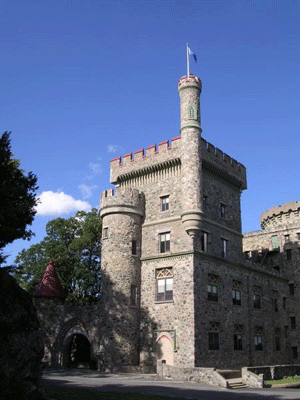
Central Perk, the coffee shop in the Emmy Award winning show “Friends” (created and produced by Brandeis graduates Marta Kauffman ’78 and David Crane ’79) is modeled after Cholmondeley’s, the campus coffeehouse at Brandeis. How many colleges have a social scene that receives nods on prime-time television weekly (daily if you include reruns)? It is located in Brandeis’ genuine castle that serves as a residence hall for upperclass students and whose unique wedge-shaped rooms overlook Boston. While students probably won’t see Jennifer Anniston or King Arthur on campus, students have a good chance of finding lifelong friends, their knight in shining armor, and much more.
Residence Life
Although students visit Boston many times during their four years at Brandeis, most are quite content to stay on campus because it is almost always bustling with activity. Approximately ninety-nine percent of first-years and eighty-two percent of all students live on campus in Brandeis’s twenty-four residence halls in nine quads. Rooms range from traditional dorm rooms (lofted rooms and doubles) to suites, townhouses, and apartments. First-year students at Brandeis are housed either in Massel or North Quadrangle, right on campus, convenient to classroom and dining options. Each quad is supervised by a professionally trained director, assisted by resident advisors who are upperclass Brandeis students. Most residence halls are coed, though single-sex areas are available. First-year students are housed in either double or lofted rooms. Upperclass students are eligible to live in single rooms, suites, or apartments, including the castle. Part of the reason campus living is so popular is because more than half of the rooms on campus are singles. A brand-new residence hall housing 220 students is scheduled to open in the fall of 2003—perfect timing for the lucky incoming class.
In the residence halls a variety of programs are offered—movie nights, ice cream parties, and informational talks on subjects such as safe sex, current events, and local issues. Big screen TVs, kitchens, and foosball tables can be found in nearly every quad lounge, which are popular hang-out spots well into the wee hours of the morning. In first-year quads, milkshakes, smoothies, and snacks are also available well into the night. Most students become confident that the quad, building, and even the hall they live in is the best in the university. Playing fields and basketball courts are adjacent to many of the residence halls, creating a perfect environment for pick-up games at virtually any hour. Every dorm room is equipped with a high-speed Internet connection, ideal for accessing multimedia, playing multiplayer computer games, or accessing Brandeis’s 1,000 electronic journals and publications.
Dining
It will probably be difficult to find college food that is as good as home cooking, but Brandeis will certainly give your folks a run for their money if not for the food, for the convenience. Usdan Cafe and The Boulevard, located in the Usdan Student Center offer cook-to-order, “grab-and-go stations,” and late night pizza delivery. If students are really hungry, they can go to Sherman Dining Hall’s all-you-can-eat facility, which serves both kosher and nonkosher foods. All the dining locations provide generous vegetarian options and a station in Sherman always provides vegan food. Brandeis accommodates every dietary restriction; students need only speak with the dining staff. Some dining options include the ability to order from off-campus restaurants such as Dominoes. By using “Who Cash” in participating area restaurants, students add even more variety to the Brandeis diet.
The newly renovated “Stein,” located above the Sherman Dining Hall, is a modern pub serving lunch and dinner entrees, as well as sandwiches, soups, salads, and homemade desserts. Students can celebrate their twenty-first birthday at The Stein with a sampling from a microbrewery or a glass of wine. Weekly Stein nights are hosted by various campus organizations and usually pack the house providing one of many outlets for the university’s academic rigors.
Clubs and Organizations
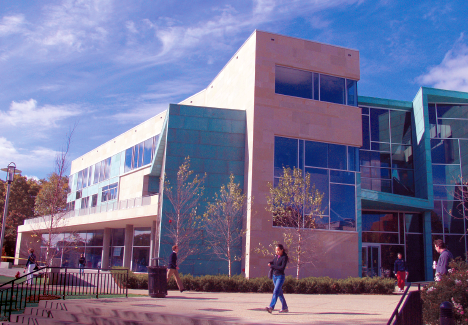
The new Carl and Ruth Shapiro Campus Center, a $25 million addition to Brandeis’s already dynamic campus, is the hub for student activity on campus. Open around the clock, seven days a week, it houses a cafe, a state-of-the-art student theater, lounges, function rooms, computer clusters, and offices for student organizations, all built around a soaring art-filled atrium.
At most campuses students must choose between serious involvement in one club or involvement in many with a selection of clubs to choose from. For example, at a big school being an editor of the student newspaper is often the exclusive post a student can hold. In contrast, a small school might welcome participation in many clubs, but might not have a selection that includes a radio station or the resources a bigger school might have to make the experience as worthwhile. Brandeis manages to deftly walk this line, making clubs and organizations an exceptionally popular outlet to have fun and learn. With more than 175 clubs and organizations, it is safe to say that every student participates in club life in some way.
It seemed that there was always something happening on campus. Whether it was a famous speaker, a club meeting, a party, an a cappellaperformance, or a rally, there was always some event to go to.
Students can write for The Justice, the independent student newspaper, or one of the ten other student publications. They can join the campus radio or television station and host a live talk show. They can join the debate team and win first place again in North American parliamentary debate. Students who dare can go skydiving, scuba diving, or mountain climbing all with a full or partial subsidy from Brandeis. The entertainment of theater groups, comedy troupes, and about a dozen a capella groups is enjoyed daily. Multicultural events fill the academic calendar and add richness to campus life. They include: Asian Awareness Week, Black History Month, Caribbean Week, Chinese New Year, Culture X, Hispanic Heritage Month, Kwanza, Mela, and the Vietnamese Spring Festival. Dozens of athletic clubs provide instructors that will show students how to improve their game in everything from rugby and Ultimate Frisbee to Tae Kwon Do and kick boxing. Religious groups provide everything from a gospel choir and Friday night shabbat dinners to a Muslim prayer room.
When Charlton Heston visited campus, I can still remember that well over 1,000 students were either standing in line for the event, chanting in protest or support, or pretending to lie dead on the ground with blood-stained shirts to dramatize gun violence. The best part was after he left when students and NRA members engaged in long and productive discussions about gun rights and gun control. The event really captured both the openness to ideas and dedication to fostering dialogue that Brandeis cherishes.
With almost two dozen activist groups, students will find a strong and active community with a great history of national advocacy. Brandeis students led The National Student Strike against the Vietnam War and convinced the Board of Trustees to be one of the first universities to divest from apartheid South Africa.
Brandeis University Athletics
Brandeisians love athletics. If you are looking for Division I athletics Brandeis is not for you, but if you are merely looking to enjoy either competitive or recreational play Brandeis will more than suit your needs. More than 1,000 students participate in intramural and club sports every year. Brandeis has ten men’s varsity sports, ten women’s varsity sports, and one coed team (sailing). The Gosman Center is one of the largest multipurpose indoor athletic facilities in the East. It has a 70,000-square-foot field house; a 200-meter six-lane track, three indoor tennis courts, ten outdoor tennis courts, squash courts, weight training rooms, and fencing, dance, and aerobic facilities.
Brandeis University Local Community
Brandeis is in the city of Waltham, an inner suburb of Boston, located nine miles upstream on the banks of the Charles River. The city is a popular dining location for residents of Boston and Brandeis students alike because of the wide variety of ethnic restaurants in its downtown. A cinema in town, specializing in independent and foreign films allows students to catch the best of Sundance as well as French, Italian, and Japanese films. For students who would like to spend some time in a big city, Boston is just a shuttle ride or commuter rail away. An on-campus commuter rail stop provides access to the Boston subway system all day seven days a week. Starting Thursday and running until Sunday, Brandeis provides free shuttles to and from Cambridge and downtown Boston.
Brandeis University Alumni
The ability to think creatively, solve problems logically, and communicate effectively defines a liberal arts education. A bachelor’s degree from Brandeis signifies exceptional achievement in all of these skills compounded with a commitment to social justice. The successes of Brandeis alumni suggest that this is a winning formula.
Alumni can be found in nearly every profession or field of work. Notably, eighteen alumni serve as presidents of colleges or universities in the United States or abroad. Ten percent of Brandeis alumni are physicians. Brandeis graduates are presidents of fifty hospitals or HMOs. Of the 2,300 Brandeis alumni in the legal profession, seventy-five are district attorneys and thirty have gone on to become judges.
Brandeis graduates are among the highest echelons of graduate school applicants. In a recent year, Brandeis seniors achieved an eighty percent acceptance rate to medical school, while the national average is forty-seven. They also enjoyed a ninety-four percent acceptance rate to law school, besting the national average of seventy-eight percent. Brandeis graduates were accepted to an average of four law schools of their choice, as compared to the national average of 2.3.
Prominent Grads
- Mitchell Albom, ’79 Author of Tuesdays with Morrie
- Paula Apsell, ’69 Executive Producer of “NOVA”; Winner of Eight Emmy Awards
- Angela Davis, ’65 Civil Rights Activist
- Thomas L. Friedman, ’75 Foreign Affairs Columnist for The New York Timesand Winner of Three Pulitzer Prizes
- Ellen R. Gordon, ’65 President of Tootsie Roll Industries
- Christie Hefner, ’74 Chair of Playboy Enterprises
- Abbie Hoffmann, ’59 Civil Rights Activist
- Margo Jefferson, ’68 Theater Critic for The New York Times; Winner of the Pulitzer Prize for Distinguished Criticism
- Marta Kauffman, ’78, David Crane, ’79 Creators, Writers, and Executive Producers of Emmy Award-Winning “Friends”
- Debra Messing, ’90 Costar of NBC’s “Will & Grace”
- Letty Cottin Pogrebin, ’59 Author and Political Activist; Founder of Ms. Magazine
- William Schneider, ’66 Senior Political Correspondent for CNN
- Judith Shapiro, ’63 President of Barnard College
- Stephen Solarz, ’62 Former Member of U.S House of Representatives
One small part of graduates’ success is the assistance they receive from the Hiatt Career Center. It provides career counseling and a range of services for undergraduates and alumni. It directs students to internships related to their interests during the academic year and throughout the summer. The Center hosts Alumni Network Events at Brandeis during which students can meet with alumni to explore a wide variety of postgraduate careers; a Shadow Program allows students to spend a day in the workplace with a Brandeis graduate to explore a particular career field; the Hiatt Alumni Career Network gives students access to thousands of alumni volunteers who offer to share advice about utilizing a liberal arts degree in a broad variety of careers; and Alumni Network Events on campus and in New York offer prearranged interview days in Boston, New York, and Washington, D.C. Beyond all this, Hiatt offers resources and assistance on standardized tests, résumé preparation, interview techniques and much more.
Local News for Brandeis University
Brandeis U. professor's book on shocking cartoons censored September 18th
If someone were to pick up a copy of Prof. Jytte Klausen's (POL) new book, The Cartoons That Shook the World, he might expect to see the said cartoons that supposedly shook the world. However, these cartoons, as well as any sort of supplementary images, are conspicuously absent.
Information Summary
Ranks 44th overall and 7th in Massachusetts
| Overall Score
On StateUniversity.com (about) |
97.1 |
|---|---|
| Total Cost
On-Campus Attendance |
$47,310 |
| Admission
Success rate |
36% |
| ACT / SAT
75 %ile scores |
32 / 1460 |
| Student Ratio
Ratio of students to faculty |
13 : 1 |
| Retention
(Full-Time / Part-Time) |
96% / N/A |
| Enrollment
Total (all students) |
5,313 |
Carnegie Foundation Classification
Research Universities (very high research activity)
| Undergraduate | Arts & sciences focus, high graduate coexistence |
|---|---|
| Graduate | Comprehensive doctoral (no medical/veterinary) |
| Undergraduate Population | Full-time four-year, more selective, lower transfer-in |
| Enrollment | Majority undergraduate |
| Size & Setting | Medium four-year, highly residential |
General Characteristics
| Highest offering | Doctoral degree |
|---|---|
| Calendar System | Semester |
| Years of college work required | N/A |
| Variable Tuition |
Special Learning Opportunities
| Distance Learning | |
|---|---|
| ROTC — Army / Navy / Air Force | |
| Study Abroad | |
| Weekend College | |
| Teacher Certification |
Student Tuition Costs and Fees
What are the typical tuition costs and fees for attending Brandeis University?
Ranks 82nd for total cost of attendance
| In District | In State | Out of State | |
|---|---|---|---|
| FT Undergraduate Tuition | $34,566 | $34,566 | $34,566 |
| FT Undergraduate Required Fees | $1,136 | $1,136 | $1,136 |
| PT Undergraduate per Credit Hour | $1,080 | $1,080 | $1,080 |
| FT Graduate Tuition | $34,566 | $34,566 | $34,566 |
| FT Graduate Required Fees | $1,136 | $1,136 | $1,136 |
| PT Graduate per Credit Hour | $1,080 | $1,080 | $1,080 |
| Total Cost of Attendance — On-Campus | $47,310 | $47,310 | $47,310 |
| Total Cost of Attendance — Off-Campus w/out Family | $47,310 | $47,310 | $47,310 |
| Total Cost of Attendance — Off-Campus with Family | $39,012 | $39,012 | $39,012 |
Student Tuition Cost History and Trends
Three year history and trends on the cost of attending
| In District | In State | Out of State | |
|---|---|---|---|
| Published Tuition & Fees | $32,500 |
$32,500 |
$32,500 |
| Cost (regardless of residency) | |||
|---|---|---|---|
| Books & Supplies | $700 |
||
| On-Campus – Room & Board | $9,050 |
||
| On-Campus – Other Expenses | $1,000 |
||
| Off-Campus w/out Family – Room & Board | $9,050 |
||
| Off-Campus w/out Family – Other Expenses | $1,000 |
||
| Off-Campus with Family – Room & Board | $2,560 |
||
Admission Details
| Application Fee Required | N/A |
|---|---|
| Undergraduate Application Fee | $55 |
| Graduate Application Fee | $55 |
| First Professional Application Fee | N/A |
| Applicants | 7,640 (3,182 male / 4,458 female) |
| Admitted | 2,776 (1,255 male / 1,521 female) |
| Admission rate | 36% |
| First-time Enrollment | 768 (352 male / 416 female) |
| FT Enrollment | 768 (352 male / 416 female) |
| PT Enrollment | N/A (N/A male / N/A female) |
| Total Enrollment | 5,313 |
Admission Criteria
What criteria does Brandeis University use for admissions?
| Open Admissions | |
|---|---|
| Secondary School GPA / Rank / Record | |
| College Prep. Completion | |
| Recommendations | |
| Formal competency demo | N/A |
| Admission test scores | |
| TOEFL | |
| Other tests | N/A |
Admission Credits Accepted
What types of credits does Brandeis University accept?
| Dual Credit | |
|---|---|
| Life Experience | |
| Advanced Placement (AP) |
Athletics - Association Memberships
| Sports / Athletic Conference Memberships | NCAA |
|---|---|
| NCAA Basketball Conference | University Athletic Association |
| NCAA Baseball Conference | University Athletic Association |
| NCAA Track & Field Conference | University Athletic Association |
ACT Test Admission
Ranks 47th for 75pctl scores
| Applicants submitting ACT results | 23% |
|---|---|
| Verbal scores (25/75 %ile) | 27 / 32 |
| Math scores (25/75 %ile) | 27 / 34 |
| Cumulative scores (25/75 %ile) | 27 / 32 |
SAT Test Admission
Ranks 44th for 75pctl scores
| Applicants submitting SAT results | 91% |
|---|---|
| Verbal scores (25/75 %ile) | 630 / 730 |
| Math scores (25/75 %ile) | 630 / 730 |
| Cumulative scores (25/75 %ile) | 1260 / 1460 |
Student Services
| Remedial Services | |
|---|---|
| Academic / Career Counseling | |
| PT Cost-defraying Employment | |
| Career Placement | |
| On-Campus Day Care | |
| Library Facility |
Student Living
| First-time Room / Board Required | |
|---|---|
| Dorm Capacity | 2,669 |
| Meals per Week | 21 |
| Room Fee | $5,558 |
| Board Fee | $4,350 |
Student Financial Aid Details
How many students use Financial Aid, and how much do they use?
Brandeis University Ranks 1688th for the average student loan amount.
| Average | Users | % of Attendees | |
|---|---|---|---|
| Federal Grant Aid | $5,136 | 96 | |
| State & Local Grant Aid | $2,654 | 57 | |
| Institutional Grant Aid | $18,436 | 451 | |
| Student Loan Aid | $4,993 | 383 | |
| Any financial aid type | 529 |
Student Enrollment Demographics
How many students are enrolled at Brandeis University?
| Men | Women | Total | |
|---|---|---|---|
Non Resident Alien | 390 | 423 | 813 |
Black Non-Hispanic | 66 | 78 | 144 |
Hispanic | 63 | 93 | 156 |
Asian / Pacific Islander | 147 | 174 | 321 |
American Indian / Alaskan Native | 5 | 3 | 8 |
White Non-Hispanic | 1,162 | 1,403 | 2,565 |
Race Unknown | 623 | 683 | 1,306 |
| Total | 2,456 | 2,857 | 5,313 |
Student Graduation Demographics
How many students graduated at Brandeis University?
| Men | Women | Total | |
|---|---|---|---|
Non Resident Alien | 29 | 33 | 62 |
Black Non-Hispanic | 10 | 13 | 23 |
Hispanic | 13 | 15 | 28 |
Asian / Pacific Islander | 38 | 48 | 86 |
American Indian / Alaskan Native | N/A | 1 | 1 |
White Non-Hispanic | 261 | 307 | 568 |
Race Unknown | 32 | 58 | 90 |
| Total | 383 | 475 | 858 |
Most Popular Fields of Study
The top 5 fields of study completed at Brandeis University.
| Men | Women | Total | |
|---|---|---|---|
| 79 | 34 | 113 | |
| 64 | 33 | 97 | |
| 47 | 44 | 91 | |
| 21 | 65 | 86 | |
| 34 | 45 | 79 |
Student Completion / Graduation Demographics
How many students are successful graduates?
Faculty Compensation / Salaries
Brandeis University Ranks 131st for the average full-time faculty salary.
| Tenure system | |
|---|---|
| Average FT Salary | $88,622 ($93,623 male / $80,960 female) |
| Number of FT Faculty | 352 (213 male / 139 female) |
| Number of PT Faculty | 134 |
| FT Faculty Ratio | 3 : 1 |
| Total Benefits | $8,057,151 |


Comment and Corrections Make a comment …
Familiar with this University? We would love to hear about your experience. Feel free to add comments or additional information regarding Brandeis University.