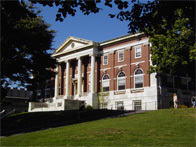
Founded in 1852, Tufts University has grown from a small, regional college to a worldrenowned,
major research university whose 5,000 undergraduates come from more than sixtyfive
countries. Regardless of where they are from, Tufts students, staff, and faculty all share the
common goal of using their intellects to better the world, whether it is working in rural Ghana
to stop the spread of parasitic diseases found in local water sources or volunteering in Boston
as translators for recent Vietnamese immigrants.
A Tufts education will inspire [you] to get out into the world and shake
things up, tear things down, and make things better. —Kyle Halle-Erbe, ’10
Referred to by President Larry Bacow as a small university with a sense of intimacy,
Tufts nurtures the development of global scholars and leaders by combining the best aspects
of small liberal arts colleges—discussion and inquiry-based classes; close relationships with
professors—and the best attributes of large research universities—funding and support for
undergraduate research; award-winning, internationally recognized faculty. Emphasizing the
importance of intellectual exploration and interdisciplinary education, Tufts fosters the
growth of poetry-writing engineers, political activist premed students, and environmentally
conscious entrepreneurs. Although students are enrolled in either the school of engineering
or the school of liberal arts, classes in each school are open to all undergraduates.
Undergraduate students also benefit from the resources and research opportunities available
at Tufts’ eight graduate schools, including the School of Medicine, School of Dental Medicine,
School of Veterinary Medicine, Nutrition School, and Fletcher School of Law and Diplomacy,
the nation’s oldest and arguably most prestigious graduate school in international relations.
A national leader in active citizenship, Tufts is home to the Jonathan M. Tisch College
of Citizenship and Public Service. In May 2006, six years after its founding, Tufts alumnus
Jonathan M. Tisch’s generous $40 million endowment gift ensured the college’s future as a university
fixture. Integrating active citizenship into the curriculum, Tisch College facilitates collaboration
between civic-minded students and faculty who aspire to solve complex real-world
problems. Recent student-initiated projects include biomedical engineers utilizing light spectroscopy
for breast cancer screening and studio art students examining art and social change
as reflected through graffiti.
Located just five miles northwest of Boston, Tufts’ beautiful 150-acre New England college
campus rests upon Walnut Hill and overlooks the city skyline. The campus is a short walk or shuttle
bus ride from Davis Square, a bustling social center that is home to independent coffee shops,
live music venues, delicious ethnic food, and one of Boston’s best used-bookstores. Davis Square,
located on the Red Line of the subway, also provides students with easy access into Boston,
where students often grab dinner in the North End (Boston’s “Little Italy”), visit the Museum of
Fine Arts (where Tufts students receive free admission), or catch a Red Sox or Celtics game.
Although students appreciate Boston’s accessibility, the heart of undergraduate life is
found on campus, home to 5,000 students and over 200 thriving student-run organizations.
Students who live on campus have the option of choosing between single-sex and coed dormitories,
on-campus apartments, fraternity and sorority houses, and numerous culture units,
including the Africana, Latino, Asian American, International, Jewish, Muslim, Spanish,
French, German, Russian, Arts, Crafts, and Substance Free Culture Units. All first- and secondyear
students are required to live on campus; many third- and fourth-year students choose to
live with friends in off-campus apartments immediately surrounding the university.
Construction vehicles and hard hats have been a common site on campus recently. Two
major construction projects were recently completed. Sophia Gordon Hall, an environmentally
friendly “green” dormitory that houses 125 seniors, opened its doors in the fall of 2006. The university’s
new music building, home to the music department and a new 300-seat, acoustically
engineered, recording-quality auditorium, was completed in January of 2007. Other campus
improvements within the past couple of years include the construction of a $2 million
boathouse on the Malden River for Tufts’ crew teams, the renovation of West Hall, a residence
hall since 1872 that is a favorite amongst students and known for its spacious rooms and prime
location on the academic quad, and the revamping of Cabot Auditorium and the Fletcher
School of Law and Diplomacy.
Tufts is an eclectic and dynamic community of passionate students from a wide variety
of geographic, racial, ethnic, socioeconomic, religious, and cultural backgrounds. Students of
color and international students make up more than a third of the undergraduate study body.
It is not unusual for a first-year student from Chicago to be roommates with a student from
Seattle and neighbors with a student from Hong Kong and a student from Texas. The diversity
within the undergraduate student body creates a stimulating, intellectual community in which
students are constantly learning in the classrooms from their first-rate professors and outside
the classroom from their eclectic classmates.
Most students are drawn to Tufts because they are looking for a challenge—both inside
and outside of the classroom. Tufts provides students with a high-quality education where the
learning extends far beyond the walls of the classroom. Tufts students appreciate the diverse
student body, beautiful campus, access to a major city, and community in which students take
their academics seriously, yet lead healthy and balanced lives.
Originally from the small, rural town of Schulenburg, Texas, Michelle Eilers, ’10, chose
Tufts because she wanted to attend a school where students learned just as much from their
peers during political debates in the dining hall and late-night discussions about global dilemmas
in the dorms as they did from their professors. She wrote, “I want to meet people with
whom I have nothing in common and argue about values and beliefs. I want to interact with
people involved in making real world contributions, because I want to make meaningful contributions
of my own.” In Tufts, Michelle and many other like-minded students have found a
perfect match.
Unlike many other prestigious universities, Tufts is a dynamic and innovative institution
of higher learning whose president, professors, and students use academic and social capital
to make tangible differences in the world. Under the leadership of President Larry Bacow, the
university has heightened an already impressive academic profile by attracting top-notch students
and faculty. Robert Sternberg, former president of the American Psychological
Association and one of the world’s foremost experts on the topics of creativity and intelligence, assumed the position of Dean of Arts and Sciences in 2005. Linda Abriola, a member of the
National Academy of Engineering and a universally recognized specialist in water allocation
and water resources, became one of the few female Deans of Engineering in the country when
she accepted that position in 2004.
Scholars and students alike recognize that Tufts is a special school—a university on the
forefront of both research and teaching, a campus defined by intellectual curiosity and handson
learning, and a community of scholars and leaders who want to “shake things up, tear things
down, and make things better.”
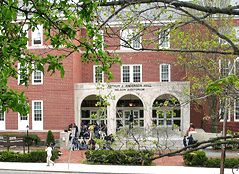
Tufts University
Academics
Whether it is meeting with a student during office hours, grabbing coffee at the library’s
Tower Café (where beverages are on the house when a student and professor go in together),
or inviting students to their houses for dinner or a barbecue, Tufts professors take a genuine
interest in the lives of undergraduates, both inside and outside of the classroom. With an average
class size of twenty and a student-to-faculty ratio of seven-to-one, classes tend to be
discussion- and inquiry-based and require students to come to class prepared and ready to contribute
to the learning process.
With an aim of providing students with a broad-based liberal arts and engineering education,
Tufts students are encouraged to explore their academic interests by taking classes in
any academic department within the university. The most popular majors within the school of
liberal arts are international relations, English, political science, and psychology. Tufts is also
recognized for its first-rate programs in history, philosophy, child development, biomedical
engineering, and community health. Mechanical engineering and electrical engineering are
the two most popular majors within the school of engineering, though the biomedical engineering
program has experienced tremendous growth and has increased in popularity in
recent years. More than forty percent of students—across disciplines—will choose to spend a
semester or a year studying abroad on one of the ten Tufts programs or one of the 200 preapproved
non-Tufts programs throughout the world. All undergraduates, in both the school of liberal
arts and the school of engineering, are encouraged to engage in undergraduate research.
What distinguishes Tufts from many other schools when it comes to research is that
rather than doing research for a professor, Tufts students play an active role in doing research
with a professor. Rather than joining an already existing research project, students are
strongly encouraged to develop their own projects and to delve deeply into their field.
Research takes place across all disciplines, from the sciences to the humanities to the arts.
Initiatives such as the Summer Scholars Research Program give undergraduates the opportunity
to engage in funded one-on-one research with a faculty member at any of the university’s
eight undergraduate or graduate schools, including the schools of liberal arts and engineering,
the medical school, veterinary school, dental school, nutrition school, and the Fletcher School
of Law and Diplomacy. Recent Summer Scholars projects include a drama major that worked
with a professor to recreate the costumes and clothing for a PBS documentary on the French
and Indian War set in eighteenth-century Pennsylvania, and a community health major who
analyzed the problems of asthma and obesity in immigrant populations. Hands-on research is
a core element of the undergraduate experience at Tufts and often culminates in a senior honors
thesis or further study in graduate school.
At Tufts, whether you like it or not, you are going to get to know your
professors. For most students, myself included, that is a good thing. My professors,
expert scholars and teachers, were all down-to-earth and inspired me to
achieve more than I ever thought possible. I formed meaningful professional
relationships and friendships with my professors that have lasted well beyond
graduation, and I still correspond with many of them on a regular basis,
whether it is to ask for advice or just to catch up.
The Experimental College
Founded in 1964, the Experimental College has been an integral part of the Tufts curriculum
for more than forty years. The Experimental College, or ExCollege, is more of
an academic department than an actual separate college within the university. Known for
offering innovative, imaginative, and interdisciplinary courses that don’t necessarily fall
into any one academic department, the ExCollege has been a favorite amongst students
since its inception.
A unique aspect of the ExCollege is that courses are usually taught by outside professionals
rather than university professors. Many of the outside professionals who teach in the
ExCollege enrich the learning environment by bringing invaluable real-world experience—
and contacts—into the classroom. Recent hits include a course taught by the former general
manager of the Celtics on “The Business of Sports: A History of the NBA”; a course on forensic
science and crime scene investigation led by a twenty-four-year veteran police inspector of the
Connecticut State Attorney’s office; and a class on “Producing Films for Social Change” taught
by an Academy Award-winning documentary filmmaker. In 2005 Tufts students in the
“Producing Films for Social Change” class won a College Emmy Award for From the Fryer to
the Freeway: Alternative Energy Today. In addition to taking classes in the ExCollege, students
also have the ability to teach pass/fail classes in an area of their own personal expertise.
All ExCollege courses count for credit toward graduation, and some count as credit toward various
majors.
The Dual-Degree Programs
Tufts has two special five-year dual-degree programs with other schools in Boston. The
first is a five-year B.A./B.F.A. program with the School of the Museum of Fine Arts,
located next to the Museum of Fine Arts in downtown Boston. The second is a five-year B.A./B.Mus. program in which students earn a Bachelor of Arts degree from Tufts and a
Bachelor of Music degree from the New England Conservatory, one of the country’s most
prestigious conservatory programs. A shuttle bus takes dual-degree students back and forth
between campuses, though many opt to ride the easily accessible subway as well.
Both dual-degree options are highly selective and are meant for students who are serious
academicians and dedicated and talented artists. To apply for either program, students
must submit an application to Tufts and a separate application to the other institution.
Students should indicate on each application that they would like to be considered for the
dual-degree program.
Early Acceptance to Tufts’ Professional Schools
During a student’s sophomore year at Tufts, he or she may apply for early acceptance to
the Tufts School of Medicine, School of Dental Medicine, or School of Veterinary
Medicine. In order to be seriously considered for the program, students must meet two criteria:
they must be on track to fulfill the required pre-health science requirements (coursework
in biology, chemistry, organic chemistry, physics, etc.) within four years and they must
have maintained a high level of academic performance during their first two years.
None of the programs are meant as acceleration programs, though some students may be
able to complete the combined dental medicine program in seven years. All students accepted
early to the medical or veterinary school, and most of those accepted early to the dental school,
will still spend four years completing their undergraduate studies and four years in professional
school. The benefit of the early acceptance program is that they will know by the end of their
sophomore year whether or not they have been admitted into a top-notch health science graduate
program. The early acceptance programs are not binding, and students have until the end
of their junior year to decide whether or not they will accept the offer of admission.
Institute for Global Leadership
The Institute for Global Leadership (IGL) provides undergraduates with an opportunity
to examine a multitude of complex global issues through course work, on-campus lectures
and symposia, and funded in-the-field research. The IGL encourages student-centered
learning and pushes students to connect theory to practice by “getting their hands
dirty” through funded international research. Recent student trips sponsored by the IGL
include a trip to the United Arab Emirates to attend a conference on women’s rights and a
trip to Zimbabwe to research the problems that country faces as a result of its scarce water resources.
Home to a wide range of initiatives, the IGL’s signature program is Education for Public
Inquiry and International Citizenship (EPIIC), a year-long colloquium exploring a major global
issue. Past EPIIC themes include “Race and Ethnicity,” “Sovereignty and Intervention,” and
“America’s Role in the World.”
More in depth information about the Institute for Global Leadership can be found at
http://www.tufts globalleadership.org/.
Study Abroad
Did you know that . . .
More than forty percent of students
choose to study abroad, placing Tufts
among the top ten research universities
for percentage of students who
study abroad.
Tufts has a campus at the foot of the
French Alps in Talloires, France.
During the summer, students have the
opportunity to live with a French family
while taking six-week-long classes
with Tufts professors in an eleventhcentury
Benedictine priory.
Tufts’ ten study abroad programs are
located throughout the world in Chile,
China, Germany, Ghana, Hong Kong,
Japan, London, Oxford, Paris, and
Spain. There are also more than 200
preapproved non-Tufts programs.
Most Popular Fields of Study
The top 5 fields of study completed at Tufts University.
Once a moderately selective regional college, Tufts has transformed itself over the past
twenty-five years into a most-selective international university. Students applying to Tufts are
required to submit the Common Application and the Tufts Supplement form. Last year twentyfive
percent of the 15,600 applicants were offered admission to either the school of liberal arts
or the school of engineering. The fact that the admissions process is highly selective should not
discourage applicants from applying since the application review process at Tufts is holistic.
As Dean of Admissions Lee Coffin likes to say, a student’s application is made up of
two parts: the “data” (a student’s academic performance) and the “voice” (a student’s
extracurricular activities, recommendations, and essays). According to the admissions
office, the vast majority of Tufts applicants are academically “qualified” to succeed in the
classroom. With that in mind, it is important for applicants to realize that although the data
certainly does play an important role in the admissions process, the voice is just as, if not
more, important.
The data portion of a student’s application consists of the high school transcript and
standardized test scores. In addition to reviewing students’ grades, Tufts evaluates each
applicant’s curricular rigor and gives preference to students who have challenged themselves
by taking AP, IB, and honors classes, or the most demanding classes available to them.
The university also requires students to submit either the SAT exam and two additional
SAT Subject Tests or the ACT exam with writing. Students applying to the school of engineering
who submit the SAT should submit an SAT Subject Test in math and a Subject Test in either
physics or chemistry. For students accepted into the class of 2011, the mid-50 percentile range
for the SAT math, critical reading, and writing exams was 670–760, and the mean composite
ACT score was 31. Although the admissions committee does take standardized testing into
consideration, it is but one of many factors in the admissions process. Students who fall within
or exceed the mid-50 percentile are not guaranteed admission and students who score below
the mid-50 percentile may not be denied admission. Students who do not speak English as a
first language are required to submit the Test of English as a Foreign Language (TOEFL) exam
as well.
The voice portion of a student’s application is often what distinguishes him or her from
the thousands of other Tufts applicants. Admissions officers rely on extracurricular activities,
recommendations, essays, and an optional alumni interview to get a better sense of who the
applicant is and how he or she would add to the Tufts campus.
Given the importance Tufts places on active citizenship and leadership, admissions officers
want to know what students have been up to outside of the classroom. Be it community
service, music, athletics, arts, entrepreneurship, or employment, Tufts places an emphasis on
the quality of a student’s involvement rather than the number of activities in which a student
has participated.
Students are required to submit one recommendation from a teacher in a major subject
area (math, science, social studies, English, foreign language) that they have had in
either their junior or senior year. The best teacher recommendations come from teachers
who know students well and are able to share stories, fond memories, and personal anecdotes with the admissions committee. A strong teacher recommendation can carry considerable
weight with the admissions committee and almost always strengthens the voice of the
application. Additional recommendations are welcomed if the student believes that the
extra recommendation will add new information to the application.
Perhaps the most important part of the voice, student essays play a significant role in
the application review process. In addition to submitting a 250- to 500-word personal statement,
applicants are given the option to write a few short essays in response to creative and
innovative questions that change annually. Past prompts include: “A high school curriculum
does not always afford much intellectual freedom. Describe one of your unsatisfied intellectual
passions. How might you apply this interest to serve the common good and make a difference
in society?” and “Create a short story using one of the following topics: The end of
MTV; Confessions of a Middle School Bully; The Professor Disappeared; The Mysterious Lab.”
Students are discouraged from writing essays about banal topics, such as a community service
trip, the “big game” or “big shot,” or one’s love for grandma and grandpa.
All interviews for Tufts are optional and are conducted by local area alumni who are part
of the Tufts Alumni Admissions Program (TAAP). After a student submits the Tufts
Supplement Form, the admissions office will notify an alumni interviewer in the students’ local
area who will in turn contact the applicant to schedule an interview. Interviews often take
place at coffee shops, bookstores, libraries, and other public locations agreed upon by both the
applicant and interviewer. The purpose of the interview is twofold: first, to provide students
with another opportunity to add to the voice of their application and, second, to learn more
about Tufts through the experiences of the alumni interviewer. In a typical year more than
10,000 interviews are completed by dedicated TAAPers who volunteer hours of their time to
remain connected to the university and to advocate for applicants from their local area. Since
interviews are optional; students who are not able to complete an alumni interview are not at
a disadvantage in the admissions process.
Students have the option of applying to Tufts Early Decision (ED) I, Early Decision (ED)
II, or Regular Decision. Both Early Decision rounds are binding, meaning that if admitted the
applicant is required to attend Tufts and withdraw any applications to other colleges. The only
difference between Early Decision I and Early Decision II is the application deadline (November
1 for ED I and January 1 for ED II). Students who apply Early Decision are notified of their admissions
decision approximately one month after the application deadline. The Regular Decision
application deadline is January 1, and all applicants are notified of their decision by April 1. The
current application fee is $70. Students who are unable to pay the application fee should contact
their guidance counselor or the Tufts admissions office to inquire about obtaining a fee waiver.
Financial Aid
One of the first questions on many high school students’ and parents’ minds is, “How am
I going to pay for college?” As the cost of attending college continues to rise, this question gains
more and more validity. At Tufts, admissions and financial aid officers work closely with students’
families to ensure that finances are not the factor that prevents a student from attending
the university. In 2006, President Larry Bacow launched a $1.2 billion capital campaign,
with a primary goal of maximizing the university’s financial aid resources.
Financial aid at Tufts is need-based and the university is dedicated to meeting 100 percent
of a student’s financial need, as determined by the Free Application for Federal Student
Aid (FAFSA), the College Scholarship Service (CSS) Financial Aid Profile, and the family’s tax
returns. The only form of merit-based aid are awards from the National Merit Scholarship
Corporation. ROTC scholarships are also available to students. Each year students resubmit
their financial aid forms so that the university can recalculate and adjust their financial aid
package as needed.
Financial aid packages usually include three types of aid: grant, loan, and student contribution.
However, the vast majority of aid is in the form of grants, or money that the student
does not have to repay. Of the $12.8 million in aid given to the class of 2010, more than $10 million
was in the form of grants. The average grant was $23,907 and the average total award was
$26,300. Student contribution, or work-study, provides students with an on-campus job during
the academic year. Though a variety of jobs are available, the most highly sought after jobs are
those that allow students to study or do work while on the clock. The foreign language lab, gymnasium,
and library media center are a few of the most popular places to be employed. In addition
to working on campus, some students decide to take advantage of the plentiful job
opportunities in Boston to help pay for school.
Something that Tufts students understand very
well is that a lot of learning in college takes places outside
of the classroom. Though students’ primary reason
for being at Tufts is to excel inside the classroom,
a healthy balance exists between coursework,
extracurricular activities, and a student’s social life.
Even though Boston is just a short T ride away,
the heart of the undergraduate social life is found on
campus. Students build time into their schedules to
participate in some of the more than 200 already existing
student organizations, ranging from the Multiracial
Organization of Students at Tufts (MOST) to Traveling
Treasure Trunk, a children’s theater troupe.
Given the university’s emphasis on integrating
active citizenship into the curriculum, it is no surprise
that the most popular student organization is the
Leonard Carmichael Society (LCS), an umbrella community service group that is home to
nearly forty outreach initiatives. Students interested in media and communications are often
active in Tufts University Television (TUTV); Tufts’ radio station, 91.5, WMFO; the Observer, a
biweekly news magazine; and the most widely read publication on campus, The Tufts Daily.
Tufts is one of the smallest colleges in the country to have a daily newspaper. Performing
artists can sing in one of the six a cappella groups, sing in the choir or gospel choir, play in the
wind ensemble or the big band, or dance in Spirit of Color, Sarabande, Tufts Dance Collective,
TURBO (a breakdance troupe), or one of the university’s step teams.
Many students are involved in the cultural organizations that are collectively known as
The Group of 6: the Africana Center, Asian/Asian-American Center, International Center,
Latino Center, Lesbian Gay Bisexual Transgender Center, and the Women’s Center. There are
also active religious organizations and groups on campus, including the Protestant Ministry,
Catholic Center, Hillel, and the Islamic Center. Students who find that their interests are not
met by one of the already existing organizations always have the opportunity to petition to create
a new organization.
Greek Life
Approximately fifteen percent of Tufts students are Greek. With twelve fraternities and five
sororities, the Greek system at Tufts is a legitimate social outlet for those interested in taking
part in Greek life. At the same time, there is no pressure to join a fraternity or sorority given
the numerous opportunities for social stimulation both on campus and in Boston. Even if a student
is not directly involved in Greek life it doesn’t necessarily exclude him or her from attending
parties, dances, fund-raisers, or other events organized by a fraternity or sorority.
Please visit http://www.tuftslife.com for more information about student life and a daily
listing of campus events.
Student Enrollment Demographics
How many students are enrolled at Tufts University?
Students interested in participating in athletics at Tufts may do so at the varsity, club, or
intramural level. The Tufts Jumbos boast twenty-nine Division III varsity athletic teams
that compete in the New England Small College Athletic Conference (NESCAC). Arguably
the most competitive Division III conference both athletically and academically, NESCAC
foes include Amherst, Williams, Wesleyan, and Middlebury.
Tufts teams compete at the highest level and placed sixth out of 281 Division III
schools in the 2005–2006 Sports Academy Directors’ Cup, an annual ranking of the best overall
intercollegiate athletic programs in the country. Though many teams had great success
in 2005–2006, of particular note was the women’s soccer team’s Final Four appearance, the
men’s basketball team’s Sweet 16 showing, and the track team’s Fred Jones capturing the
national triple jump title at the NCAA Outdoor Track and Field Championships.
Popular club sports include a nationally ranked Ultimate Frisbee team, rugby, flag football,
and table tennis. Those simply looking to stay in shape can take advantage of Tufts’
40,000 pounds of free weights, new nautilus equipment, indoor pool, and the Gantcher Family
Sports and Convocation Center’s elevated indoor 200-meter track and indoor tennis courts.
Alumni
Given the geographic diversity of the undergraduate student body and the emphasis on
educating tomorrow’s global leaders, it is no surprise that Tufts graduates can be found
throughout the world. There are more than 80,000 Tufts alumni living in places as close as
Boston and New York and as far as Botswana and New Delhi. Current undergraduates and
recent graduates greatly benefit from the Tufts Alumni Association, an active network of
alumni who are eager to offer advice, resources, and contacts.
Upon graduating from Tufts, around half of
all students will go directly to graduate school,
though within five years of graduating more than
eighty percent of all graduates have already completed
a graduate degree or are in graduate school.
Approximately a quarter of the graduating class will
engage in volunteer opportunities or complete prestigious
scholarships and fellowships. Each year Tufts is
one of the top schools of its size to send students on
to be Fulbright Scholars and Peace Corps Volunteers.
Other recent graduates have also been recognized as
Marshall Scholars, Truman Scholars, Udall Scholars,
and recipients of the Jack Kent Cooke Foundation’s
Cooke Scholarship. The remaining quarter will enter
into the workforce in fields including public service
and government, investment banking, consulting,
teaching, and journalism among others.
When people ask me what my friends did after
we graduated, I usually don’t know where to start.
Kate, whom I met during our weeklong freshman
orientation community service trip in Boston,
won a Fulbright Scholarship to do research on the
HIV/AIDS epidemic in sub-Saharan Africa and then
went on to work for UNESCO in Paris before doing a
master’s degree in international public health.
Steve, whom I lived with all four years of college,
recently received his master’s degree in Islamic
and Middle Eastern Studies in Israel and has also
been working full-time for a leading conflict resolution
nonprofit. Steve’s connections at Tufts led to a oncein-
a-lifetime opportunity the year after we graduated.
That year, he traveled to India as part of a three-person delegation sent to meet with the Dalai Lama
and advise the Tibetan government in exile in their
dealings with the Chinese.
My other friends are doing equally impressive
things across the country and throughout the world,
ranging from Ph.D. and professional degree programs
to opening up a bookstore on the Greek island of
Santorini to working in postconflict areas such as
Rwanda and Northern Ireland.
Prominent Grads
Vannevar Bush, ’13, Scientist,
Inventor
John Holmes, ’29, Poet
Daniel Patrick Moynihan, ’48, Former
U.S. Senator, Ambassador to the UN
General Joseph Hoar, ’56, Four-Star
General in Persian Gulf War
Frederick “Rick” Hauck, ’62,
Astronaut
Joseph Neubauer, ’63, CEO, Aramark
Corp., Philanthropist
Jeffrey Drazen, ’68, Editor-in-Chief of
New England Journal of Medicine
Anita Shreve, ’68, Best-selling Author
William Richardson, ’71, Governor of
New Mexico, Former U.S. Secretary
of Energy, Ambassador to the UN,
Diplomat, and Congressman
William Hurt, ’72, Academy Awardwinning
Actor
Arthur Sulzberger, Jr., ’74, Chairman
and Publisher, The New York Times
m Meredith Viera, ’75, Co-host, NBC’s
Today
Peter Gallagher, ’77, Actor, The O.C.
Jeffrey Kindler, ’77, CEO, Pfizer
Jamie Dimon, ’78, CEO, J.P. Morgan
Chase
Neal Shapiro, ’80, Former President,
NBC
Oliver Platt, ’83, Actor
Rob Burnett, ’84, Emmy-winning
Producer, Late Show with David
Letterman
Tracy Chapman, ’86, Grammy-winning
Musician
Hank Azaria, ’88, Emmy-winning Actor
Pierre Omidyar, ’88, Founder of eBay,
Philanthropist
Darrell Scott, ’88, Award-winning
Country Singer and Songwriter
Jonathan Greenblatt, ’92, Cofounder,
Ethos Water
Guster (Adam Gardner, ’95, Ryan
Miller, ’95, and Brian Rosenworcel
’95), Band
Please visit Tufts E-News, http://
enews.tufts.edu, for regular updates
on Tufts graduates making headlines.
Feel free to add comments or additional information regarding Tufts University, or discuss this school in the University Discussion Forum
almost 5 years agoLarry DeCaro Larrydecaro ((at)) aol dot com
I wanted to know what the requirements for S.A.T. and G.P.A. are for admissions in general for Tufts? ........ ball park figure for either a B.A. or B.S.
This website and associated pages are not associated with, endorsed by, or sponsored by Tufts University. StateUniversity.com has no official or unofficial affiliation with Tufts University.
Larrydecaro ((at)) aol dot com
I wanted to know what the requirements for S.A.T. and G.P.A. are for admissions in general for Tufts? ........ ball park figure for either a B.A. or B.S.