StateUniversity.com – U.S. University Directory [ Home :: University List :: North Carolina ]
Chapel Hill, NC 27599
p. 919-962-2211
w. www.unc.edu
University of North Carolina at Chapel Hill
General Information, Alumni, History, Campus, Students, Faculty, Address, and Tuition
- NEW - College and University Blog with many tips like acing the ACTs, SATs, college admissions, and preparing for college.
- University Forum and Discussion - Brand New Message Board For All Your Questions
- Information on Thousands of Careers - One-stop resource for very comprehensive, and up-to-date career information. Contains more than several thousand job profiles each with a job description, education and training requirements, salary information, working conditions, employment outlook and much more!
- Student Encyclopedia - Encyclopedia for reference and research from the Cambridge Collection.
University of North Carolina at Chapel Hill Introduction
Carolina is a study in contrasts. Grits ‘n’ gravy and liberal activism; founded by slave owners but unflinchingly committed to diversity; world renowned yet dedicated to local service. UNC is an engaging mix of sobering social concern and all-night parties, intellect and athleticism, and leadership tempered by tradition. It’s a combustible blend that fuels passionate debate, innovation, and introspection.
Chartered in 1789, the University of North Carolina is a child of the Revolution and the first public university in the United States to open its doors just four years later. Now over 210 years old, UNC still blazes trails and champions implausible causes. When the university’s chancellor announced the Carolina Covenant in 2003, UNC became the first university to guarantee that its neediest students would graduate debt free. The initiative gained national attention and several universities followed suit.
But what they couldn’t imitate was the unwavering commitment to the public good, to the people, that is inherent in all things Carolina. Since its founding, UNC has first and foremost been an institution of the people, an uncommon feat in a field that is increasingly driven by revenue and rankings. The people, for UNC, are not just the residents of North Carolina but each and every student who studies in its halls. Carolina is committed to serving and to educating—not just those who can afford a world-class education, but also those who can no longer afford to live without one.
The Student Body
That commitment to serving a diverse student body is reflected in the classroom, where you’re just as likely to sit next to a congressman’s son as you are the daughter of a textile worker, where people from all backgrounds dissect and discuss social issues such as female oppression in Third World countries and outsourcing. It’s an environment that causes a healthy degree of friction and feeds red-hot academics. UNC consistently ranks among the top universities in the United States and is home to one of the nation’s top business schools, the Kenan-Flagler Business School. About eighty percent of Carolina students graduate within five years after meeting a wide range of liberal arts requirements, completing a rigorous study in their academic major, and often studying abroad for a semester.
They are able to do so because Carolina attracts the best and brightest from all walks of life. Three-quarters of recent freshmen ranked in the top ten percent of their high school class, and almost 200 were valedictorians. Among them were students with perfect SAT scores, National Merit finalists, student body presidents, and talented athletes and musicians. With such highly qualified applicants, Carolina’s admissions process is extremely competitive, especially among out-of-state students. Less than thirty-seven percent of would-be Tar Heels are admitted each year and competition among out-of-state applicants is especially fierce because state law caps nonresident enrollment at eighteen percent of the student body. That makes an out-of-state admission offer from Carolina one of the hardest to come by in the country.
UNC is academically rigorous, but what makes Carolina a must-attend university is its unparalleled focus on experience gleaned outside the classroom. Carolina has perhaps the most civically engaged student body of any school in the United States. You’ll be hard pressed to find students hunkered in the library night after night. Instead, members of the Young Democrats and College Republicans go head to head on listservs and in The Pit, the “unofficial” center of campus. Aspiring journalists pour hours of work into The Daily Tar Heel, the campus’ award-winning daily newspaper. Students counsel rape victims and build houses, and then head to the athletic fields.
The Campus
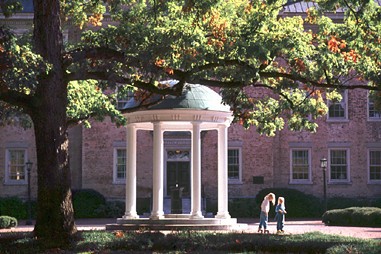
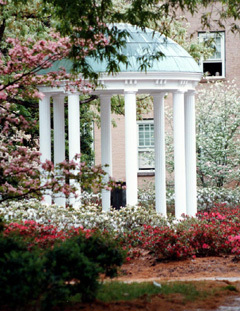
They do it all in and around one of the most beautiful college campuses in the nation—from the grassy tree-lined quads to the marbled halls of stately Wilson Library, the chiming Bell Tower to the pink and white blossoms buzzing with bees. Students return to a campus at summer’s end that is lush and green and in a few months will be ablaze with the reds, oranges, and yellows of fall. They can always expect a few snow flurries and maybe even an ice day or two, perfect for sledding, snowball fights, and other childhood pastimes far removed from the pressures of mid-terms and papers. And without fail, just as students begin to hate crisp days, the campus bursts into bloom, drawing warmth and sunbathers to the quads.
It’s a place made for active lives, punctuated by a handful of lazy, sun-filled days. If college, to you, just means double-majoring and getting out, you’d probably be better off at any number of other schools. Carolina is best savored. Expect to play hard, work harder, and always be on the go. Carolina students, faculty, and administrators are always pressing forward, embracing change, moving at full throttle.
In short—the faint of heart need not apply.
The Carolina experience is part community, part stunning intellect, part dedication, and a pound or two of passion. Add a dose of revelry and adventure and top it off with timeless architecture and rolling lawns. At its core, Carolina offers top athletics, a world-class education, a focus on service and leadership, and a fun-loving student body—and its unique role as a leading public institution makes it a must attend. The university is ever-mindful of its duty to “the people,” and as a public school, Carolina educates a far more diverse student body than found at many private schools.
Chapel Hill, which plays host to the university, is a town with a village mentality, and the caring, engagement, and warmth that comes with it. It sprung up around the university and will forever be a university town, but with about 50,000 full-time residents, it’s now large enough to offer some “townie” flavor of its own. Step onto Franklin Street, sample the shops, restaurants, and bars, and you’ll never want to see a Main Street or First Street again.
All told, Carolina provides the quintessential college experience without the cliché. Expect to get rowdy from time to time, to take your studies seriously and your public duty even more so. Prepare to become a thinker, a leader, and a caretaker of all that has come before.
University of North Carolina at Chapel Hill Academics
UNC is a world-class research institution with humanities at its heart. As such, the faculty strives to produce graduates well versed in both the hard sciences and the arts. Biology majors will graduate with a basic appreciation for Chaucer, and a chemistry set won’t be a foreign object to journalism majors. Undergraduates are given ample opportunity to participate in faculty research or projects of their own design, and for a large research institution, faculty members are surprisingly accessible. Carolina is careful to maintain a 14 to 1 student-faculty ratio overall, and even professors in large lecture classes make themselves readily available.
Professors do a great job of making themselves accessible to students and are, in fact, disappointed if students don’t take them up on their offer. Right from the start, I got to know some professors well, and those relationships stayed with me throughout my time here. — Dan Harrison, 2004, Current Carolina Law Student
First-Year Seminars
Carolina ensures that students immediately have the opportunity to connect with faculty by offering dozens of intimate, engaging courses called First-Year Seminars. These aren’t the 200-person lecture classes of freshman lore. The classes typically are limited to twenty students or fewer and are available only to first-year students, so you won’t have to fight upperclassmen for a choice spot. The seminars enable students to study topics that go well beyond the basics and to participate in faculty-led research they traditionally wouldn’t tackle until their junior or senior year. The program offers more than 300 courses in 38 departments and schools, though not all classes are available in a given semester. Current topics range from “American Culture in the Era of Ragtime” to “Space Identity and Power in the Middle East” to “Energy Resources for a Hungry Planet.”
General College
Most first-year seminars fulfill course requirements in general education, which is composed of a whole host of courses students must take in the College of Arts and Sciences. All students spend their first two years in the General College where they must fulfill about twenty specific foundations, approaches, and connections requirements, such as Quantitative Reasoning, U.S. Diversity, Literacy and Performing Arts, Historical Analysis, and English Composition and Rhetoric. The course options within each perspective are broad, allowing students to chart their own unique intellectual course.
Students also can place out of some courses or use selected Advanced Placement and International Baccalaureate tests to earn credit. General College credits typically are earned during students’ first two years, though some upper-level general education requirements are required during junior and senior years. To meet the requirements of the General College and complete their major on time, students typically carry a manageable course load of twelve to fifteen hours. Full-time students must obtain special permission to carry fewer than twelve hours or more than seventeen.
Majors
UNC offers seventy-one undergraduate majors in nine of thirteen schools. Students typically declare a major heading into their junior year, though students who enter Carolina with college credit, place out of courses, or carry especially heavy loads may begin working on a major earlier. When declaring a major, undergraduates either remain in the College of Arts and Sciences or enter one of four professional schools (dentistry or medicine), as well as Kenan-Flagler Business School or the schools of education, information and library science, journalism and mass communication, nursing, and public health. The Business and Journalism schools are the most popular schools, and biology, psychology, and political science are among the most popular majors within the College of Arts and Sciences. Political science, psychology, and Romance Languages are all common second majors.
Students can double-major at Carolina or can pursue a major and two minors. Certain majors, such as journalism, require an area of outside concentration. Though rare, students can major in two schools, but because of the intense, focused course load required in most professional schools, they must get special permission to do so.
Global/International Focus
Carolina, over the past few years, has markedly increased its focus on global education — from the study of foreign languages to global issues classes to study abroad. By the end of 2006, the school completed the construction of the Global Education Center, which will bring international studies, resources for study abroad, and international research centers under one roof.
UNC has long had a robust study abroad program that enables students to tailor foreign experience to their academic pursuits and personal interests. Students can choose from over 300 credit-bearing programs in seventy countries and can opt for a semester, a year, or a summer session abroad. UNC students have participated in programs all over the world, including Singapore, Sydney, Cuba, Cairo, Montpellier, and Moscow. Academic eligibility requirements vary from program to program. Numerous programs provide internships and service learning opportunities abroad as well as specialized courses taught by UNC faculty or courses taught at a local university. The extensive program portfolio, combined with UNC’s growing emphasis on global education and its new curriculum, has made the university’s study abroad program one of the most successful in the United States.
The Carolina Southeast Asia Summer Program (SEAS) was an opportunity of a lifetime. Truthfully, this was my first time outside of the country, and I was hesitant about leaving home. However, upon my return, I quickly discovered I had not missed very much while being away. The program fostered self-confidence in my academic pursuits. Now, I have an open mind in terms of health, race and ethnic relations, and economic development. — LyTonya Fowler, UNC Chapel Hill undergraduate, Carolina SEAS Program 2006
According to the Institute of International Education, Carolina has a higher rate of students going abroad than any other public research university nationwide. During the 2003–2004 academic year, 1,362 undergraduates studied abroad. UNC ranked sixth among all public and private research universities for the total number of undergraduate and graduate students going abroad (1,657). Those who have taken time to study abroad say the experience was invaluable for their academic and personal development.
Honors
Accepted applicants are automatically considered for Carolina’s Honors Program, which admits about 200 incoming freshman each year. Students not selected for the program can apply during their freshman or sophomore years. Honors classes also are open to students not enrolled in the Honors Program, and although students in the program get first shot at the classes, honors classes rarely fill up before they open to general enrollment. Students not in the program can still graduate with honors by maintaining a high grade point average, usually higher than a 3.2 but determined by individual departments, and by completing an honors thesis senior year. Many students that graduate with honors opt for that route.
University of North Carolina at Chapel Hill Admissions
So, you know you want to go to Carolina, but aren’t sure how to score one of those coveted fat envelopes. The good news: Carolina has a large admissions staff that pores over applications, considering the unique abilities each candidate would bring to the incoming class. The bad: About 19,000 students competed for less than 3,600 spots last year, which makes admission to Carolina highly competitive—even more so if you’re applying from outside North Carolina.
Out-of-state enrollment is limited to eighteen percent of the undergraduate class, or about 650 of the freshman spots any given year. In 2005, more than 10,000 applicants competed for those spots, making an out-of-state offer to attend Carolina one of the toughest to come by in the country. Now that you know the basic numbers, here’s a rough guide on how to figure your odds.
Academic Excellence
There’s no set formula for success, but a demonstrated record of academic excellence is a must to score an admissions offer from Carolina. The university requires—not suggests— that students have pursued college-preparatory work in high school, and the Admissions Office recommends that students take as many Advanced Placement or International Baccalaureate courses as possible. Carolina requires a high school diploma from an accredited institution and will not accept a GED or other high school equivalency degree for freshman admission.
Once you are sure you’ve got the basics covered, it’s time to turn your attention to test scores and class rank. Four students with perfect 1600s and 107 National Merit Finalists numbered among the 3,751 incoming freshmen in 2005. That class, on average, posted an SAT score of 1,299, with out-of-state students averaging 1,355.
It’s important to consider that the average SAT scores and class rank of the admitted class have been consistently climbing. And it’s equally important to consider that while academic excellence is crucial, admissions officers at Carolina don’t base their decisions on test scores and grade point averages alone.
Life Experience
The trump card at Carolina can be summed up in three phrases: demonstrated leadership, a commitment to community service, and diverse life experiences. Particular strength in one area can make up for deficiency in another because, while Carolina values well-rounded students, its focus is on creating a well-rounded class. Carolina’s leaders see its eclectic, energized student body as a major strength and as a crucial vehicle for reaching and improving a broad swath of society.
University Chancellor James Moeser puts it this way: “There is a sustained commitment to public service and great potential for leadership. It’s by design that we attract people like that.” In fact, Moeser and other leaders are so focused on that goal that they recently created an upper-level management position at UNC dedicated solely to studying and cultivating incoming classes. So, don’t underestimate the importance of extracurricular activities, strong references, a captivating college essay, and more than a little passion.
University of North Carolina at Chapel Hill Financial Aid
Carolina consistently rates as a best buy in national publications, meaning it provides a quality education for a relatively low cost. Still, the cost of attendance would be prohibitive for many students, especially out-of-state students, without financial aid. UNC is committed to meeting one hundred percent of students’ demonstrated financial need in order to ensure that every qualified student has a shot at a Carolina education, regardless of their finances. The university does so with a combination of scholarships, loans, and federal, state, and university grants, and private gifts.
Students who apply for admission are automatically considered for merit-based schol- arships, but you can submit additional information if you are interested in the Robertson Scholarship (see below). To apply for need-based aid, submit the Free Application for Federal Student Aid, or FAFSA, and the CSS/PROFILE no later than March 1. Both forms are available online on the FAFSA and College Board Web sites.
The staff is helpful and understanding, and the office’s director, who was a low-income, first-generation college student, has been innovative and aggressive in advocating for enhanced access for students with financial need.
Carolina Covenant
One of those innovative ideas was the Carolina Covenant, which is Carolina’s promise that its neediest students will graduate debt free. Launched in 2003, the landmark program covers all the costs of education through scholarships, grants, and a ten- to twelve-hour-a-week work-study program. Loans are not part of the picture. To be considered for the Covenant, all you have to do is fill out the standard financial aid forms listed above. Students whose family incomes fall at or below two hundred percent of the federal poverty line will automatically qualify for the Covenant.
Robertson Scholarship
The Robertson Scholarship is a joint privately funded program hosted by Carolina and Duke University. It is designed to foster collaboration between the two institutions and to allow selected students to benefit from the best of both schools’ course offerings and faculty expertise. Thirty students are selected for the program each year; fifteen matriculate at Carolina and fifteen at Duke, though all scholars can attend classes at either campus. Students selected for the program receive full tuition, room, and living stipends at Carolina and a laptop computer. Applicants should exhibit academic excellence, leadership potential, a commitment to community service, and strong ethical principles.
Morehead Scholars Program
The Morehead Scholarship is a privately funded scholarship program and is the most prestigious honor at Carolina. The program provides a whole host of on- and off-campus enrichment activities and a strong network of mentors and potential employers. The scholarship includes full tuition and fees for four years, a laptop, a fully funded, four-year summer enrichment program that begins the summer before freshman year, and an annual stipend that covers all other normal expenses, including housing, meals, travel, and books. The total estimated value for in-state students is about $80,000 and $140,000 for out-of-state students, because of the different tuition costs.
About forty students are selected for the scholarship each year, which is entirely merit-based. The criteria used to evaluate candidates are: capacities to lead and motivate fellow students, scholastic ability and extracurricular attainments, moral force of character, and physical vigor as shown by participation in sports or in other ways. Students must be nominated by the Admissions Office or a participating school to apply. All schools in North Carolina are eligible to nominate students, and select schools across the United States and Great Britain are eligible. To see if your school can nominate candidates, visit http://www.moreheadfoundation.org. If your school isn’t on the list, you still can be nominated by the Carolina Admissions Office if you apply by the November 1 deadline.
University of North Carolina at Chapel Hill Students
The Pit, a brick campus square of sorts, is the social hub of the campus. It’s buzzing during class hours with students hawking hundreds of organizations, passing out fliers for upcoming events, or just chatting with friends between classes. Located between the student union, the main dining hall, the campus bookstore, and two libraries, The Pit is the place to see and be seen between dusk and dawn.
After the lights go down, students flock to Franklin Street, the main drag in Chapel Hill, which borders the campus on the north. Franklin Street has dozens of homegrown bars and restaurants, including several microbreweries and lots of options for dining al fresco. Every Halloween, it fills with about 80,000 revelers from across the state for what is billed as the largest block party in the United States. And when UNC beats Duke in men’s basketball, students rush the street, setting supervised fires, climbing trees, and just celebrating. “It’s the best main street in America,” twenty-one-year-old Ike Johnston, a senior, said of Franklin Street. “It’s an entire business district in a small town made to satisfy people between ages eighteen and twenty-two.”
Student Organizations
Student organizations are as essential to a Carolina education as finals and term papers. Carolina has over 600 officially recognized student organizations, and if you still can’t find one that fits your interests, you can launch your own. Social and political organizations, such as the Black Student Movement, Young Democrats, College Republicans, and the Lesbian, Gay, Bisexual, Transgender—are extremely active on campus and pepper The Pit with information on events and initiatives. Those groups play a significant role in campus politics as do members of UNC’s large, independent student government. Student Body President elections, held every February, never fail to produce animated campaigns and a large slate of candidates.
With student organizations, whether it’s working tech on a play or working sixty hours a week for the student newspaper, chances are you’ll come away with a deeper understanding of what you want to do with life, as well as practical experience. — Jennifer Samuels, 2004
Student Press
Covering it all is a vigorous student press, namely, The Daily Tar Heel, the campus’ award-winning, independent student newspaper. The DTH is funded entirely through advertising and consistently is recognized as one of the top student dailies in the country. It has produced storied alums such as author Thomas Wolfe and Charles Kuralt of CBS. Carolina also has several publications funded through student fees, including Blue & White magazine, The Carolina Review, and TheBlack Ink. The journalism school also produces a mostly student-run, award-winning television broadcast program called Carolina Week.
Community Service
Students also are active in more direct community service, both on and off campus. The university boasts a sizeable Habitat for Humanity chapter, an influential Campus Y, hundreds of annual service projects and fund-raisers, and an active service-learning program in which students take courses that require off-campus community service component. Carolina’s largest annual student fund-raiser, Dance Marathon, is a twenty-four-hour dance marathon. In 2006, 750 dancers raised $201,142 for the N.C. Children’s Hospital— both of these were records. The marathon involves hundreds of students from across campus but its volunteer positions are heavily populated by UNC’s Greek community.
Greek Life
The Greeks, which are an active part of campus life, sponsor various 5Ks throughout the year and are best known for the Derby Days fund-raiser in the fall and several large parties thrown on the last day of classes each year. The Greek system, which has twenty-two traditional fraternities and nine sororities, eight historically black fraternities and sororities, and fourteen religious and multicultural ones, draws about fourteen percent of Carolina students. Greek life will provide you with a full social calendar, but you definitely don’t have to go Greek to have a fulfilling, active social life at Carolina.
University of North Carolina at Chapel Hill Athletics
Carolina is basketball country, and with five national titles, legendary Coach Dean Smith, and star Michael Jordan to its name, there’s no question why. The men in baby blue play a high-octane game and consistently post wins in what is the toughest basketball league in the country, the Atlantic Coast Conference.
I was dragged to my first Carolina men’s basketball game. I should have counted myself lucky to have a ticket, but as a native Texan, I was raised on the notion that football reigns supreme. So it was with hesitation that I joined the sea of Carolina blue rolling toward the massive Dean Dome, a building that somehow manages not only to be imposing but also inspiring and irresistible. As the crisp air filled with the electricity of the crowd, a chill ran up my spine. By the time I made it to my seat in the stomping, whooping students’ section, I knew it wasn’t the cold but rather the first of what would be many encounters with basketball fever.
Still, if your passion is more lush grass than polished wood, more hurdles than hoops, you’re not alone. Carolina—across the board—is an athlete’s paradise. The university is home to twenty-eight men’s and women’s varsity teams, and has dozens of intramural and club teams, including the highly competitive men’s club rowing team. Carolina has aggressively implemented Title IX and has some of the most successful women athletes in the country.
In fact, the true Tar Heel dynasty isn’t basketball, but women’s soccer. The team has brought home eighteen national titles and developed athletes such as soccer celebrity Mia Hamm and her fellow 2004 Olympic Gold medalist, Cat Reddick. The Tar Heel team hosts a soccer camp every summer and has inspired thousands of female athletes nationwide. They have a devoted following and draw some of the largest crowds of any nonrevenue sport at UNC.
If cheering from the stands isn’t your idea of athletics, but you don’t want the pressure of a varsity team, Carolina still has plenty of options. Most club teams, a step up from intramural competition, travel for games and are relatively well funded through student fees and fund-raisers. For the more casual athlete, the campus offers numerous well-maintained intramural fields, tennis, volleyball, and basketball courts, ropes courses, a golf course, miles of paths and trails, two pools, and state-of-the-art workout facilities.
What’s With The Blue Foot?
It’s a Tar Heel of course. Carolina’s actual mascot is a ram, but its athletic programs universally are known as the Tar Heels. The same nickname also is widely used to indicate a North Carolinian. So what is a Tar Heel? The most common explanation of the nickname dates back to the Civil War. The story more or less goes like this: North Carolina troops were fighting a battle in Virginia alongside other troops from that state. They were taking quite a beating and next thing the Carolina boys knew, the Virginians had retreated. But the North Carolinians fought on, undeterred—and they won. According to lore, the Virginians asked the victorious troops in a condescending tone whether there was anymore tar down in the Old North State. The reply: “No, not a bit; old Jeff’s bought it all up. He’s going to put it on your heels to make you stick better in the next fight.”
Since then, as the legend goes, North Carolinians were known as the Tar Heels for their ability to stick out a fight. As Carolina alumni and administrators are eager to point out, UNC Tar Heels are known for fighting the good fight, not only on the basketball and football field, but in all aspects of life.
University of North Carolina at Chapel Hill Local Community
Chapel Hill is the quintessential college town, complete with stunning lawns and centuries-old homes, a vibrant nightlife, and a progressive, close-knit community. It’s home to about 50,000 of the most highly educated people in the state and joins nearby Carrboro—a quirky, charismatic town—in playing host to Carolina students. Chapel Hill and Carrboro are the heart of Orange County, which boasts miles of meandering country roads perfect to unwind and recharge on after a tough day of classes.
Pass up the lush, rolling hills for Interstate 40, which runs through Chapel Hill, and you can be in downtown Raleigh, the state capital, in about thirty minutes or in Durham, home of Duke University, in ten minutes flat. Together, Chapel Hill-Carrboro, Durham, and Raleigh form the Triangle region of North Carolina, a metropolitan area that is home to more than one million people, contains the Raleigh-Durham International Airport, and is internationally renowned for top-notch research and technology. In sum, Chapel Hill offers the charm and safety of a small town with the nearby amenities of a large urban center.
University of North Carolina at Chapel Hill Alumni
Carolina gets in your blood. Whether or not you were a Tar Heel born and bred, like the fight song says, you are a Tar Heel for life when you leave Carolina. That not only means graduates have a deep, lifelong connection to the university, but also that they pursue their dreams with the zeal and character Carolina has taught them. Tar Heels are givers, the lifeblood of countless communities, visionaries, and leaders.
Carolina consistently sends undergraduates on to pursue masters and doctorates at top-notch schools, including Harvard, Stanford, Columbia, and Carolina’s own graduate programs. Others have gone on to become highly successful entrepreneurs, teachers, authors, professional athletes, entertainers—you name it—and many venture into politics, particularly in North Carolina.
Carolina has large alumni associations across the United States and a host of devoted alumni who give millions of dollars to the school each year. None will ever forget the main quad in the wee hours of the morning—calm, more than a little balmy, and simply awe-inspiring. None will ever forget screaming until it hurt in the only dome that will ever mean basketball, or the late nights at Linda’s and He’s Not Here on Franklin Street, and the early mornings learning Spanish in Dey Hall. And they will forever rally ’round the Well, even if only in their hearts, when hope and courage are in short supply.
Prominent Grads
- Mia Hamm, 1994, World Famous Women’s Soccer Player
- Charles Kuralt, 1965, Beloved CBS News Broadcaster
- James K. Polk, 1818, Only alumnus to serve as U.S. President
- Hugh McColl, 1957, Retired Chairman and CEO of Bank of America
- Michael Jordan, 1986, Perhaps the greatest basketball player ever
- Thomas Wolfe, 1920, Author of “Look Homeward Angel”
- Andy Griffith, 1949, TV Actor, Comedian, Producer, and Grammy-winning Musician
- David Brinkley, 1992, Distinguished TV Journalist
- Marion Jones, 1997, Olympic Track Star
- Davis Love III, 1993, PGA Tour Member
Information Summary
Ranks 37th overall and 3rd in North Carolina
| Overall Score
On StateUniversity.com (about) |
97.3 |
|---|---|
| Total Cost
On-Campus Attendance |
$15,750 |
| Admission
Success rate |
34% |
| ACT / SAT
75 %ile scores |
30 / 1390 |
| Student Ratio
Ratio of students to faculty |
15 : 1 |
| Retention
(Full-Time / Part-Time) |
97% / 50% |
| Enrollment
Total (all students) |
27,717 |
Carnegie Foundation Classification
Research Universities (very high research activity)
| Undergraduate | Arts & sciences plus professions, high graduate coexistence |
|---|---|
| Graduate | Comprehensive doctoral with medical/veterinary |
| Undergraduate Population | Full-time four-year, more selective, lower transfer-in |
| Enrollment | Majority undergraduate |
| Size & Setting | Large four-year, primarily residential |
General Characteristics
| Highest offering | Doctoral degree |
|---|---|
| Calendar System | Semester |
| Years of college work required | N/A |
| Variable Tuition |
Special Learning Opportunities
| Distance Learning | |
|---|---|
| ROTC — Army / Navy / Airforce | |
| Study Abroad | |
| Weekend College | |
| Teacher Certification |
Student Tuition Costs and Fees
What are the typical tuition costs and fees for attending University of North Carolina at Chapel Hill?
Ranks 635th for total cost of attendance
| In District | In State | Out of State | |
|---|---|---|---|
| FT Undergraduate Tuition | $3,705 | $3,705 | $19,353 |
| FT Undergraduate Required Fees | $1,635 | $1,635 | $1,635 |
| PT Undergraduate per Credit Hour | $124 | $124 | $645 |
| FT Graduate Tuition | $4,613 | $4,613 | $18,611 |
| FT Graduate Required Fees | $1,623 | $1,623 | $1,623 |
| PT Graduate per Credit Hour | $256 | $256 | $1,034 |
| Total Cost of Attendance — On-Campus | $15,750 | $15,750 | $31,398 |
| Total Cost of Attendance — Off-Campus w/out Family | $16,466 | $16,466 | $32,114 |
| Total Cost of Attendance — Off-Campus with Family | $8,100 | $8,100 | $23,748 |
Student Tuition Costs for Professional Fields
What are the typical tuition costs and fees for getting a professional degree?
| In State | Out of State | |
|---|---|---|
| Medical Degree — Tuition | $10,292 | $33,958 |
| Medical Degree — Required Fees | $1,627 | $1,627 |
| Dentistry Degree — Tuition | $12,635 | $28,117 |
| Dentistry Degree — Required Fees | $1,882 | $1,882 |
| Pharmacology Degree — Tuition | $11,380 | $27,351 |
| Pharmacology Degree — Required Fees | $1,626 | $1,626 |
| Law Degree — Tuition | $10,202 | $22,620 |
| Law Degree — Required Fees | $2,802 | $2,802 |
Student Tuition Cost History and Trends
Three year history and trends on the cost of attending
| In District | In State | Out of State | |
|---|---|---|---|
| Published Tuition & Fees | $4,613 |
$4,613 |
$18,411 |
| Cost (regardless of residency) | |||
|---|---|---|---|
| Books & Supplies | $900 |
||
| On-Campus – Room & Board | $6,700 |
||
| On-Campus – Other Expenses | $2,246 |
||
| Off-Campus w/out Family – Room & Board | $7,504 |
||
| Off-Campus w/out Family – Other Expenses | $1,920 |
||
| Off-Campus with Family – Room & Board | $1,722 |
||
Admission Details
| Application Fee Required | N/A |
|---|---|
| Undergraduate Application Fee | $70 |
| Graduate Application Fee | $73 |
| First Professional Application Fee | $70 |
| Applicants | 19,728 (7,907 male / 11,821 female) |
| Admitted | 6,737 (2,698 male / 4,039 female) |
| Admission rate | 34% |
| First-time Enrollment | 3,807 (1,525 male / 2,282 female) |
| FT Enrollment | 3,800 (1,522 male / 2,278 female) |
| PT Enrollment | 7 (3 male / 4 female) |
| Total Enrollment | 27,717 |
Admission Criteria
What criteria does University of North Carolina at Chapel Hill use for admissions?
| Open Admissions | |
|---|---|
| Secondary School GPA / Rank / Record | |
| College Prep. Completion | |
| Recommendations | |
| Formal competency demo | N/A |
| Admission test scores | |
| TOEFL | |
| Other tests | N/A |
Admission Credits Accepted
What types of credits does University of North Carolina at Chapel Hill accept?
| Dual Credit | |
|---|---|
| Life Experience | |
| Advanced Placement (AP) |
Athletics - Association Memberships
| Sports / Athletic Conference Memberships | NCAA |
|---|---|
| NCAA Football Conference | Atlantic Coast Conference |
| NCAA Basketball Conference | Atlantic Coast Conference |
| NCAA Baseball Conference | Atlantic Coast Conference |
| NCAA Track & Field Conference | Atlantic Coast Conference |
ACT Test Admission
Ranks 109th for 75pctl scores
| Applicants submitting ACT results | 23% |
|---|---|
| Verbal scores (25/75 %ile) | 24 / 31 |
| Math scores (25/75 %ile) | 25 / 30 |
| Cumulative scores (25/75 %ile) | 25 / 30 |
SAT Test Admission
Ranks 84th for 75pctl scores
| Applicants submitting SAT results | 99% |
|---|---|
| Verbal scores (25/75 %ile) | 590 / 690 |
| Math scores (25/75 %ile) | 610 / 700 |
| Cumulative scores (25/75 %ile) | 1200 / 1390 |
Student Services
| Remedial Services | |
|---|---|
| Academic / Career Counseling | |
| PT Cost-defraying Employment | |
| Career Placement | |
| On-Campus Day Care | |
| Library Facility |
Student Living
| First-time Room / Board Required | |
|---|---|
| Dorm Capacity | 8,320 |
| Meals per Week | N/A |
| Room Fee | $3,960 |
| Board Fee | $3,130 |
Student Financial Aid Details
How many students use Financial Aid, and how much do they use?
University of North Carolina at Chapel Hill Ranks 3497th for the average student loan amount.
| Average | Users | % of Attendees | |
|---|---|---|---|
| Federal Grant Aid | $3,313 | 524 | |
| State & Local Grant Aid | $3,114 | 821 | |
| Institutional Grant Aid | $5,636 | 1,102 | |
| Student Loan Aid | $3,312 | 841 | |
| Any financial aid type | 2,385 |
Student Enrollment Demographics
How many students are enrolled at University of North Carolina at Chapel Hill?
| Men | Women | Total | |
|---|---|---|---|
Non Resident Alien | 659 | 585 | 1,244 |
Black Non-Hispanic | 844 | 1,912 | 2,756 |
Hispanic | 367 | 551 | 918 |
Asian / Pacific Islander | 761 | 965 | 1,726 |
American Indian / Alaskan Native | 75 | 144 | 219 |
White Non-Hispanic | 8,378 | 11,441 | 19,819 |
Race Unknown | 479 | 556 | 1,035 |
| Total | 11,563 | 16,154 | 27,717 |
Student Graduation Demographics
How many students graduated at University of North Carolina at Chapel Hill?
| Men | Women | Total | |
|---|---|---|---|
Non Resident Alien | 15 | 17 | 32 |
Black Non-Hispanic | 119 | 287 | 406 |
Hispanic | 17 | 40 | 57 |
Asian / Pacific Islander | 83 | 120 | 203 |
American Indian / Alaskan Native | 11 | 16 | 27 |
White Non-Hispanic | 1,040 | 1,640 | 2,680 |
Race Unknown | N/A | 1 | 1 |
| Total | 1,285 | 2,121 | 3,406 |
Most Popular Fields of Study
The top 5 fields of study completed at University of North Carolina at Chapel Hill.
| Men | Women | Total | |
|---|---|---|---|
| 501 | 230 | 731 | |
| 104 | 280 | 384 | |
| 153 | 218 | 371 | |
| 111 | 258 | 369 | |
| 152 | 101 | 253 |
Student Completion / Graduation Demographics
How many students are successful graduates?
Faculty Compensation / Salaries
University of North Carolina at Chapel Hill Ranks 85th for the average full-time faculty salary.
| Tenure system | |
|---|---|
| Average FT Salary | $94,078 ($103,453 male / $79,327 female) |
| Number of FT Faculty | 1,490 (911 male / 579 female) |
| Number of PT Faculty | 328 |
| FT Faculty Ratio | 5 : 1 |
| Total Benefits | $30,714,442 |


Comment and Corrections Make a comment …
Familiar with this University? We would love to hear about your experience. Feel free to add comments or additional information regarding University of North Carolina at Chapel Hill.
10 months ago
Jessica Monroe mammajessica2004 ((at)) yahoo dot com
I was an employee on the campus of UNC-CH for 17 years and student for 1 year; to me, the university is like a compact world! I learned so much, met people from all over the world (students, professors, royalty/diplomats, etc), attended a lot of cultural and scholarly programs, etc. You can almost live your entire life on campus without venturing out past Franklin Street. Education, food, the arts, leisure activities...what a great experience!!!