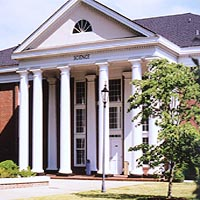
Mitchell Community College
Academics
There are four main academic departments at MCC: Business, Engineering, and Computer Technologies; Humanities and Fine Arts; Mathematics, Natural, Social, and Human Sciences; and Nursing, Allied Health, and Public Service Technologies. In addition, the Public Safety Training Center at MCC offers basic law enforcement training, fire training, EMS training, and rescue training.
Programs in the Nursing, Allied Health, and Public Service Technologies department include Cosmetology, Early Childhood, Medical Assisting, and Nursing. Most students in these programs enter the workforce directly, with the exception of nursing students who transfer to four-year institutions to earn a bachelor’s of nursing.
Programs in the Mathematics, Natural, Social, and Human Sciences department include Biology, Chemistry, Cooperative Education and Job Placement, Criminal Justice Technology, History, Human Services, Mathematics, Physics, Psychology, and Sociology. Almost all students in this department are on the transfer track.
Programs in the Humanities and Fine Arts department include Art and Design, Communications, Developmental English and Reading, English, Foreign Languages and Cultures, and Music. The majority of Humanities students transfer to four-year universities after earning their associate’s degree.
Programs in the Business, Engineering, and Computer Technologies department include Accounting; Air Conditioning, Heating, and Refrigeration; Business Administration; Computer Technologies; Electrical and Electronics Technology; Electronics Engineering Technology; Marketing and Retailing; Mechanical Engineering Technology; Office Administration; and Web Technologies. Most students in this department enter the work force directly after completing their work at MCC. There are many certificates offered as well.
Continuing Education
MCC offers continuing education to meet the needs of the people of Iredell County and the surrounding area. Classes include academic subjects, cultural advancement, personal enrichment, and vocational and technical improvement. Continuing Education Units (CEUs) are awarded to professionals who need them for their work such as real estate agents, notary publics, building contractors, and vehicle safety and emissions inspectors. MCC also offers personalized training to industries that request it. Continuing Education also provides Adult Basic Education (ABE), General Education Development (GED), English as a Second Language (ESL), Compensatory Education (CED), and Basic Skills in the Workplace.
Distance Education
Distance education options include GED online, real estate certification, auto dealer certification, and Spanish for the workplace. Students enrolled in distance education must have internet access, email, Internet Explorer of Firefox, and any software that is required for their specific courses.
Community Service
Community Service classes at MCC are designed for the personal interests of adults in the community. Classes in painting, photography, pottery, cake decorating, stained glass, sewing, and similar artistic topics are offered on a regular basis. Community Service also organizes an annual artist series, a community chorus, an inspirational choir, and a band.
Focused Industrial Training
The Focused Industrial Training Program teaches workshops and classes on new technologies for private industries in the area. These technologies include new hardware and software applications for computers, manufacturing equipment, and more.
Small Business Center
The Small Business Center provides educational services for small business owners and individuals hoping to start small businesses. They particularly focus on computer technology courses, such as training in work processing, spreadsheets, databases, desktop publishing, computerized accounting, and presentation programs.
Library Services
The library provides reference assistance, interlibrary loans, internet access, audiovisual services, video and audiocassette editing, and telecourse videotapes.
High School Programs
There are several programs to introduce college education to area high school students at MCC, including Dual Enrollment, Future College Plans, and Early College. The Early College program functions at two high schools: The Collaborative College for Leadership and Technology (CCTL) and The Visual and Performing Arts early College High School (VPAC). Students in these schools enter in 9th grade and stay in their programs for five years, graduating with both a high school degree and an associate’s degree.
Academic Competitions
MCC was the first community college to be accepted into NASA’s University Student Launch Initiative Competition in 2008. Since then MCC has done well in competitions for launching projectiles.
Mooresville Campus
The Mooresville Center offers several credit courses and continuing education programs. Just 20 miles north of Charlotte, the city of Mooresville is known as the home of several NASCAR racing teams. Also the home to the Universal Technical Institute’s NASCAR Technical Institute, Mooresville is known as “Race City USA”. There are more than 60 NASCAR teams in the city and two automotive museums, the North Carolina Auto Racing Hall of Fame and the Historical Automotive Museum.
Students at the Mooresville Center can study accounting, business administration, early childhood education, information systems, medical assisting, and phlebotomy. Programs to connect high school students with MCC are also active at the Mooresville facility. Continuing Education classes at Mooresville include Community Service, Small Business Seminars, Occupational Extension, Allied Health, and Employability. Basic Skills include GED preparation, ESL, Basic Skills, and Compensatory Education.
Mitchell Community College
Students
Dining
Although there are no residential halls or dining services at MCC, there is a local food vendor (Tom’s Big Dogs) outside the student union most weekdays selling hamburgers, hotdogs, French fries, soft drinks, and other items. In addition, there are snack and beverage machines in the student union and on the lower level of the Mooresville Center.
Clubs and Organizations
The Student Government Association (SGA) is the voice of the student body for the administration. SGA also administrates funds for other student organizations and sponsors a number of events and campus-wide activities throughout the academic year. Activities in past years include Fall Convocation, Halloween Monster Mash, a vendor fair, activities to celebrate Black History Month, Spring Week, and Awards Day.
Student groups on campus include Art Club, which promotes fine arts among the student body and wider community; Cosmetic Arts Society, which promotes civic and professional involvement for students in the cosmetology program; Criminal Justice Association, which supports students exploring the field of criminal justice; Diverse Expression, which promotes written and spoken creative expression; Examines Nutrition, Exercise, and Renewal Goals for Yourself (ENERGY), an online well-being support group; Human Services Club, which promotes mental health in the community; International Club; Learning Transitions Club, which supports the needs of adult students with changing lives; Minority Male Mentoring Initiative, which provides one-on-one group mentoring and workshops for substance and drug abuse prevention; Phi Beta Lambda, an award-winning national organization for business students; Phi Theta Kappa, a national honors society; Photography Club; Projectile Society, for students who wish to design and launch all manner of projectiles; Student Nurses Association, which promotes professional standards of nursing for students in allied health programs; and Underground Fellowship, a religious organization for students of faith.
College Ambassadors
The College Ambassador program allows students in good standing with the community and the college (and a GPA of at least 2.5) to represent the college at events such as new student orientation, band and chorus concerts, alumni events, and giving campus tours.
west_soccer_2 ((at)) hotmail dot com
There is a major problem with parking, not enough room. College is in a downtown historic district, which means no room for growth. And you better be sure you know (for yourself) the particular curriculum path for your major.