Make no mistake: there are hundreds of outstanding colleges and universities across
the country and around the world. However, few schools match the educational opportunities
offered at the University of Rochester. Rochester is one of the nation’s smallest private
research universities. Professors are accessible, classes are small, and one-on-one undergraduate
research is the norm.
At Rochester, there are no required subjects. There are no general education
requirements or core curriculum. You can study what you love, and not spend time fulfilling
someone else’s concept of education. Rochester has found that students do their best
when studying what they love. Rochester students are empowered to make crucial decisions
regarding their individual educational experience. From day one students are able to
take classes that align with their academic passions. This academic freedom sets Rochester
apart from most other colleges and universities. With this freedom, more students are able
to double or even triple major if they want to.
The University of Rochester, founded in 1850, is located in Rochester, New York, a city
that offers almost everything you would find in a big East Coast city, but without all the traffic.
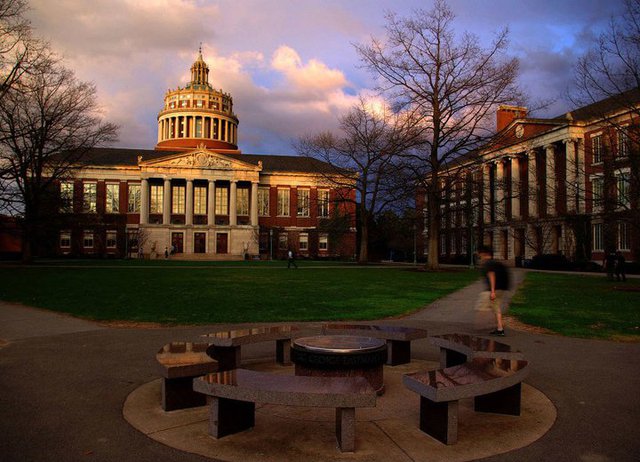
More than a million people call the Rochester area home. The River Campus, the university’s
main campus, sits on the banks of the Genesee River and covers ninety acres.
Rochester is a residential campus, and over
eighty percent of undergraduate students choose to
live in university housing. More importantly, this is
not the kind of school where students race home on
the weekends. Nearly all students choose to stay on
campus and enjoy all that the university has to offer.
There are more than 220 student groups, and it
seems that every night there is at least one group
performance or sponsored event taking place. From
a cappella shows, to cheap movies, to varsity games,
there is always something to do.
The university provides transportation offcampus
via free shuttles if you want to experience all
that the city has to offer. There are dozens of outstanding
restaurants, shops, movie theaters, and so
much more just minutes from campus. The world-renowned Eastman School of Music is
also just a short ride away. Many concerts at Eastman are free or just a few dollars for all
Rochester undergrads. Students can even take free music lessons at Eastman for credit.
Whether it’s the open curriculum, outstanding undergraduate research opportunities,
a vibrant campus, or a beautiful city, Rochester has a lot to offer. This is a place where
you’ll define your college experience on your own terms.
At Rochester…
you will find students from all 50
states and more than fifty countries.
there are more than seventy majors
in the humanities, social sciences,
and natural sciences.
ninety-six percent of freshmen
return for their sophomore year.
eighty-six percent of all undergraduate
students live on campus.
seventy percent of students are
involved in volunteer activities.
seventy-five percent of students are
involved in undergraduate research.
ninety-six percent of seniors have
had at least one career-related
experience.
As you can see, the University of Rochester
has a lot to offer; it’s definitely a great place to be an
undergrad. Whether it’s the unique curriculum, the
outstanding research opportunities, or the active
on-campus community and engaged student body, Rochester is a place where you can have an undergraduate experience like no other.
Rochester truly stands alone among other research universities and constantly strives to be
better, as is evidenced by Rochester’s motto, “Meliora,” or “Ever Better.” This isn’t just a
saying or catchphrase; it’s a philosophy we demonstrate every day. Rochester shows this by
adapting to an ever-changing academic landscape in ways that enable students to fully
explore their interests and chart their own academic course.
Excited Yet?
Have more questions?
Check out the Admissions Web site at
http://enrollment.rochester.edu/admissions/.
You can watch cool videos, chat with current
students, connect with Admissions on the
online forums, learn more about undergraduate
research, and see for yourself how the
Rochester curriculum works.
University of Rochester
Academics
Students arriving on the Rochester campus as freshmen can begin studying what
they love on day one and do not have to wait until their junior year to have real choices
about what classes to take.
Required core classes and general education requirements are seen as a necessary evil
by many undergraduate students at other institutions. Often, around the first two years of a
student’s college career can be spent taking classes necessary to fulfill requirements on a
graduation audit, not classes that are chosen because that’s what the student wants to study.
The Rochester Curriculum is at the center of the academic experience each undergraduate
has. At Rochester, students get to chart their own unique academic path free of
limiting, mandatory core classes. If you want to take classes in a foreign language or in the
arts, you can, but Rochester will not require you to. If you never want to take a math course
again, that’s your choice. This freedom of learning and depth of study all take place at one
of the nation’s leading private research universities.
Majors, Minors, and Certificates
All academic areas at Rochester are divided between three major fields: Natural Sciences,
Humanities, and Social Sciences. Choosing a major takes place by the end of a student’s
sophomore year, and before graduation, students must take at least two different, three-class
“clusters” in the major academic fields their major is not part of. Many students take advantage
of the cluster system to pick up a minor or a second major more easily, while others just
explore an area of study outside their major that they’ve always wanted to.
The wide range of seventy-plus majors includes popular programs in Biology, Psychology,
and Music, along with unique programs in Brain and Cognitive Sciences, Economics and
Business Strategies, and American Sign Language. Programs from the Department of Political
Science and the Department of Economics are nationally ranked in the top fifteen.
With all the academic freedom afforded Rochester students, minors and certificate
programs are a popular choice. Possible minors include areas as varied as Arabic and
Medical Anthropology, and you can get a certificate in such topics such as Biotechnology,
Medphysics, and Asian Studies.
New Majors
Four Public Health programs
Financial Economics
Economics and Business Strategies
Archeology
Engineering and Architecture
International Relations
Academic Opportunities
The close relationship with the Eastman School of Music not only offers a great resource
for Rochester students, but students can take classes and lessons at the worldrenowned
music school.
Research as an undergraduate is the norm, not
the exception. Seventy-five percent of students participate
in undergraduate research, and unlike other
research universities, you don’t have to wait. You can
dive right in during your freshman year, if you choose.
Freshman applicants can also apply for one of
Rochester’s four programs that automatically grant students admission to one of the university’s
graduate schools. These programs include the Rochester Early Medical Scholars
(REMS) program, an eight-year B.A./B.S.-M.D. program, Guaranteed Engineering at
Rochester (GEAR), a 3-2 B.S./M.S. program, Guaranteed Rochester Accelerated Degree in
Education (GRADE), a five-year B.A./B.S.+M.S., and the Rochester Early Business Scholars
Program (REBS), a six-year B.A./B.S.-M.B.A. program. Interested prospective students must
fill out an additional supplement by December 1st to be considered for these programs.
Once at Rochester, many students decide to continue their studies at the graduate
level at Rochester by taking part in one of the 3-2 programs in Business Administration,
Engineering, Fifth Year in Teaching, Human Development, Optics, Physics, and Astronomy
(and Medical Physics), and Public Health.
Take Five Scholars Program and Other Programs
Once you get to Rochester, it’s possible you’ll find so many areas of study you want to
explore that four years simply won’t be enough. For these students, Rochester offers the
tuition-free Take Five Scholars Program. Through the program, students complete a fifth year of undergraduate study at Rochester in an academic area that is outside of their major
concentration.
Another option for students is the Kauffman Entrepreneurial Year, or KEY, Program.
Qualified students may propose to devote as much as an entire academic year to internships,
special projects, business plan development, research into various facets of entrepreneurship,
or analysis of how culture and public policy influence entrepreneurial activity.
With the assistance of faculty advisors, KEY students complete their additional study
tuition-free.
Study Abroad
If you’re looking for a more global adventure, then the study abroad programs at
Rochester will satisfy any passion you have. Studying abroad at Rochester is a possibility,
no matter what your major is, and Rochester believes that study abroad is an integral
part of the undergraduate curriculum. Thirty-five percent of the Class of 2007 participated
in one of seventy-five study abroad programs in countries as varied as Australia, Ghana,
Italy, Argentina, and China.
Most Popular Fields of Study
The top 5 fields of study completed at University of Rochester.
Rochester’s admissions process is characterized by a comprehensive and holistic
evaluation, one that emphasizes academic achievement and sincerely considers the intangible
strengths of a prospective student. Applicants are not reduced to a transcript and a
test score, but are evaluated as individuals in a highly personalized approach. In this way,
it is a process that reveals much about what makes Rochester unique.
Rochester asks that prospective students complete the Common Application or the
Universal College Application along with the Rochester Supplement. Each application
includes basic demographic information, a description of achievements and activities, and
a college essay. Students should also submit all transcripts, including SAT/ACT scores, and
two to four letters of recommendation. For students interested in applying to one of
Rochester’s combined graduate degree programs, an additional supplement is required.
Applicants are encouraged to submit writing samples, artwork, musical recordings, and/or
any other supplementary materials at their discretion.
All of these documents constitute a completed application and should be submitted
to Rochester no later than January 1st (December 15th for international applicants).
Students planning to apply to Rochester’s binding Early Decision (ED) program should submit
their application materials by November 1st. In 2008 Rochester received nearly 12,000
applications from students competing for approximately 1,000 spots in the freshman class.
About 25% of last year’s freshman class enrolled through Early Decision.
The Interview
The personal nature of Rochester’s evaluative process is evident in the importance that
is placed on the admissions interview. While it is not required, prospective applicants
are highly encouraged to schedule an interview with an admissions counselor or alumni
representative. This provides students with an opportunity to ask important questions and
to put a face to what is otherwise a two-dimensional stack of papers in an informal setting.
Instead, they are casual conversations; you’ll never be asked what kind of tree you would
be and why.
Interviews are offered on campus and in more than one hundred cities worldwide
each fall. Students may also arrange to have an interview scheduled with an alumni volunteer.
Rochester will accommodate any and all students requesting an interview.
Financial Aid
The costs of attending a private research university
are high, but the Financial Aid Office works
with every admitted student to ensure that the cost of
enrollment is not a barrier to attending Rochester.
Rochester is committed to meeting the full financial
need of every admitted student. Combinations of
merit scholarships, grants, low-interest loans, and
work study help ninety percent of Rochester students.
For the vast majority of Rochester’s merit
scholarships, there is no separate application. These
scholarships range from $8,000/year to full tuition
and are renewable over four years. They are awarded
based on the overall strength of a student’s application,
and are not based solely on standardized test
scores or GPA, but if you’re serious about competing
for merit scholarships, scheduling an admissions
interview is strongly recommended.
Both the College Scholarship Service (CSS)
PROFILE and the Free Application for Federal
Student Aid (FAFSA) are required in order for a student’s
need-based financial aid to be determined.
The deadline for filing these financial aid applications
is February 1st, and Early Decision applicants
should submit the CSSPROFILE by November 15th.
Student Financial Aid Details
How many students use Financial Aid, and how much do they use?
University of Rochester 2646th for the average student loan amount.
Secrets to getting the best New York scholarships and financial aid
Rochester is a place where students can study what they love in a challenging academic
environment while still maintaining a life outside of the library. Put simply, Rochester
students work hard but still have plenty of time to get involved in the campus community.
If there’s one thing you need to know about social life at Rochester, it’s that more
than eighty percent of undergraduates choose to live on campus. Why do so many students
make this decision? Because the dorms are great, the food is good, student activities are
numerous, athletics are competitive, and the heart of the city of Rochester is just a quick
shuttle ride away. Off-campus housing is inexpensive and accessible, but most students just
don’t want to give up their on-campus experience.
Campus Housing
Undergraduate housing options are numerous. From corridor-style freshman dorms, to
special-interest houses, to suite-style upperclassman buildings, there’s a housing
option to fit your idea of what college living is supposed to be. Last year the university
opened several new upperclassman dorms featuring single bedrooms, a bathroom for every bedroom, and air conditioning. All dorms are just a quick walk from the library, dining facilities,
athletic center, and academic buildings; to get from one end of campus to the other
takes about ten minutes on foot.
Student Groups
With so many undergrads living on campus, you would expect there to be many active
student groups, and there are. In fact, Rochester has more than two-hundred student
groups including varsity, club, and intramural sports teams, a cappella groups, religious
roundtables, music ensembles, Greek organizations, dance troupes, and so much more.
The Arts
Whether you’re a classical singer, tuba player, Latin dancer, comedy actor, or mural
painter, you’ll find your niche at Rochester.
If you play an instrument or sing, you’ll find it easy to continue taking lessons or join
an ensemble. Whether you audition to take free lessons at Eastman, try out for one of the university’s
four a cappella groups, or take the always popular History of Rock course, you’ll
always have a musical outlet. If you’re not an aspiring musician but still want to listen, the
Eastman School offers numerous free concerts for Rochester undergrads throughout the year.
If you dance, you won’t have a problem finding a group that suits you. From hip-hop,
to tap and jazz, there are several dance groups to choose from.
If you act, direct, or enjoy working behind the scenes, Rochester’s International
Theatre Program is open to all students regardless of major. Rochester also boasts an outstanding
improv comedy troupe.
If you paint, draw, or sculpt, you have an array of Art and Art History courses to choose
from. Rochester also has an art center with ample workspace and even a darkroom for student
use. In addition, there is a student-run art gallery on campus.
The City
As a Rochester student, you’ll spend a lot of
your time on campus, but when you feel the
need to venture into the city for a bite to eat, a
game to watch, or a show to catch, the university
makes it easy. A university-owned shuttle bus
service takes students throughout the city.
More than a million people call the city of
Rochester home. The city offers the entertainment
and culture of a big East Coast city, without
the headaches. The city is known for its festivals.
From jazz, to local art, to independent film, it
seems as if there is at least a festival a week during
the warmer months (and no, “warmer
months” does not mean July and August only).
Where Do Students Go in the City?
Artisan Works—see local artists at work and
enjoy a large collection of eclectic pieces
Geva Theatre—a professional theater showing
everything from musicals to improv
Memorial Art Gallery—part of the university,
free for all undergrads
Rochester Public Market—offers fresh
produce, baked goods, ethnic cuisine,
flowers, and much more
Strong Museum—one of the top children’s
museums in the country (yes, undergrads
go here)
Susan B. Anthony House—national historic
landmark celebrating this women’s suffrage
movement leader
Monroe County Parks—more than twenty
parks in the metropolitan area
Eastman School of Music—popular coffee
shops and restaurants are nearby
George Eastman House/Dryden Theater—
mansion of the university’s leading
benefactor; the Dryden has daily showings
of classic and contemporary films
Little Theatre—the city’s premier theater for
independent films (great student pricing)
Other Options
It is important to note that campus life
extends far beyond what has been mentioned
above. Rochester students are also politically
and religiously active.
College Democrats and College Republicans
are popular options for the politically minded. For those wanting to express their
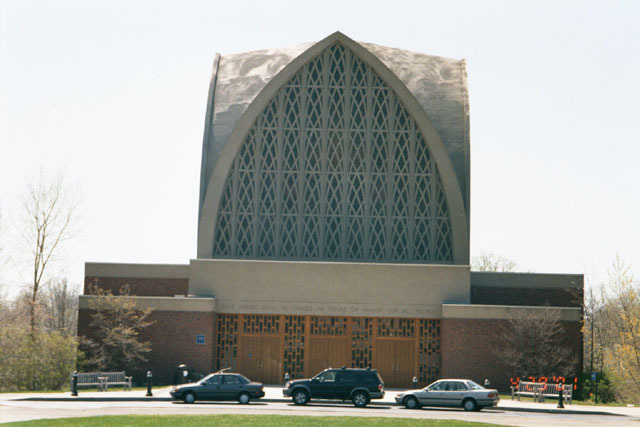
faith or learn about the faiths of others, the Interfaith Chapel is a house of prayer for all.
Rochester undergrads are also active in the community. More than seventy percent of
undergrads volunteer.
There is also an active Greek community on campus; about twenty percent of undergrads
join fraternities and sororities. The vast majority of these groups have houses or dorm floors on campus. In addition to providing a vibrant
night life for many undergrads, Greek groups organize
community service projects and academic programs
throughout the year.
Student Enrollment Demographics
How many students are enrolled at University of Rochester?
More than 3,400 students participate in varsity, club, and intramural sports at Rochester.
In addition to a wide variety of club and intramural sports, Rochester has 23 varsity
teams. The university’s varsity teams compete in two NCAA Division III conferences, the
Liberty League, and the geographically diverse and highly competitive University Athletic
Association. Some of Rochester’s toughest rivals include Wash U., Chicago, and NYU.
The centerpiece of athletics on campus is the Goergen Athletic Center. This recently
renovated facility features an 11,000-square-foot fitness center, four basketball courts, four
tennis courts, a twenty-five-meter swimming pool, a two-hundred-meter track, racquetball
and squash courts, and several multipurpose rooms used for dance and martial arts classes.
Local Community
Over one million people live and work in the Rochester metropolitan area. Because of
the beauty of its natural landscape, including Lake Ontario and the Finger Lakes
region, parks, professional sports teams, planetarium, museums, orchestras, theater companies, and its overall quality of life, Rochester has been ranked among America’s most
livable cities. Students may not choose to attend UR just to live in Rochester, but students
soon discover the gem of the city in which they live and study.
There is just so much that the city has to take advantage of. From various
specialty restaurants to Blue Cross Arena and its performances, from the Little
and Geva Theatres to various nightlife venues, there are countless ways to keep
entertained in Rochester. — Lindsay Dussing, ’07
For many students, Rochester becomes their classroom. Professors regularly take trips
to parts of the community for lessons. Other students see Rochester as their playground. For
example, Bristol Mountain, a popular ski resort, is only thirty minutes from campus.
Every other Saturday, my friends and I catch the 10 A.M. bus to the Public
Market. After getting our necessary cups of Saturday morning coffee or steaming
cider at Java’s, we stroll, watching bundled families in the winter and kids
climb giant pumpkins in the fall. We pick up cookies from the Amish stand, lots
of fresh fruit and vegetables from local farmers, pasta, a French baguette from
the bakery, Brie cheese, and the always the same sweet potato pie for dessert.
Back in the dorm, we cook up a delicious dinner and gather around our hodgepodge collection of plates and mugs with the same small group of friends and
maybe a guest or two for our ritual meal. — Lindsey Lewis, ’09
Alumni
Because of their individualized undergraduate
experience, Rochester graduates are uniquely qualified
and prepared for life after college, whether in
the graduate school, an internship, or a career. The
Career Center is a valuable resource on campus for
students to perfect their resume, sharpen their interviewing
skills, network with employers and alumni
throughout the year at on- and off-campus events,
and find summer and postgraduate jobs. Ninety-six
percent of all Rochester graduates have had at least
one career-related experience, and seventy percent
of second-semester seniors have found a job, an
internship, or have enrolled in a graduate or professional
program.
Rochester graduates interested in medical or
law school have consistently outperformed national
averages. Eighty-two percent of Rochester students
with a GPA of 3.6 or higher were accepted to medical
school, far exceeding the forty-two percent national acceptance rate. Rochester graduates
have an eighty-six percent law school acceptance rate, well above the national average.
With an alumni network nearing 100,000 graduates spanning the globe, Rochester students
also have unparalleled opportunities for networking, internships, and career development.
Prominent Grads
Ruth Balser, ’69, member of the
Massachusetts House of
Representatives
Frederick Bieber, ’76, medical geneticist
and Harvard University professor
Steven Chu, ’70, Nobel laureate
(physics)
Jason Diamond, ’97, plactic surgeon
featured on the E Channel series
Dr. 90210
Robert Dolan, ’77, Dean of University
of Michigan Business School
Renee Fleming, ’83, Grammy-winning
soprano opera singer
Robert Forster, ’64, Chairman and
C.E.O. of Warner Brothers
Daniel Gajdusek, ’43, Nobel laureate
(physiology or medicine)
Edward Gibson, ’59, former NASA
astronaut
Steven Hahn, ’78, Pulitzer Prizewinning
historian on faculty at
University of Pennsylvania
N. Hayles, ’77, critical literary theorist
Susan Hockfield, ’73, President
of MIT
Kenneth Keating, U.S. Representative
and Senator from New York
Galway Kinnell, ’49, Pulitzer
Prize-winning poet
Arthur Kornberg, ’41, Nobel laureate
(physiology or medicine)
Masatoshi Koshiba, ’55, Nobel
laureate (physics)
Lawrence Kudlow, ’69, Associate
Director of the Office of Management
and Budget under Ronald Reagan;
CNBC host
Chuck Mangione, ’63, Rochester
native and Grammy-winning
flugelhorn player
Barry Meyer, ’64, Chairman and
C.E.O. of Warner Brothers
James Pawelczyk, ’82, NASA
astronaut
Richard Rashid, ’77, oversees
Microsoft Research’s worldwide
operations
Dan Rosenthal, ’88, Assistant to the
President in the White House under
Bill Clinton
Debra Rupp, ’74, actress, “That 70s
show”
Robert Sack, ’60, Judge, United
States Court of Appeals for the Second
Circuit
Avie Tevanian, ’83, figure in the
development of the Mac OS X at Apple
Vincent Vigneaud, ’27, Nobel laureate
(chemistry)
Faculty
Rochester faculty members are somewhat unusual for faculty at one of America’s best
research universities: they teach undergraduates and they love doing it. Not only are they an ever-present force in the classroom as early as a student’s first introductory class,
but ninety-seven percent have the highest degree in their field. Classes are more often
small and discussion-based, and faculty members are notorious for being available even
outside of office hours. With a student to teacher ratio of 9:1 and many faculty winners of
the Nobel and Pulitzer Prizes, the Rochester faculty, like the Rochester curriculum, exemplify
the reasons Rochester stands out as unique among research universities.
This website and associated pages are not associated with, endorsed by, or sponsored by University of Rochester. StateUniversity.com has no official or unofficial affiliation with University of Rochester.
Rochester, NY 14627-0011
p. 585-275-8063
w. www.rochester.edu