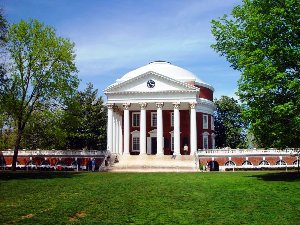
In the fall, Thomas Jefferson’s village stretches out before you. The tops of the maple and
ash trees lining the evergreen lawn burn with the reds, oranges, and yellows of the East Coast
fall. The graceful lines of their trunks are echoed in the rows of white colonnades that frame
the lawn and announce the historic pavilions and rooms, still living quarters for popular faculty
and honored students. Everywhere, the vast expanse of grass is dotted with picnickers,
students studying, mini football games, and picture-snapping tourists. Yet your gaze is drawn past all of this to the north end of the lawn, to the building commanding the entire scene, the
world-famous Rotunda. Based on the Roman Pantheon, the sparkling marble of its flowing
staircase and regal columns and the elegant arc of its majestic dome ensure that the Rotunda
is not only a historical landmark, but one of the most beautiful structures ever to grace a
college campus.
bq, As I walk to my dreaded test, I smile as I remember that by the time I get
out of class, the sun will have set and warm yellow light will be glowing within
the many windows surrounding the lawn. I know that on my walk home, I’ll feel
more like a lucky tourist after closing time than an undergraduate headed to the
dining hall.
Amazing aesthetics, however, is not the reason why UVa has long been known as the
“Public Ivy,” and why it attracts so many exceptional students and professors. Founded by
Thomas Jefferson in 1819, UVa remains one of the highest ranked state-funded institutions in
the nation. Offering undergraduate programs in architecture, arts and sciences, commerce,
education, engineering and applied science, and nursing, the university continues to operate
on its founder’s belief in the importance of a solid liberal arts education. Of its 20,380 enrolled
students, two-thirds are undergraduates, and while offering the opportunities and diversity of
a medium-size school, UVa still has a fairly concentrated main campus area, creating a smaller
community feel. In other words, it will be virtually impossible to walk to class without recognizing
at least a few faces. The central campus area has 1,166 acres and fifteen libraries. (The
overall size is 3,392 acres, with 535 buildings.) Many students and professors also take advantage
of the extraordinary new Albert and Shirley Small Special Collections Library, which
houses numerous rare historical books and items and also boasts one of the most extensive collections
of Thomas Jefferson’s effects and documents in the world. Although steeped in history
and tradition, UVa remains on the cutting edge of technology, offering computerized library services,
Internet access, and a variety of resources, including mainframes, minicomputers, PCs,
and a network of printers, which are available to students at the many computer labs around
grounds. Courses that use a variety of software for collaboration to enhance class communication
are quite common. Special learning facilities at UVa include a learning resource center, an
art gallery, radio and TV stations, and an art museum.
Attending UVa is more than just going through the motions of four years of tests, papers,
and parties. It is an experience that will completely consume you. You will be a first-year
instead of a freshman, you will live on-grounds instead of on campus, you will be able to write
the honor pledge in your sleep, you will learn “The Good Old Song,” and you will come to
recognize Thomas Jefferson as some sort of deity. At the end of it all, you will be welcomed into
one of the most close-knit, active, and supportive alumni networks in the country. But most
important, you will have interacted with top-notch professors and students, will have been a
part of Jefferson’s still thriving vision of public education, and you will have done it all without
you or your parents having to face the increasingly terrifying price tag of a private institution.
So ask yourself, why would you want to attend UVa?
Because of its high rankings, its rigorous standards, and
its feasible tuition? Obviously. Because you would have
the chance to take a poetry seminar with former U.S.
poet laureate Rita Dove, or a class on race relations
from civil rights activist Julian Bond, or a political science
lecture with renowned political analyst Larry
Sabato? Of course. Because of the academic opportunities,
including honors programs, student-run newspapers,
magazines, and radio stations? Absolutely. Or
even because of its outstanding Office of Career
Planning and Placement, which offers internships,
externships, résumé and job search guidance, and even
arranges interviews with major companies on grounds?
Positively. Maybe because of the richness of UVa’s history
and tradition, from its creation by one of the most
important men in America’s past to its unique continuation of distinguished customs such as the
student-run honor system or the benevolent and mysterious secret societies? Definitely. Is it
because the school is located in the heart of a charming city from which you can drive for ten
minutes and be in some of the most beautiful, rural scenery in the country? Certainly. Aside from
all of this, you realize that you want to attend UVa because of all the little things, from painting
Beta bridge, or attending the Restoration Ball, to working for Madison House, or living in La
Maison Française, which make any student who attends this university a member of a community
and a part of an experience that stretches far beyond a four-year education.
University of Virginia-Main Campus
Academics
The distinguished majors program is just one example of the outstanding academic
opportunities available at UVa. You can take part in internships, study abroad and accelerated
degree programs, B.A.-B.S. degrees in biology environmental sciences, dual majors in most arts
and sciences programs, student-designed majors and an interdisciplinary major, as well as nondegree
study and pass/fail options. A first-year on-grounds honors program and seven national
honor societies, including Phi Beta Kappa, are available, as are the departmental honors programs.
If you take the time to explore the options and pursue your interests, the university is a
once-in-a-lifetime shot at an amazing collection of knowledge, talent, and possibility. Faculty
are the recipients of such honors as the MacArthur Award, the Pulitzer Prize, the National
Book Award, the Humboldt Award, and Fulbright Fellowships. Graduate students do teach
thirty-three percent of the introductory courses. Yet the student–faculty ratio remains fifteen
to one, and the College of Arts and Sciences specializes in small, discussion-oriented seminars
led by full professors. These courses often involve a significant workload, but they also usually
cover the professor’s favorite subject, from such topics as Native American poetry to cult studies
or Civil War culture, and can be extremely informative, interesting, and entertaining.
For more than a year, I have worked one on one with a professor who
was an expert in my area of interest. I exhausted every resource in the libraries
and university archives. I read, researched, wrote, edited, and rewrote, and
though I missed some parties and lost some sleep, I gained something else—the
realization that UVa honors thesis is an experience I may never want to relive,
but it’s also one of which I will always be proud.
Course Requirements
Depending on your major, your flexibility to choose electives and select courses will vary.
For example, an English major will always have more decisions to make during registration
than a premed biochemistry major. However, because UVa focuses on instilling a
broad liberal arts background in all of its students, the distribution requirements insure
that everyone gets a chance to sample the wide variety of course material offered. All
undergraduates must complete twelve hours of mathematics and science, six hours each of humanities, composition, and social sciences, fourteen credits of foreign languages,
three hours of historical studies, and three hours of non-Western perspectives. In total, by
graduation, students must complete 120 credit hours, including 18 to 42 hours in their
major, with a minimum GPA of 2.0.
Majors
English, history, and biology are the strongest majors academically, while commerce,
psychology, and history have the largest enrollments. UVa confers B.A., B.S., B.A.R.H.,
B.I.S., B.S.C., B.S.E.D., B.S.N., and B.U.E.P. degrees in addition to master’s and doctoral
degrees.
Echols Scholars Program
An example of academic opportunity at UVa, the Echols program offers talented students
the means to make the most of their scholastic experience. Founded in 1960 by
university faculty, the program continues to operate under the guidance of tenured or
tenure-track professors who act as special advisors and mentors to the scholars. As an
Echols scholar, your only requirement at UVa is to graduate with 120 approved credit hours.
A scholar is free from the distribution requirements and even from declaring a major at all.
Many scholars use this freedom to focus on “concentrations” in several of their areas of interest,
to double major, or to truly invest themselves in a distinguished majors program. Echols
scholars also enjoy priority in choosing courses from ISIS, UVa’s computerized
registration process, and a scholar will usually never have trouble adding into a restricted or
full class. The Echols program also encourages richness in more than just the educational
areas of college life. First-year scholars live together in adjacent dormitories and special
group activities, both academic and social, are offered for scholars of all years. Participation
in the Echols Scholars Program is usually based on an invitation process. Every UVa applicant
is considered, and approximately ten percent of each entering class is chosen.
Honor Code
You will sign and date this statement hundreds of times if you attend UVa, but what exactly
does it mean, and why is it so important? Established in 1842 in order to ease tensions
between faculty and students, the Honor System was soon adopted and maintained by the
students. Although it has changed to reflect the ideals of the ever-shifting student body, the
system remains an integral part of the UVa mind-set. The simple principles of honor establish
a network of trust rarely found in a college setting, including unproctored tests, take-home exams, and even check-writing privileges throughout the local community. However, violating
such significant trust also means significant consequences. If a student commits a willful,
serious act of lying, cheating, or stealing, and is found guilty by a jury of peers, the only possible
sanction is a permanent dismissal from the university. Since the system is entirely
student-run, you may participate in many different facets, perhaps as a randomly selected
juror, an honor committee member, or an honor advisor, counsel, or educator. Regardless of
whether you seek it out, rest assured that the Honor System, its benefits and responsibilities,
will be an important part of your daily student life.
On my honor as a student, I have neither given nor received aid on
this exam.
Pressure and Competition
In general, the students at UVa were serious about academics when they were in high
school and by the time they reach Charlottesville, they’re even more determined to make
the most of their college experience. At the same time though, there is rarely an overwhelming
sense of academic pressure and competition. UVa students can usually excel in
the classroom without losing their perspective on the larger picture. As one wide-eyed firstyear
student found out, a sense of humor is often involved in keeping stress under control.
It was 2:00 A.M. in the middle of finals week. I had been buried in my
books since early that morning. Despite all my preparation, I was debating not
even showing up for my test the next day, I was so sure I was going to fail. Just as
I was about to close my book and give up completely, a group of students who had
been studying together for hours right next to me suddenly jumped up on top of
their table and began an impromptu striptease in the middle of Clemons Library.
Pretty soon they had the entire room either participating or cheering them on.
When it was over, everyone settled right back down and continued studying. It
reminded me that life was not solely about finals. I suddenly realized that I would
survive the week. After that, I didn’t even mind reopening my books.
Most Popular Fields of Study
The top 5 fields of study completed at University of Virginia-Main Campus.
You’ve got the grades and the extracurricular activities. You’ve taken the toughest
courses your high school offers, squared away your recommendations, and conquered the SAT.
But in front of you lies one of the most comprehensive college applications in the country.
There are several short essays as well as one long, open-ended, and intimidating question.
Since you’ve set your heart on UVa, you’ve done some research and discovered that sweating
over these questions is indeed important. The Admissions Committee will be examining each
of your responses in detail, giving your whole application the kind of attention it would typically
only receive at a small, private school.
Each year, the qualifications of students applying to UVa are more impressive. SAT I
scores for a recent freshman class were Verbal—652, Math—671. The average ACT score
was 29.
All applicants must take the SAT or the ACT, as well as two SAT Subject Tests of their
choice. Although the GED is accepted, most successful candidates have graduated from
accredited high schools and have completed sixteen academic courses including four courses
of English, four of mathematics beginning with Algebra I, two of physics, biology, or chemistry
(three if they are applying to engineering). AP credits are accepted. Recently about one out of
every three applicants was accepted to UVa. You will generally have a slightly better chance if
you are from Virginia, or if you fall into the legacy category by being the child of alumni. In any
case, if you are seriously considering UVa, then you are probably an excellent student with
impressive extracurricular activities, outstanding recommendations, and an eye-catching
application essay.
Financial Aid
Approximately forty-six percent of all undergraduates receive some form of financial aid,
including Parents PLUS loans. Aside from Athletic Grants-in-Aid, non-need-based loan programs,
and special scholarships, all undergraduate financial aid is based on financial need.
Five percent of undergraduates are involved in part-time work-study employment and the
average earnings from college work for the school year are $2,690. To qualify for financial aid,
entering students must complete and submit a Free Application for Federal Student Aid
(FAFSA) and a Financial Aid Statement (FAS) by March 1. A new initiative, “Access UVa” offers
loan-free packages for low-income students, caps on need-based loans for all other students,
and a commitment to meet 100 percent of need for every student.
Student Financial Aid Details
How many students use Financial Aid, and how much do they use?
University of Virginia-Main Campus 2320th for the average student loan amount.
Secrets to getting the best Virginia scholarships and financial aid
With their virtually universal appeal, football games are an example of a UVa social event
that draws together all different sections of the student body and the local community,
both of which have interesting dynamics. Each year, UVa seems to welcome a more diverse
entering class. Of the more than 13,000 present undergraduate students, sixty-nine percent are
from Virginia, with the rest coming from all fifty states and Washington D.C. and 120 foreign
countries, including Canada. Sixty-two percent of the students are white, nine percent are
African American, and eleven percent Asian American. Forty-three percent are Protestant,
twenty-two percent are Catholic, and twenty-three percent claim no religious affiliation.
At UVa football games, fans of all ages, sporting Cavalier paraphernalia,
throng together at the back of the vehicles, imbibing homemade fried chicken,
sandwiches, barbecue, beer, and all sorts of other goodies they don’t serve at the
dining halls. Luckily, my roommate was a legacy student with an entire family
of enthusiastic, generous alumni, and I would find myself munching and
mingling with the entire clan. A steady stream of students, many showing
traditional spirit with their khakis and skirts, others waving banners and
various body parts smeared with orange and blue paint, moves through the gates
to descend on the bleachers.
Clubs and Organizations
While major school activities such as football games, the famous annual Virginia Film
Festival, and the traditional Foxfield Races bring everyone together, most students
find an outlet for their social lives through one or more of the numerous activities offered
on grounds. With more than 600 clubs and organizations to choose from, UVa students tend
to be as active outside as they are inside the classroom. One of the more popular social
opportunities is the Greek system. An example of deeply rooted tradition at the university,
there are over sixty social and service fraternities and sororities in which twenty-eight
percent of men and thirty percent of women are involved. Many more make treks to Rugby
Road (the site of many of the fraternity and sorority houses) on Thursday, Friday, and
Saturday nights, where there is never a shortage of parties.
For those who tire of the Greek scene, there is no shortage of alternative extracurricular
pursuits. Aside from academic societies and professional clubs (including the oldest
debating society for undergraduates in the nation) there are groups related to art, band, cheerleading,
chess, choir, chorale, chorus, computers, dance, drama, culture, film, gay interests,
honors, international concerns, photography, politics, and sports. There are religious associations
and special interest groups, including a UNICEF chapter and ROTC. UVa also has a daily
newspaper, a weekly news journal, and plenty of student-run special-interest magazines, as
well as two radio stations that broadcast on grounds. Another immensely popular organization
is Madison House, through which students participate in a variety of community services.
Student Enrollment Demographics
How many students are enrolled at University of Virginia-Main Campus?
Finally, activities that require more coordination, such as intramural sports, are also a
favorite way to socialize. More than eighty-five percent of students participate in the
thirty different sports available. For the more serious and talented athletes, UVa has eleven
intercollegiate sports for men and twelve for women. The university is also a Division I
member of the NCAA and competes in the Atlantic Coast Conference. From the recently
expanded Scott Stadium and the new John Paul Jones 15,000 seat arena to four recreation
centers (including an aquatic and fitness facility), UVa offers students every opportunity to
enhance their bodies as well as their minds.
Basically, on those rare occasions when you don’t actually have to be studying something
(and those more frequent times when you choose not to study something), you’ll find plenty of
other agendas you want to pursue. The key is to choose which activities are most important to
you and to make sure you allot some of your precious nonacademic time to truly enjoying them.
Local Community
Charlottesville itself offers a unique mix of long-time residents and ever-present
tourists. Although the city and surrounding Albemarle County have a population of
almost 200,000, Charlottesville maintains a small, friendly town feeling. At UVa, you are nestled
just east of the Blue Ridge Mountains, only minutes from the homes of Thomas
Jefferson, James Madison, and James Monroe, as well as the stunning sights of Shenandoah
National Park and Skyline Drive. In short, there’s never a problem finding activities when
the relatives come to visit. As a student, you’ll probably spend a significant amount of social
time on “the corner,” a group of shops, bookstores, restaurants, and bars within walking distance
of grounds, or on the historic downtown pedestrian mall, which has movie theaters,
local boutiques, plenty of coffee houses, and even a new ice skating rink.
Alumni
In a typical year, UVa awards over 3,000 bachelor’s degrees. Among those graduates,
the most popular majors are economics, psychology, commerce, history, and English. About
500 public and private organizations recruited on grounds last year.
Under a massive oak behind the Rotunda, I, along with the close friends
I have made over the last four years, lean together, a blur of caps, gowns, and tassels.
The camera snaps one last time before I take my first steps in the procession
that marks the end of our undergraduate education. As the May morning
stretches lazily towards a steamy afternoon, I descend the steps of the Rotunda
and gaze out over the lawn, now overflowing with a colorful mass of proud parents,
camera-wielding grandparents, and wide-eyed siblings. Later, at my major
ceremony, I hold out my hand and receive the long roll of paper that justifies and
attests to all of the cramming, sleepless nights, three-hour finals, and fifteen-page
papers of the last few years. Stepping off the stage, no longer a student, I realize
that the diploma I clutch is not only a consummation of the past, but what will
now also be a powerful key to my future.
Prominent Grads
Since its foundation by one of the most
famous presidents in American history,
UVa has attracted and schooled many of
the nation’s notable political leaders,
including President Woodrow Wilson;
Senators Robert and Edward Kennedy,
John Warner, Charles Robb, and
Christopher “Kit” Bond; Congressman
L.F. Payne; and Governors Gerald Baliles,
B. Evan Bayh III, James Gilmore, Angus
King, Lowell Weicker, and Mark Warner.
Other graduates include:
Feel free to add comments or additional information regarding University of Virginia-Main Campus, or discuss this school in the University Discussion Forum
over 2 years agoStan Ballenger stanbbren ((at)) aol dot com
Congratulations for what the baseball team has accomplished in the last ten days!!!!!!
First, winning the ACC tournament.
Second, and very impressive, beating the number one pitching prospect in the nation--Strasburg of San Diego St.
Third, and even more impressive than beating Strsburg, is beating the No. 1 team in the nation AT Irvine !!!!! No matter what happens from here on, you can't take that accomplishment away !!
Again, congratulations Virginia.
This website and associated pages are not associated with, endorsed by, or sponsored by University of Virginia-Main Campus. StateUniversity.com has no official or unofficial affiliation with University of Virginia-Main Campus.
stanbbren ((at)) aol dot com
Congratulations for what the baseball team has accomplished in the last ten days!!!!!! First, winning the ACC tournament. Second, and very impressive, beating the number one pitching prospect in the nation--Strasburg of San Diego St. Third, and even more impressive than beating Strsburg, is beating the No. 1 team in the nation AT Irvine !!!!! No matter what happens from here on, you can't take that accomplishment away !! Again, congratulations Virginia.